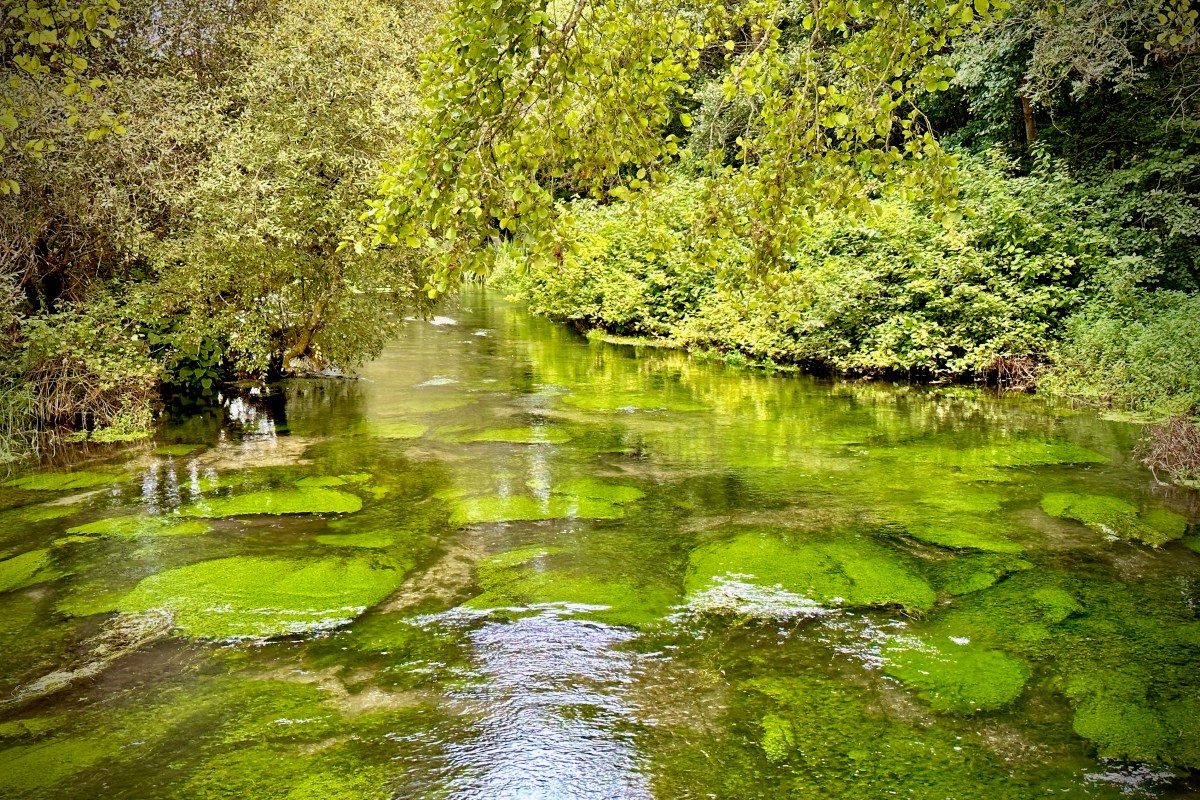
I’ve fielded a bit of correspondence lately because some people are confused about the status of chalk streams as a priority habitat. The confusion mostly arises out of the way in which the NE maps are published: there are several of them.
So, this is my attempt to bring a bit of clarity to the situation.
The original list of UK biodiversity action plan habitats was created between 1995 and 1999. Chalk rivers were the only riverine habitat. Other freshwater habitats included fens, machair, eutrophic standing waters and a few others.
The list was revised in 2007 in order to “ensure that the UK BAP remains focussed on the correct priorities for action and takes account of changes in the status of UK biodiversity in addition to new information and knowledge”.
The review added considerably to the list of priority habitats including other riverine habitats but the Report on the Species and Habitat Review made clear that in adding additional types of freshwater habitat, chalk rivers were not subtracted. Under the summary of major changes in Table 1 it clearly states under “rivers and streams – major changes”.
“New habitat, incorporating an existing habitat (Chalk Rivers). Further work by specialists is required to develop guidelines for the identification of river reaches which will be priorities for UK BAP action.”
That further work led to the current list of priority habitats HERE in the UK Biodiversity Action Plan Priority Habitat Descriptions – Rivers (Updated December 2011).
See the document for more detail but essentially the list of qualifying criteria in is:
1. Riverine water bodies of high hydromorphological / ecological status.
2. Headwaters (within 2.5km of its furthest source as marked with a blue line on Ordnance Survey (OS) maps at a scale of 1:50,000. Headwaters which have been significantly altered from their natural state are not included).
3. Occurrence of the EC Habitat Directive Annex I habitat (H3260 Watercourses of plain to montane levels with the Ranunculion fluitantis and Callitricho-Batrachion vegetation). The definition will include (but not be confined to) all river SACs designated for the feature.
4. Chalk Rivers (as given in the existing BAP definition).
5. Active shingle rivers. Data for this can come from River Habitat Surveys (Environment
Agency 2003) or indicator species of invertebrate (see criterion 7).
6. Areas or Sites of Special Scientific Interest designated for river species, riverine
features or fluvial geomorphology.
7. Species including:
i. Annex II Habitats Directive species 2
ii. BAP priority species
iii. Invertebrate species which are strongly indicative of river shingle
The BAP definition stated:
Chalk rivers have a characteristic plant community, often dominated in mid-channel by river water crowfoot Ranunculus penicillatus var pseudofluitans and starworts Callitriche obtusangula and C. platycarpa, and along the edges by watercress Rorippa nasturtium-aquaticum and lesser water-parsnip Berula erecta.
They have low banks which support a range of water-loving plants. This plan considers action required for the river channel and banks but not for the whole catchment or floodplain.
All chalk rivers are fed from groundwater aquifers, producing clear waters and a generally stable flow and temperature regime. These are conditions which support a rich diversity of invertebrate life and important game fisheries, notably for brown trout Salmo trutta, brook lamprey Lampetra planeri, salmon Salmo salar, crayfish Austropotamobius pallipes and otter Lutra lutra are among the species listed on Annex II of the EC Habitats Directive which chalk rivers support.
Most chalk rivers have ‘winterbourne’ stretches in their headwaters. These often run dry, or partially dry, in late summer because of lack of rainfall recharging the aquifer. A characteristic range of invertebrates has adapted to these conditions, as is the brook water crowfoot Ranunculus peltatus.
The list of priority habitats has not changed since that date, but the mapping has slowly caught up with the definition and in that mapping lies some confusion.
There are several maps of priority habitats: the one you will find easily if you google “river priority habitat” is – as it clearly states in the summary HERE – the map “of rivers and streams that exhibit a high degree of naturalness”.
The map which you won’t find easily is the MAP OF CHALK RIVERS which, as it clearly states in the summary is a map of:
“Priority Habitat Chalk Rivers, based on Environment Agency Detailed River Network v3. Data prepared Autumn 2021.Data shows the location of Priority Habitat Chalk rivers and Streams.”
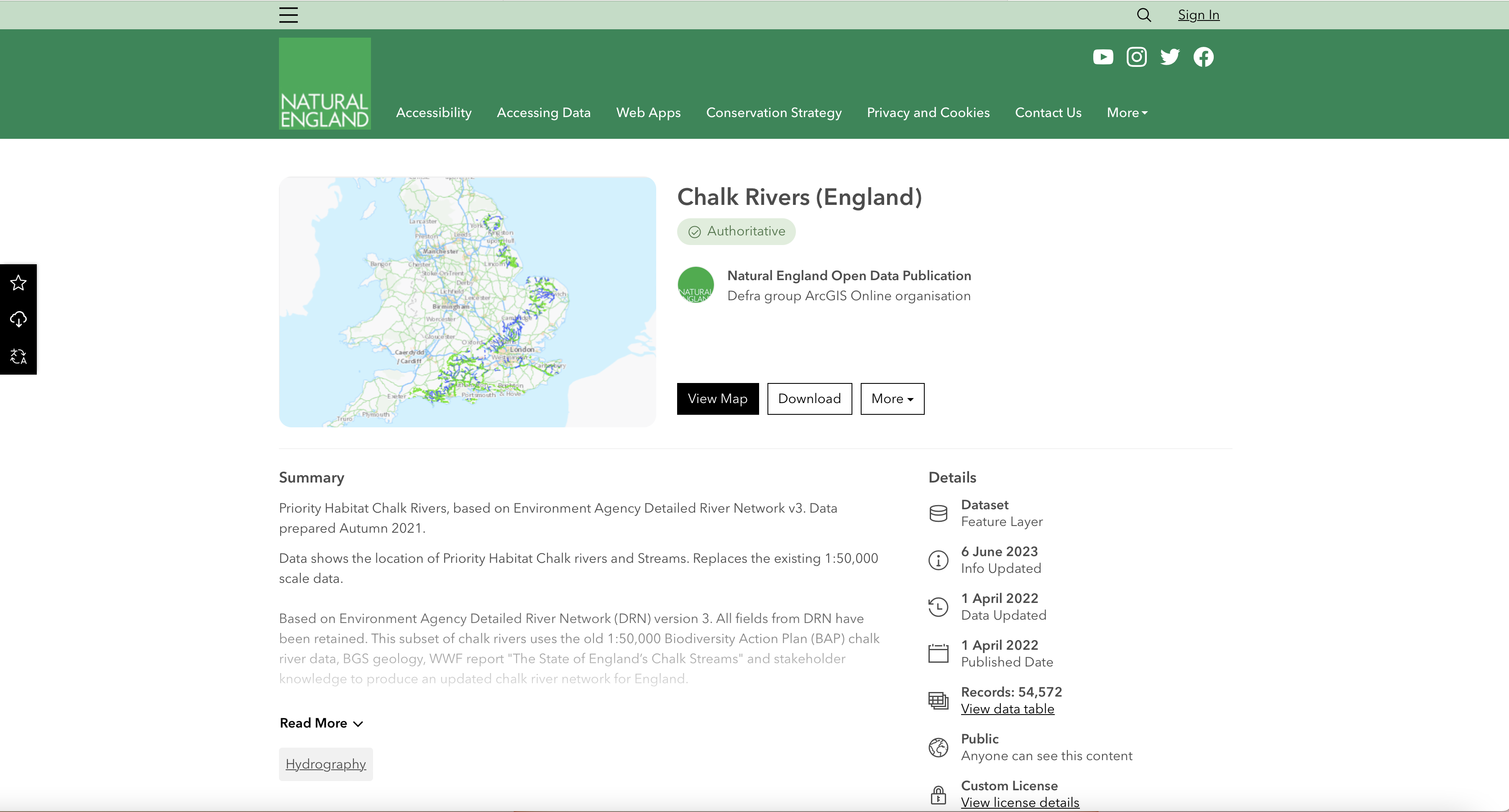
There is also another map HERE where you can toggle on and off the different layers for different priority habitat types.
Chalk rivers were the proto riverine priority habitat and when they were designated as such it was because they supported communities of ranunculus, starwort and berula, because their low banks and high water-tables support varied communities of riparian water-loving plants, and because they are spring-fed, altogether meaning they support a very large bio-diverse community of designated flora and fauna (see my previous post).
 Chalk-Streams