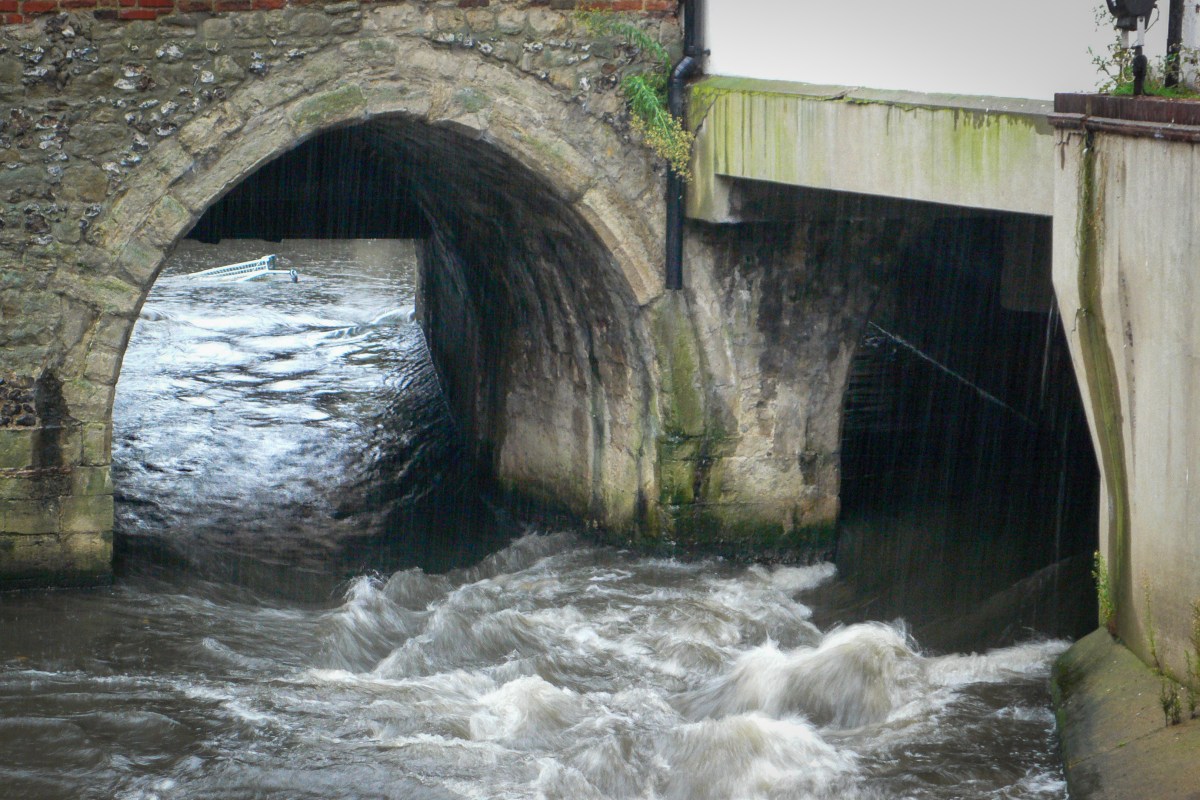
Above: the Hogmsill chalk stream in south London spilling sewage in a light shower in 2007
Repatriation of ownership, public listing, long-term funding, transparency & accountability, independent regulation. It’s not rocket science.
Below is a three-minute summary of how that might work — and why the solution may lie somewhere between privatisation and nationalisation. Read beyond that for the full article.
The Water Industry Debate: A Short Version
Public anger over Britain’s polluted rivers has surged and campaigners are calling for the water industry to be nationalised. After decades of sewage spills and dividends flowing to investors, bringing water back into state control feels like justice.
But nationalisation alone will not necessarily clean our rivers. In the UK, pollution in Scotland and Northern Ireland—where water is publicly owned—are comparable to England and Wales. Across Europe, excellent water systems exist under a variety of ownership models. What the good versions share are long-term investment, governance, and strong regulation.
Britain’s sewage crisis is too deeply embedded to be sorted with a change of clothes. We inherited Victorian sewers that mix rainwater and wastewater, meaning rain regularly overwhelms the system and forces discharges into rivers. Add chronic under-investment (by government and private industry) going back 50+ years, population growth, urban paving, and patterns of heavier rainfall, and the pressure has only increased.
The other part of the failure is financial and regulatory. Water infrastructure requires large capital investment upfront that must be repaid slowly through bills. This should produce a stable, low-risk utility attractive to long-term investors. Instead opaque ownership and weak regulation allowed debt to balloon while infrastructure investment stagnated. Shareholder capital injections have been minimal, with most spending effectively directly funded by customers through their bills. Regulators focused solely on keeping prices low while environmental oversight weakened.
Nationalisation risks recreating the same problems. Two of the institutions that failed most visibly—Ofwat and the Environment Agency—are already public bodies. State ownership does not automatically deliver stronger accountability or better environmental outcomes. The lesson from countries with world-class water systems, such as the Netherlands, is that success depends on transparent governance, specialist institutions, stable long-term funding, and democratic accountability.
Rather than treating nationalisation as the only answer, we should focus on the structural weaknesses that allowed the crisis to develop. Reform could look something like this:
1. Compulsory public listing.
2. A re-patratration of ownership: 75% minimum domestic shareholders.
3. Clarity of corporate ownership / governance.
4. A financial and policy environment that encourages long-term, stable funding from sources that are sensitive to public opinion
5. A simple and easily comprehensible method of assessing and publicising relative environmental performance.
6. Functional specialisation: separating water supply from sewerage and water treatment.
7. Regulatory specialisation: discrete and independent bodies for standards, permitting, monitoring and enforcement.
8. Democratically accountable catchment authorities that are independent of central government.
9. Complete transparency and real-time data.
10. Formalised 3rd sector and citizen science validation of standards.
Rivers do not care whether the water industry is owned by the state, by pension funds, or by listed companies. They respond only to whether sewage is treated properly, infrastructure is maintained, and the law is enforced. If we keep the debate focused on those outcomes, rather than on ideology, we might build a water system worthy of the landscapes it serves.
Nationalisation-lite – the longer version.
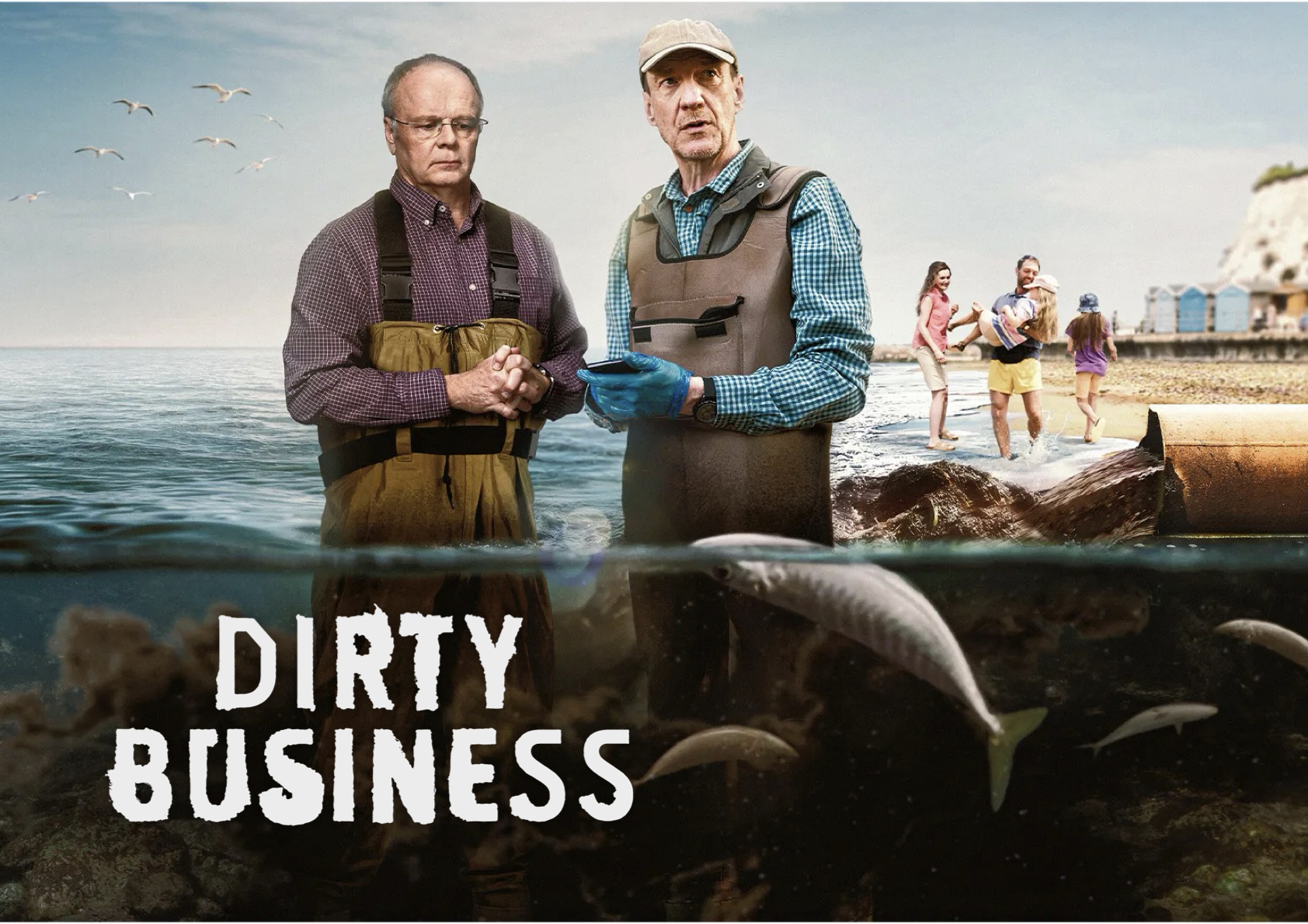
Taking its lead from last year’s hit drama Mr Bates Versus the Post Office, Channel 4’s Dirty Business has dramatised the malpractice of water companies and the incompetence of regulators, bringing public anger to a fever pitch.
From the town square— the X account of Hugh Grant, for example— comes the universal cry to ‘nationalise the water industry’. Nationalisation is, after all, what leading lights amongst the campaigners have been calling for. As Feargal Sharkey said to Toby Perkins MP, Chair of the Environmental Audit Committee, last summer 2025: ‘Right now, the vast majority of this industry, if not the whole industry, actually needs to be taken back into state control’.
Not nearly as prominent a voice as Mr Sharkey, I have nevertheless been campaigning for river health since the early 1990s. I co-authored the 2017 WWF report Flushed Away that helped bring this sewage scandal to a wider audience and stood with WWF’s brilliant Rose O’Neill and Kathy Hughes in a drafty corridor in Westminster, vainly trying to interest passing MPs. I should be delighted that a campaign once thought too esoteric for the public to care about (WWF hesitated over publication) has now hit the headlines. Finally, something might happen.
So, why do I feel uneasy about this war-cry of nationalisation as the answer? Reform UK has expressed support, and I suspect a more left-leaning Labour government might eventually do the same, particularly under pressure from the Greens. The current Labour government has taken state ownership off the table, for now, but you never know.
It’s not as if nationalisation would necessarily be the wrong answer long term, but quite apart from the fact that decisions like this shouldn’t be swayed by TV dramas, it feels in its current catch-cry form like too much of an easy, crowd-pleasing solution and one that won’t necessarily lead to cleaner rivers and seas.
Nationalisation has replicated and could very well again replicate the failings of the privatised system, under a different guise. Unaccountable corporate greed or unaccountable inefficiencies of state: take your pick. I’m more interested in the environmental outcome than thumbing the eye of capitalism: even if, in this case, the thumb may be deserved.
An equality of badness
There is mixed evidence, at least nationally, as to whether state-owned water industries lead to better environmental standards. True, beyond our shores the best countries for quality of wastewater treatment all feature various forms of municipal and state ownership. But here in the UK, where we appear constitutionally unable to run state entities as well as they do on the Continent, the pollution of our rivers and seas is as bad in Northern Ireland and Scotland (where water is state-owned) as it is in England and Wales.
Conversely, there is little evidence that private companies deliver better environmental standards either. This equality of badness may, in large part, boil down to cost. A clean environment is more expensive than a dirty one, no matter who is running the system. Over the last 50 years we have had underinvestment by the state followed by underinvestment by private companies. Is this because a world-class system would cost more than the British public is willing to pay? Has our industrial heritage driven too deep a wedge between people and their own landscape?
It can’t be an accident that the five best European countries for quality of wastewater services are motivated by the need to look after prominent and fragile ecosystems: Denmark, Finland, the Netherlands, Switzerland, and Austria. Of course, England’s population density is much higher— 450 per square kilometre— than all of those other ‘good water’ nations, bar the Netherlands (441). Wales is comparable with Denmark (150 v 140), Scotland (70) is someway between Finland (18) and Denmark (109).
Arguably, none of the above rivals started from such a low base. In the UK, river water quality is actually much better now than it has been for several centuries, especially when it comes to poo. Rivers like the Mersey once clogged with islands of industrial filth. When the SS Alice sank in the Thames in 1878, it was the sewage-infested water that killed people.
Designed to pollute
Worse, in the UK we have inherited a water system that is pretty much designed to pollute: Bazelgette’s combined sewerage was a massive improvement relative to the squalor of the mid 19th century, but time has caught up with it. We have plugged our modern lifestyles and the Augean oceans of poo 70 million people produce onto the nation’s river network via a system of pipes that must be flushed through with rainwater to remain functional. To keep even vaguely on top of this, our sewage systems need to have massive overcapacity and then must also stay ahead of the relentless creep of urban sprawl, paving, house building, car parks, retail parks, and roads that send more and more rainwater down the drain. Not to mention the 13 million extra bottoms relative to when the water industry was privatised and the more intensive rainfall patterns of recent years.
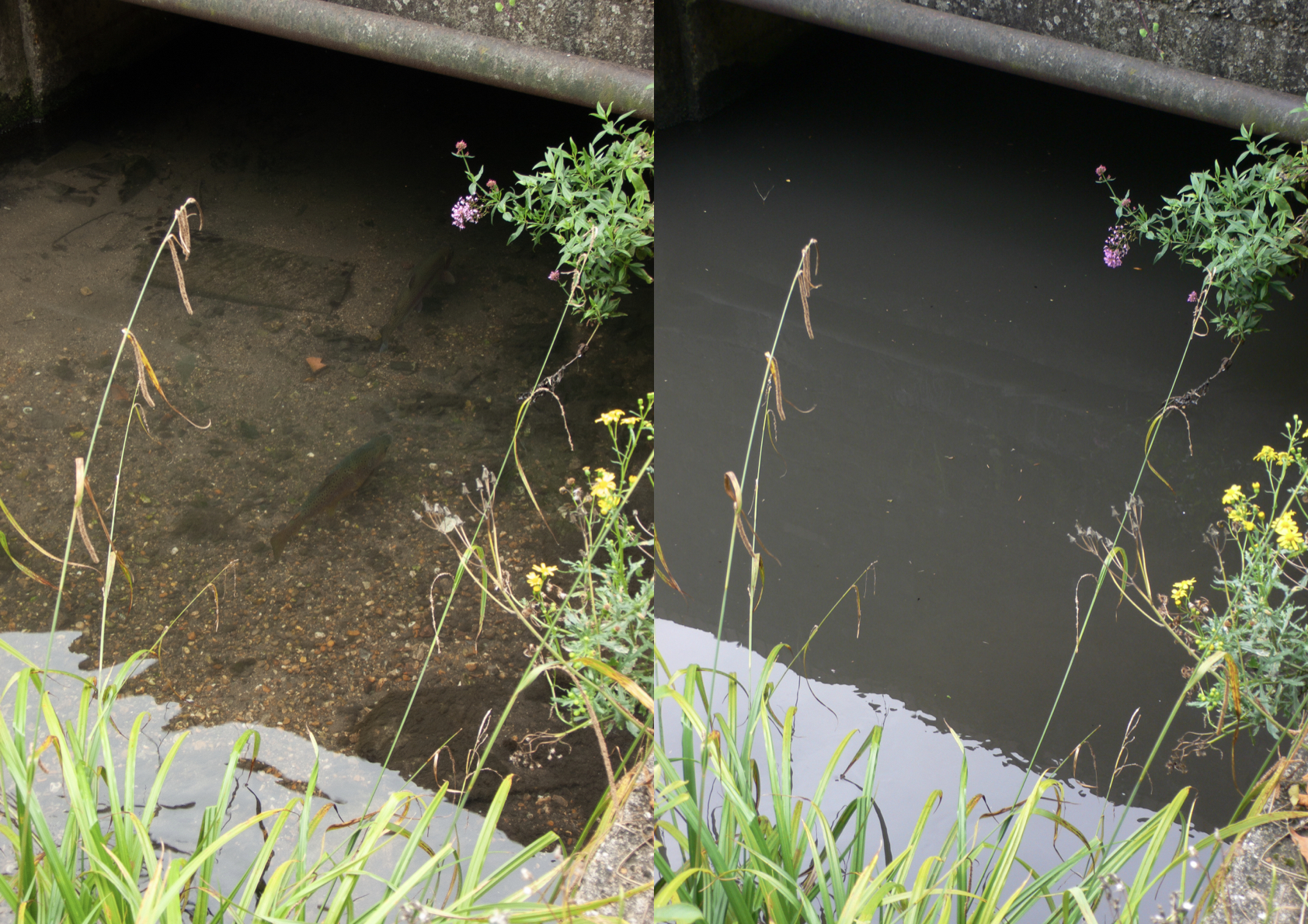
Now you see it, now you don’t. Our ‘combined’ sewage system has a fundamental flaw, mixing rainwater with sewage.
It is clear that privatised or nationalised, our industry needs investment: firstly to become fit for purpose with its existing, flawed (combined rainwater and wastewater) plumbing network and masses more investment than that to become fit for the 21st century. I wrote about a better system in my last blog: as far as possible we would take our rivers – certainly our most ecologically fragile rivers – off the supply and discharge network altogether. We would take the water in pipework to large, technically advanced treatment works close to the coast, with all the existing sewage works repurposed as stormwater storage tanks, like beads on a chain. This is all a long way off. For now we need to fix the holes in the roof. As we stand, water companies are looking to Ofwat to take the brakes off and provide a bit more investment through increased bills. Ofwat is looking to shareholders to fund their share. One option is unjust (in the historical context); the other is unlikely to happen.
But the fundamental idea of privatisation is not inherently wrong (nor nationalisation, for that matter), and need have nothing to do with the grottier ends of capitalism. Under any form of ownership, sewage infrastructure (if it is to be functional) requires a lot of capital, so much that it must be borrowed and the debt recouped over time through the bills charged to the beneficiaries of that infrastructure. The creditor (whether lending to the state, municipal utility or a private company) will therefore demand a reasonable dividend – they’re not going to invest for free – but they can at least be sure of a very reliable income stream, for people must use the loo in good times and bad.
I don’t see any way round that basic model. Either the government borrows the money and water infrastructure joins the queue behind all the other things the government must borrow money for (welfare, the NHS, education, policing, and defence). Or private companies, or some other institution, must borrow it. Independent funding is a feature of the exemplar publicly owned system I analyse below. A very large part of the protest against the current set-up in the UK is the apparent profiteering. However, a private entity can take various shapes and forms, can even be not-for-profit. Ideally to investors a water utility should look more like an income-yielding bond, rather than a geared-up cash cow.
Clearly, any set-up needs effective regulation, and clearly, our privatised industry didn’t get it. The problem was not so much the principle of privatisation but the way it was allowed through lack of effective regulation, environmental or financial, to metastasise into opaque financial wizardry.
How we got here.
The water industry was privatised in 1989. For a while, some extra investments were made: the shares floated at about £7 billion. Debt was written off and a green dowry added by the UK government to sweeten the deal. The infrastructure was in no great shape, and at the time, society had no real awareness of the degree to which releases of raw sewage were just part of what went on. In the 1980s, ‘Bocky Belly’ was an inevitable side-effect of swimming in the Frome downstream of Dorchester. I’m sure it was the same everywhere. People joked that you couldn’t drown in the Mersey, because you’d die from poisoning first.
Years later, it became clear that water companies really were routinely dumping raw sewage into rivers and seas (I took the photo at the head of the blog in 2007 and if you could smell it you’d gag), though still no one quite knew how much or how often. It was all just ‘flushed away’. In 2012, the much-unsung environmental hero Bob Latimer established through the European Courts(see para 7.) that according to the Urban Wastewater Treatment Directive – to which we were signatories – raw sewage should not be released other than in ‘exceptional weather conditions’: very much contrary to what was happening on his local river, the Whitburn.
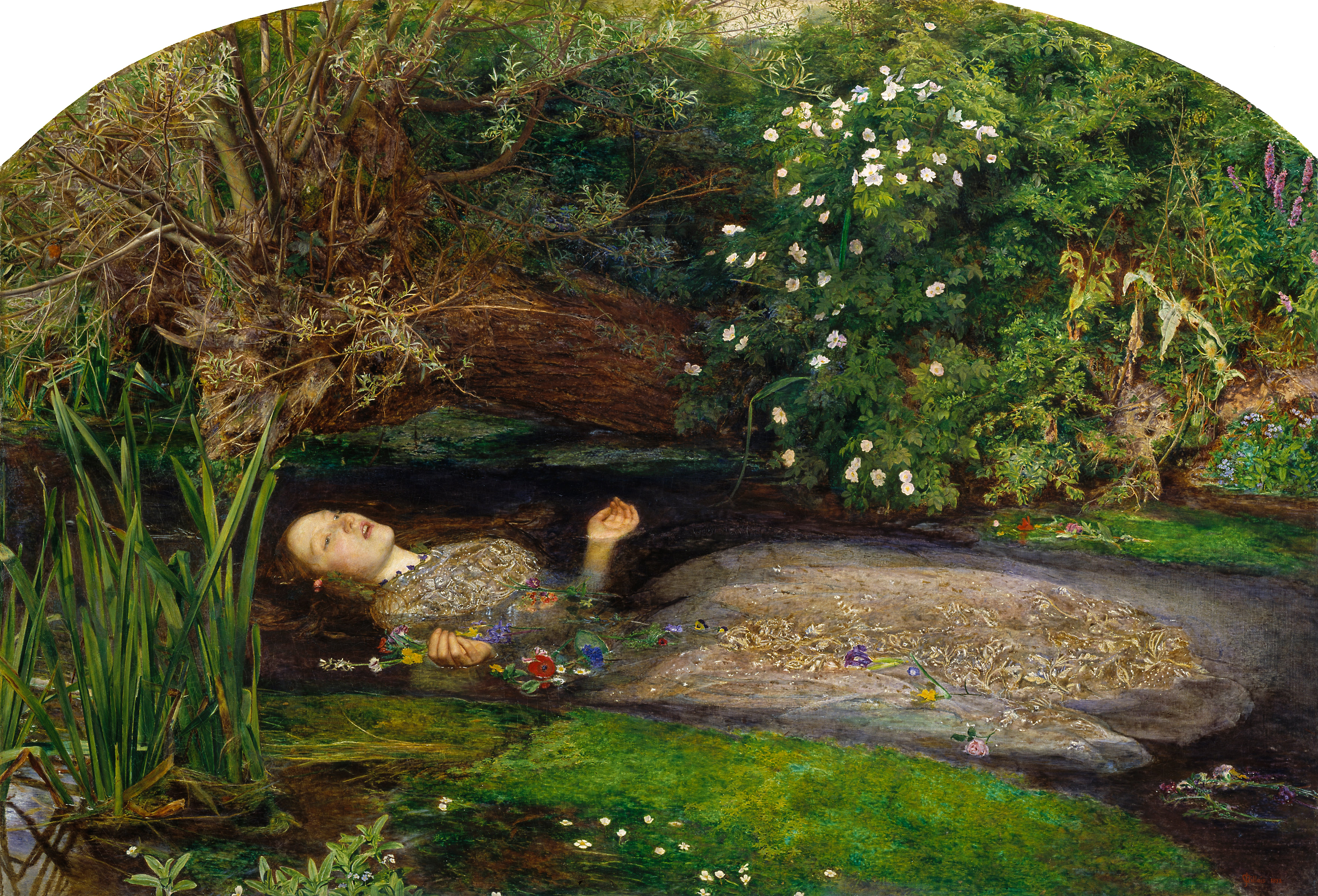
A short while later, Fish Legal won a ruling that compelled water companies to comply with Environmental Information Regulations, and on the heels of that, WWF’s Rose O’Neill sent a Freedom of Information request to every water company, asking for details of their raw sewage spills. From memory, only one answered because only one had any idea. At the time, only a handful of sites were monitored at all. However, research by the South East Rivers Trust showed that the outfalls on the River Hogsmill in South London were spilling far more frequently than they had been designed to. And into a fragile chalk stream at that, the site of John Everett Mills famous painting of Ophelia. The spills were not related to exceptional weather.
If only that had been the worst of it. It took dogged campaigners like Phil Hammond and Ash Smith (as portrayed in the Dirty Business drama) to push more persistently and unearth a nationwide scandal of environmental malpractice driven by financial malpractice.
As Flushed Away identified, water company investment had stalled: that’s assuming it had ever really started. I remember we calculated that at the existing levels of investment in 2015 it would have taken 800 years to upgrade the systems. Ofwat – the financial regulator – set the price of water and was determined that it wouldn’t go up. Shareholders added little extra capital over time. Caught between the regulated price and income-hungry shareholders, water companies sweated sewage infrastructure to breaking point and the environment paid the bill. Debt accrued but flowed sideways into the pockets of shareholders, many of them overseas institutions that – one might argue – had little interest in the UK’s environment.
Clearly, Ofwat failed to curb any of this. So long as the price to the consumer remained low, the feeling was – so one must guess – that the greater good was being served? Besides, Ofwat at the time had no environmental remit, only one of cost to the consumer. However, the Environment Agency, whose job it is to police the industry’s environmental standards, must also have been asleep at the wheel. Monitoring of river water quality, of fish and invertebrates, all fell from regular to infrequent to scant in the early 2010s. Prosecutions for pollution were rare. Water companies were left to mark their own homework. From the outside it looked as if the environmental regulator was compromised by the economic implications of applying the law.
No wonder it all went wrong. Now, almost everyone agrees that structural change is needed.
Structural change
The Water Special Measures Act is this government’s attempt to address some of those failings. A lot of store is being set by the potency of other eco-populist catch-cries: bonus bans and criminal liability. I don’t know how effective these will be. Do we really think that water-company chief executives set out to break the law? Sewage infrastructure is not fit for purpose because of a problem decades in the making, now colliding with a level of public awareness far higher than even a few years ago. In AMP8 Ofwat has allowed for an unprecedented level of investment, very largely paid for by increased bills and only time will tell to what extent this starts to address the problem. It is only the start, however.
Looking at where we are and where we go next, the Achilles heel of nationalisation as an alternative is surely that two of the three institutions responsible for this poor situation are public bodies already. If Ofwat and the EA failed in their parts, why should we expect a public water industry to per se do any better?
The fact is we have had nothing like the reasonable investment model that we might have, where shareholders look not for creaming profits but for a modest, steady yield, offset by minimal risk. Instead, as research has shown, we have had net zero investment, debt has ballooned, and the money spent on infrastructure has all come from customer bills. According to a 2024 analysis by David Hall from the University of Greenwich – refuted by Ofwat and the industry – shareholder investment has effectively amounted to zero in real and adjusted terms between 1990 and 2023. At the same time, debt has ballooned from effectively nothing (the companies were debt-free at privatisation) to around £70 billion today. The total spent on infrastructure has been about £190 billion, but where did the money come from? Mostly from bills, according to David Hall, while all the debt has allegedly gone to pay dividends.
The difference between fair and what we got
The difference between a fair model and the model we got must surely be the difference between the dividends owners have paid themselves and a fair dividend yield on the investments made.
Against the £190 billion invested in infrastructure, £70 billion is modestly inline with a fair yield, equating to roughly a 2% pa dividend. However, if the £190 billion mostly came from bills, and a much lower sum was invested – and it appears to be true that there have been few injections of fresh capital over time – that £70 billion of dividend, rather than being a reasonable yield on £190 billion of investment, is a very generous yield on the amount invested at floatation. A fair yield on the £7 billion would have amounted to between £9 and £16 billion. (2.5% – to 3.5% over 35 years).
Meanwhile, according to critics, the companies have been leveraged with debt and bills have been higher than they should have been, in spite of Ofwat’s determination to keep them low.
All of which suggests that the system needs rebuilding. And yet while nationalisation might stem the bleed of debt capital to overseas ‘investors,’ would a nationalised version be any better from an environmental point of view? Let’s not forget the problems privatisation was supposed to address: regional water authorities disinclined to prosecute themselves for polluting waterways, chronic underinvestment (by government), creaking infrastructure, deteriorating water quality (a 1985 River Water Quality survey found a high % of sewage works breaching their limits), and very little appetite by customers to pay more for their water and sewage. The full English one might say, since we are so very good at polluting rivers. Plus ça change.
A paucity of ideas
The replication of these problems, whether under private or public ownership, probably explains the vagaries in the public debate. Beyond the easy catch-cry of nationalisation, there are few ideas, with the exception of those coming from Dieter Helm.
Alistair Carmichael MP, chair of EFRA’s Commons select committee, was tellingly non-specific when quizzed by Toby Perkins MP, chair of the Environmental Audit Committee. EFRA looked at ownership models to inform the Cunliffe report: the government had – at that time – ruled out state ownership. Nevertheless, said Carmichael, there is a fundamental truth that ‘you can have any model of ownership that you choose, but actually, if your industry as a whole has the wrong culture, if you lose focus on the customer service and environmental protection, then you’re always going to end up with bad outcomes.’
Instead of starting with the answer of ‘nationalisation’ and working backwards, we might do better to look at specifically what has gone wrong – a hurried privatisation that didn’t compel proper investment, opaque ownership regulations with no obvious accountability, a total failure of economic and environmental regulation, all built around a system of infrastructure that is conceptually flawed – and try to build a better answer from there. The clear evidence globally is that good environmental outcomes depend on satisfactory levels of investment, adequate regulation, and corporate governance, no matter how the water entity is owned.
Carmichael argued that regulation is what it boils down to, and many will agree with him. The regulator must keep the industry’s ‘feet to the fire,’ however the industry is constituted. Our regulatory system, Carmichael highlighted, is split between too many agencies and was not set up to cope with the labyrinthine financial structures the water companies fragmented into over time.
Hmmm. The single regional regulatory authorities that preceded privatisation had failed too. A 2020 Cambridge University Press study into drinking water standards found that public bodies commit significantly more treatment and contamination event violations and fewer reporting violations relative to private bodies, but also speculated that private bodies may exercise strategic underreporting. Which might lead one to the obvious conclusion that no matter what structure is set up, the regulatory side must be completely and effectively separate from the operational side and must not be captured by economics. Although the system has clearly failed, I have strong doubts that the state would have regulated itself any better.
In the UK, it has taken a third-sector form of inspection and regulation by protestors and NGOs to bring the issue to the fore. Any good system going forward must make room for a formal moderation by citizen scientists of the official marking system and the inclusion of that third-sector moderation in the regulation process.
Nevertheless, this economic capture is probably inevitable, to some degree, both of the state regulator and – surprisingly – the courts. In his book The River Pollution Dilemma in Victorian England: Nuisance Law versus Economic Efficiency, Leslie Rosenthal convincingly argues that in spite of the fact that British rivers have been protected back into the mists of time by Common Law and riparianism (the principle that owners of waterside property may make reasonable use of the water so long as that use does not inhibit the water’s quality and quantity for other users), a balance of convenience skewed towards economic efficiency and the greater common good has long overridden the common law in terms of practical application in the courts. Courts are unwilling, in other words, pedantically to apply the law if it causes economic harm (i.e. the cost of water going up) to a very large number of people, relative to the rights of a few.
It has made virtually no difference over time whether our rivers have been protected by riparianism, the 1876 River Pollution Prevention Act, the Prevention of Pollution Act of 1951, or the Urban Wastewater Treatment Directive. Economic efficiency will prevail, no matter how much a middle-class wild-swimmer or trout-angler (like me) may wish otherwise. Many critics insist that ‘we just need better enforcement,’ and they are not wrong, but the idea that courts alone can drive the levels of investment needed to build a world class system seems far-fetched.
Going Dutch?
So, what are the features of world-class water systems and how can we adapt them to our somewhat unique situation of inherited rust, too many bottoms, too much paving?
The Dutch system is widely regarded as among the best in the world. Drinking water is of a very high quality and is less expensive to the consumer than in the UK. Wastewater is treated to a very high standard too – 70% undergoes sophisticated tertiary treatment.
With the exception of the combined authority that serves Amsterdam (Waternet) the supply and treatment of drinking water is separated from the collection and management of sewer systems, which is in turn separated from the management of wastewater treatment plants. This allows for a high degree of specialisation.
Drinking water is supplied by regional non-profit and publicly owned utilities. Tariffs to the consumer cover costs, investment and maintenance.
Wastewater, on the other hand, is run under the Dutch water authority model, Waterschappen, comprising twenty-one decentralised public bodies (generally defined by geographical catchments) that form the main operational component of the water management system. Responsibilities include flood protection, water levels, water quality, and – critically – wastewater treatment.
Importantly, in terms of what we might learn, these regional boards are democratically accountable and are technically highly specialised and experienced. They are among the oldest democratic bodies in the country, originating in the 12th century and have acquired expertise over the centuries. They levy their own taxes and also have access to long-term financing through the publicly owned Nederlandse Waterschapsbank (NWB Bank), which provides low-cost loans for public infrastructure. This financial autonomy ensures stable funding for long-term water management projects and supports the sustainable operation of the Dutch water governance system.
The cornerstones of the managerial system are, therefore: functional specialisation, decentralised governance, democratic legitimacy, and financial independence.
Regulation
That’s all very well, but who holds their feet to the fire? In the UK, Alistair Carmichael MP pointed to the ‘littered landscape’ of Ofwat, the Environment Agency, the Office of Environmental Protection, the Drinking Water Inspectorate, as part of the problem in holding the water industry to account. ‘You know, everybody’s got a bit of skin in the game, and then when things start to go wrong, it’s too easy for somebody to say, well, that’s not really our job, it’s theirs.’
Countering the Carmichael viewpoint, the Dutch system is radically decentralised with tiers of overlapping regulatory responsibility. Water boards must answer to the National Inspectorate (ILT), Provincial permitting authorities, the National Water Manager Rijkswaterstaat, scientific oversight (RIVT) , democratic elections, the courts, and effective public scrutiny.
Carmichael’s thoughts presaged those of government, however. In June last year the environment secretary Steve Reed announced that Ofwat would be abolished and a new super regulator would take over from Ofwat, the EA and the drinking water inspectorate. ‘A single, powerful regulator responsible for the entire water sector will stand firmly on the side of customers, investors and the environment and prevent the abuses of the past’.
The Dutch model suggests that overlapping or even split regulation was not the problem. Quite the contrary, it has been a strength. The problem in the UK is buried in the optimism of Steve Reed’s quote. A conflation of the interests of customers, investors and the environment is exactly what Ofwat and the EA got so wrong. The interests of customers, for example, are precariously balanced around the question of cost. A single, super regulator sounds very grand but at the coal-face it’s always a trade-off. Resolving these competing interests is not at all easy in theory, let alone practice. I’d place more faith in discrete and clearly defined areas of regulation with watertight barriers around any possibility of regulatory capture.
For a long time, for example, the thought was that a major barrier to progress in curtailing the over-abstraction of rivers, was the water company licence of right to abstract. What we needed, we all thought, was the ability to remove those licences when it is clear a stream is being damaged, without the need to compensate the water company. We now have that ability, but vanishingly few licences have been revoked. The burden of proof has now moved to slam-dunk, plank-in-the-face evidence of damage, beyond a dry riverbed and dead fish, mind, because a dry riverbed and dead fish might be down to natural causes. The EA has long been caught between protecting the environment and permitting activities that damage it. This is an impossible situation. So long as the EA is saddled with schizophrenic regulatory tasks it will struggle to do its job properly.
A super regulator may well struggle with the same issue of irreconcilable interests. And when it does, money will win, just as it does now.
Nationalisation-lite.
So, if and when the regulators fail to ‘hold feet to the fire,’ – which they will from time to time, even in a perfect world – we come back to the question of governance and accountability. Something that is so clearly transparent in the Netherlands. How directly publicly accountable are the ownership structures in the UK?
Not very much, is the answer. Only three out of nine (South-West Water, United Utilities, and Severn Trent) are publicly listed. The majority of the shares in each of these – 60% to 70% – are held by UK investors, mostly pension funds, insurance companies, and retail investors. These institutions, which will all have active Environmental, Social, and Governance (ESG) departments, should in theory be more sensitive to UK public opinion than the complex and opaque smorgasbord of private equity, foreign sovereign wealth funds, foreign pension funds, and asset management companies that own the other six water companies.
Does this difference in ownership structure translate across to differing levels of environmental performance? Maybe. Severn Trent was the only company with a top-of-the-class rating in 2024. However, Wessex Water appears to be the water company with the best environmental record over time, and yet it is majority-owned by the Malaysian infrastructure conglomerate YTL.
Even so, clarity and accountability could and should make a difference.
It is standard practice globally that companies of particular strategic importance to a nation – airlines, for example, telecommunications, energy – must have a minimum percentage of domestic ownership. Delta, American Airlines, Air Canada, and Qantas must all be owned by a minimum of 51% domestic shareholders. In Canada and Japan, foreign investment is limited to 20% of telecom operators. Both Canada and Australia edict that domestic pension funds must hold majority shareholdings in strategically important companies. The reasons are obvious but include security and economic sovereignty.
Why should water be any different? If all the water companies were by law publicly listed on the UK stock exchange, with a maximum foreign ownership capped at, say, 25%, it would surely lead to more clarity and therefore accountability in their governance. Even better if the financial system and policy environment strongly encouraged investors such as domestic pension funds to own large shares of this national infrastructure. Pension funds have long investment horizons, a need for steady income, and an ability to invest very large sums of money on fair terms. UK pension funds and their active ESG departments should be much more sensitive to public opinion than opaque overseas financial vehicles.
Especially if we could also create a clearer portrayal for customers of ownership associated with relative environmental performance. Why shouldn’t every water bill list who the primary shareholders of that company are? And, why shouldn’t every water bill include the environmental performance rating of that company over the previous one year and five?
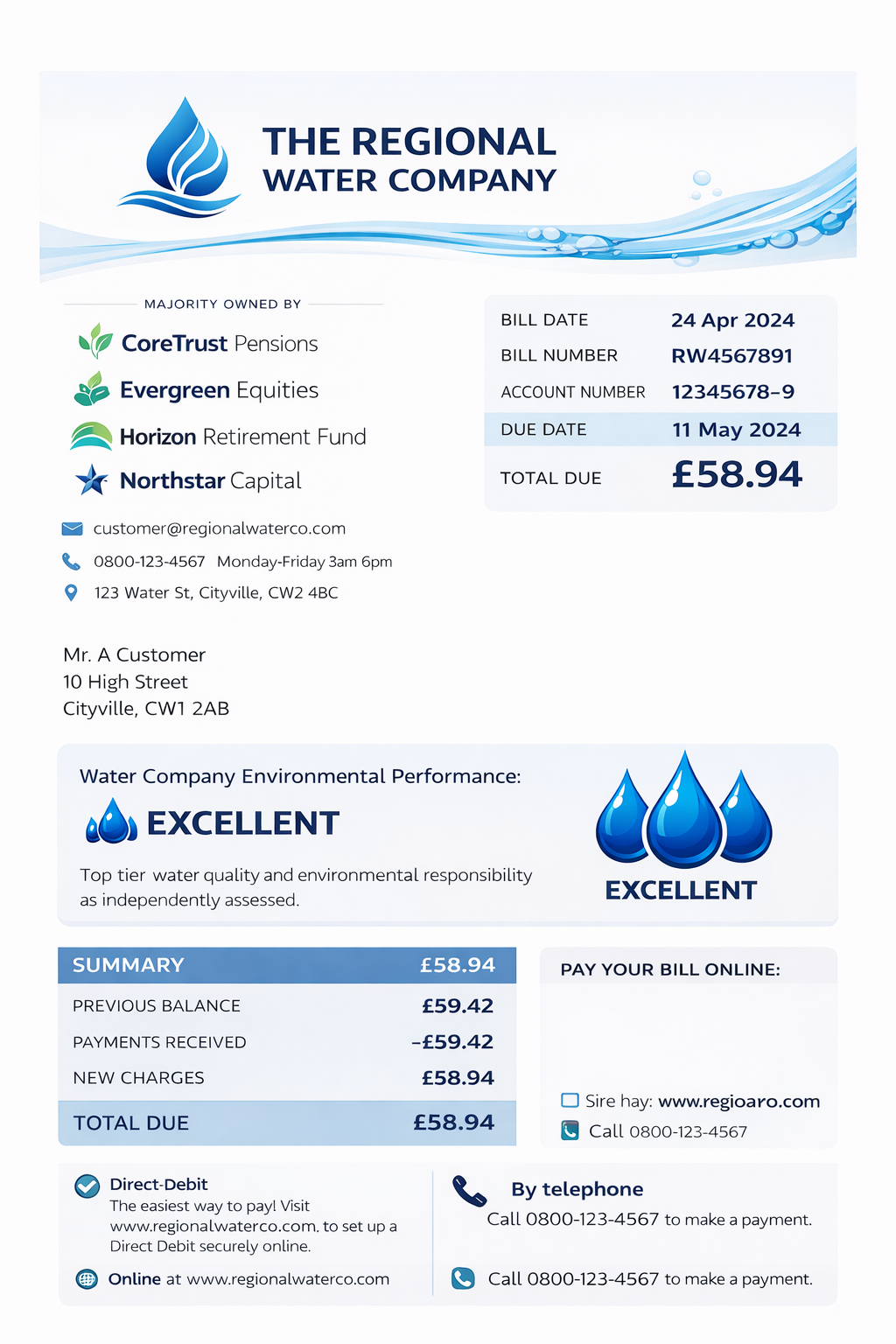
The Environment Agency produces a star rating every five years. But few people know about it and it is a bit too esoteric for customers in my view. Customers need a little blue drop or a little brown drop. And they need this printed prominently at the top of the water bill alongside the company logos and a list of who the primary UK-based shareholders are. I can see the likes of Legal & General very much preferring to see their names printed under the blue drops, not the brown.
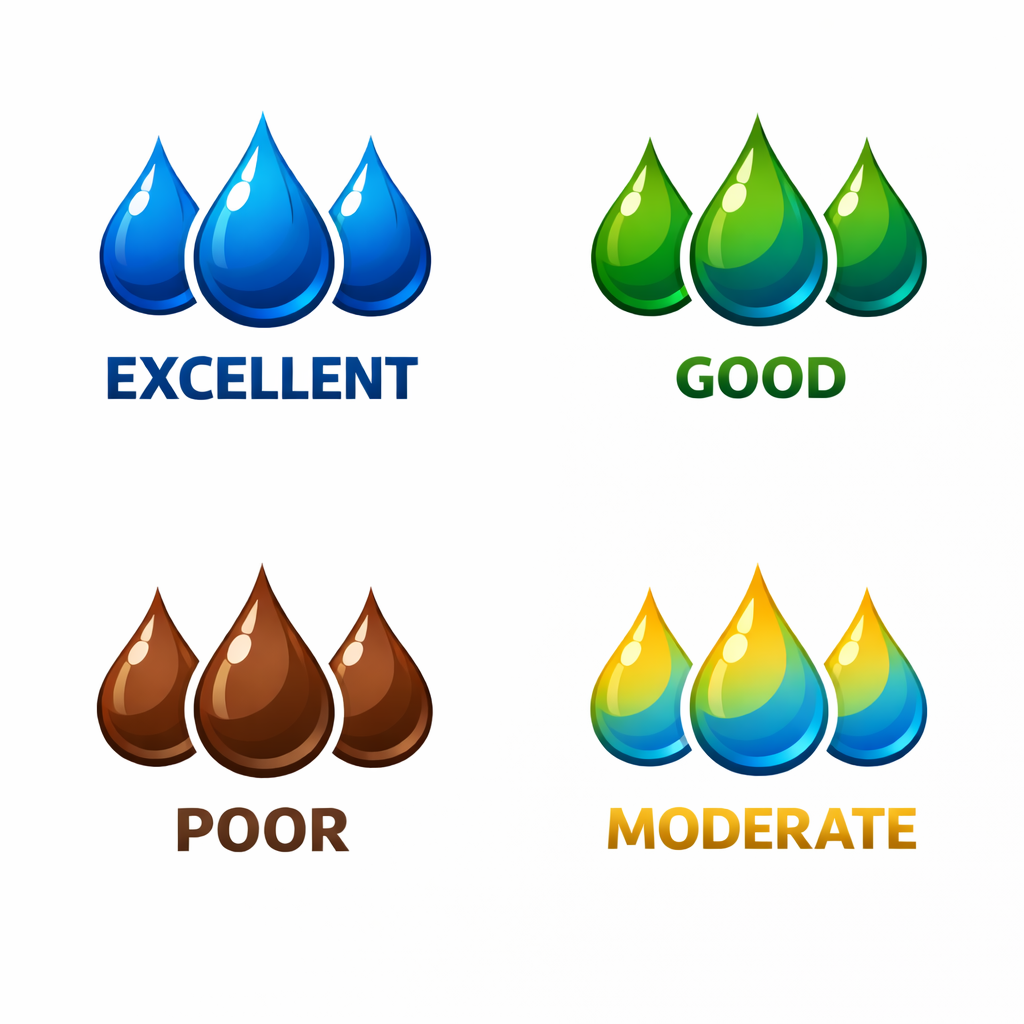
I have no idea how legally tricky it would be to mandate this public listing, to mandate a minimum % of UK ownership, and enact the policies that would encourage the right kind of investor. But I suspect it would be easier, and less expensive for the government than nationalising the industry and less likely to spook the markets, to use an overworked phrase. A system such as this would achieve a level of nationalisation-lite and powerfully add to our arsenal of regulation the leverage of corporate sensitivity to public opinion, curtailing the financial shenanigans and driving stronger environmental stewardship over time.
Ownership alone will not clean our rivers.
It is tempting, when a system fails so visibly, to reach for the most dramatic solution available. Nationalisation has the virtue of clarity and the emotional satisfaction of redress. After decades in which the public has watched sewage pour into rivers while dividends flowed out to investors, it is easy to see why the call resonates. However, the failures we are dealing with are systemic. They include poorly designed privatisation, unaccountable corporate ownership, and a regulatory regime tasked with divided and irreconcilable priorities, that was under-resourced and in places captured by the very economic constraints it was meant to police. Changing the ownership without fixing those structural weaknesses risks simply recreating the same problems in a different set of clothes.
What ultimately determines environmental outcomes is more practical: sustained investment, transparent governance, and regulators that are genuinely independent and empowered to enforce the law. Countries that succeed at managing water tend to combine these features regardless of whether their systems are public, private, or hybrid.
That is why a better path may well lie somewhere between the slogans. A system that makes ownership transparent, encourages long-term domestic ownership and investment, aligns shareholder incentives with environmental performance, and strengthens independent environmental regulation could deliver many of the benefits people associate with nationalisation without the financial and political upheaval of full state takeover.
Call it nationalisation-lite if you like.
1. Compulsory public listing.
2. A re-patratration of ownership: 75% minimum domestic shareholders.
3. Clarity of corporate ownership / governance.
4. A financial and policy environment that encourages long-term, stable funding from sources that are sensitive to public opinion
5. A simple and easily comprehensible method of assessing and publicising relative environmental performance.
6. Functional specialisation: separating water supply from sewerage and water treatment.
7. Regulatory specialisation: discrete and independent bodies for standards, permitting, monitoring and enforcement.
8. Democratically accountable catchment authorities that are independent of central government.
9. Complete transparency and real-time data.
10. Formalised 3rd sector and citizen science validation of standards.
Above all, the debate should not become a proxy war over ideology. Rivers do not care whether the water industry is owned by the state, by pension funds, or by listed companies. They respond only to whether sewage is treated properly, infrastructure is maintained, and the law is enforced. If we keep our focus there — on the ecological outcome rather than the ownership model — we might build a water system worthy of the landscapes and people it serves.
 Chalk-Streams