
At the news the other day that the government had agreed in principle to draft an amendment in the Levelling Up Bill to specifically cite chalk streams as intended recipients of protection from the impacts of abstraction, pollution and damage to physical habitat, certain critics took less time than Usain Bolt does to cover 100 meters before trolling out the well-worn cavil that protection has “failed” to protect the existing SSSIs and SACs and is therefore a waste of time. On the grounds that you cannot win an argument on Twitter I’ve never bothered to pick an argument over what “failed” means in this context, or the fact that the “unfavourable condition” statistics cited in previous posts making the same argument have often applied to the whole assemblage of units, not just the river, or that the bar to favourable condition is generally much higher than good or even high WFD status or that it is empirical fact that abstraction rates are lower and phosphate stripping rates higher on designated streams or that the reasons a river unit might be considered unfavourable go well beyond the WFD tests and might include, for example (and completely off the top of my head) excessively stocking farmed fish, overly managing the riparian parts of the the river, and using impoundments to retain water levels etc.
Ali Morse, water policy manager with the Wildlife Trusts, did take that step, however and answered back with some excellent points which I repeat here for those sensible folks who avoid the flying monkey cage-fight that is now renamed as X.
To the post which read:
“There are already 11 chalk streams designated as either SSSIs and or SACs all of which has done absolutely nothing to protect any of those rivers, nothing! Not one of them is anywhere near being in ‘Favourable’ condition. The eNGO lobby getting played yet again by government.”
Ali replied:
Ok let’s unpick this one – a 
Q: Are all designated #chalkstreams in good condition? A: certainly not. But does that mean protection has achieved ‘nothing’; is it worthless? (1/x)
Eleven chalkstreams are designated as SSSIs, four of which are further protected, at least in part, as SACs. As important sites, targets for these designated rivers are more stringent than those for other rivers. So how are they faring against these? (2/x)
Well, it’s hard to say. The River Kennet for example was recently assessed as unfavourable, but recovering. But most others – the Test, Itchen, Bere Stream, Nar – are awaiting new assessments. Prior assessments for some are now ~10yrs old. (3/x)
designatedsites.naturalengland.org.uk/SiteFeatureCondition
So are they at least in better condition than non-protected chalkstreams? Well, WWF’s 2014 report looked at whether chalkstream waterbodies were at ‘Good’ status (a Water Framework Directive classification) and found that designated rivers were no better off than others (4/x)
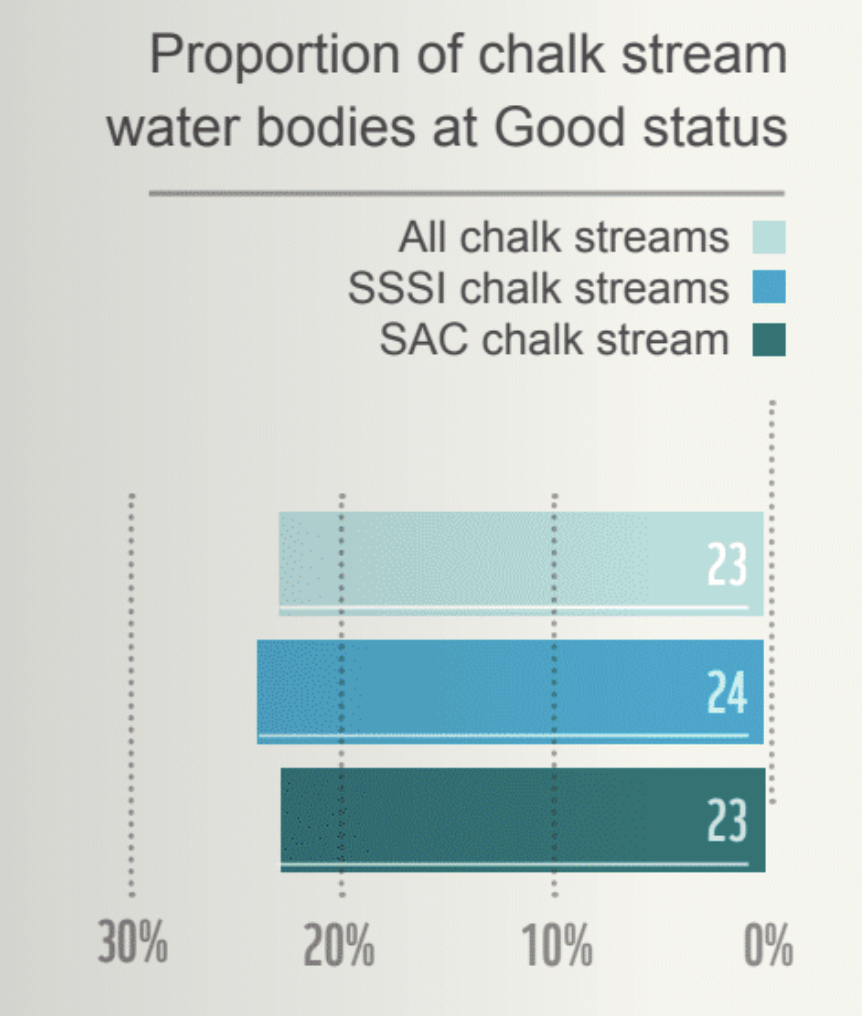
But that doesn’t show the whole story – a WFD status of Good can (rightly) only be awarded if ALL parameters are classed as good. For ecology, most English rivers (86%) fail this standard – but could protection mean that designated chalkstreams are closer to achieving it? (5/x)
If we look at phosphate – the most common cause of WFD failures – does designation offer any merits? On some fronts, yes it does. For example, SAC chalkstreams have a higher % of sewage treatment works that strip phosphate, meaning cleaner discharges. (6/x)
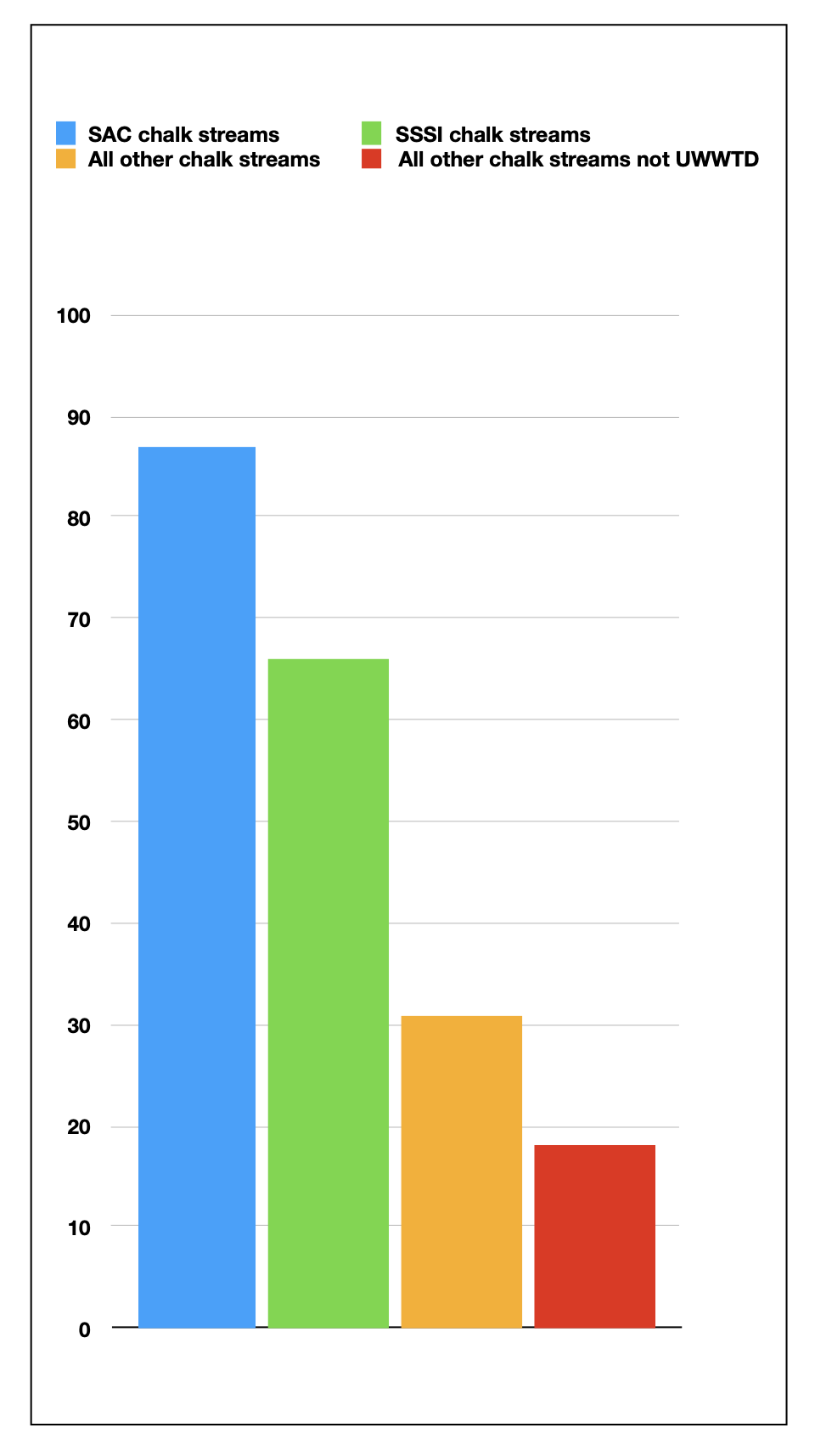
SSSI streams also benefit. Then those where the Urban Wastewater Treatment Directive dictates that P-stripping is required. So these protections have driven investment. Similarly, designated rivers fare better with abstraction, with reductions being prioritised here first. (7/x)
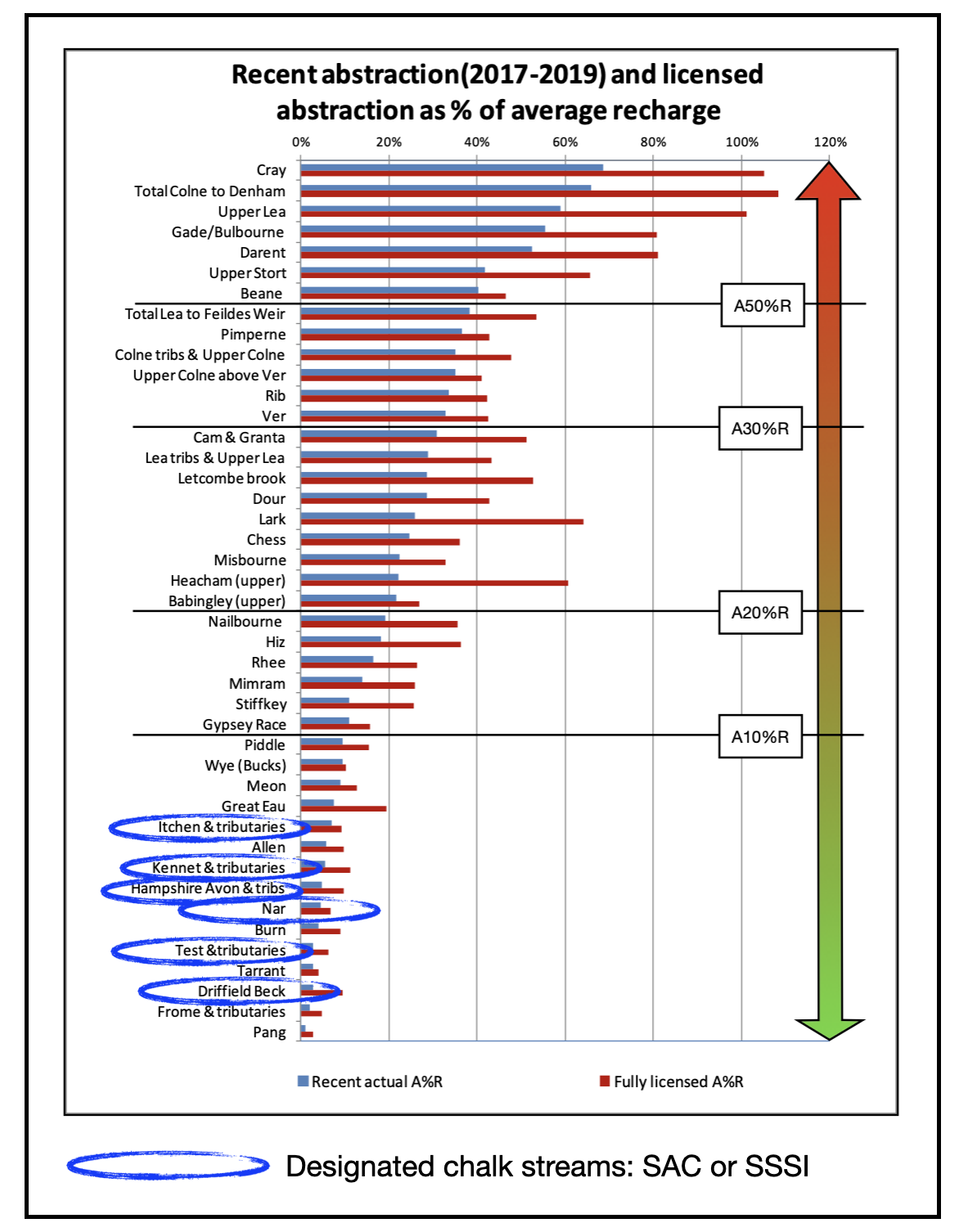
They are also often a target for habitat restoration, with the designation prompting investment from project funders and partners. See for example the Test & Itchen River Restoration Strategy https://youtu.be/Lq_w0FAccPI (8/x)
Yet the designation certainly doesn’t protect against everything. In particular, it can’t control what happens in the wider catchment. Runoff from farmland, pollution from urban areas, invasive species and other external pressures remain prevalent. So we need extra levers. (9/x)
Planning is one such gap, esp. as population growth & demand for new housing are high in the chalk counties of S&E England. Current rules don’t give chalkstreams adequate protection, whether harmed directly (at development sites) or indirectly (e.g. via water abstraction) (10/x)
I’m not sure how specific consideration of chalkstreams in planning decisions could be a bad thing – other than perhaps from the perspective of non-chalkstreams which won’t benefit. But we have to start somewhere. (11/x)
In theory the promised clause in the LURB will require that reports provide explicit info on harm & how it’ll be avoided / mitigated / compensated, giving Local Authorities the grounds on which to base decisions. We’re yet to see Govt’s wording but it’ll be a version of… (12x)
“protection for chalk streams…so as to reduce the harmful impacts of excessive abstraction & pollution and improve their physical habitat”. And if good decision making doesn’t follow, it will at least give others stronger grounds on which to challenge. (13/x)
Worth noting too that additional protections like consideration via planning rules will probably most benefit those ‘Cinderella’ chalkstreams currently neglected by designations – gems like the Meon, the Stiffkey, The Gypsey Race… (14/x)
…and that those protections, in whatever form, were the collective wish of stakeholders that contributed to the formation of the CaBA Chalkstreams Restoration Strategy – yes eNGOs but also fishing clubs, community groups, campaigners, practitioners, academics & others. (15/x)
So, maybe these new planning protections won’t be effective – but seems an odd thing to shout down. Surely our chalkstreams need every lifeline we can offer them? And this isn’t the only solution we’re demanding, not by a long way. (/End)
Thank you Ali. Very well put.

 Chalk-Streams
Planning is a start a very good start, and it protects the most vulnerable of Streams Like the River Ems——but we need the Protection Now. I sit on a planning Committee and if Natural England say it’s harmful to a river we will refuse permissions—-but we need them Natural England to recognise the intrinsic value and beauty of our Chalk Streams and the vast biodiversity of wildlife they support. Give me the support and we will refuse applications.
I’m at a point of considering the position of the EA and would like some advice from Charles—-I have sent a private email to you re the Harris action.
Thanks, Roy
LikeLike
Thank you. I will digest this. It does not look altogether good for our Chalkstreans though. Katerina. Xx
LikeLike