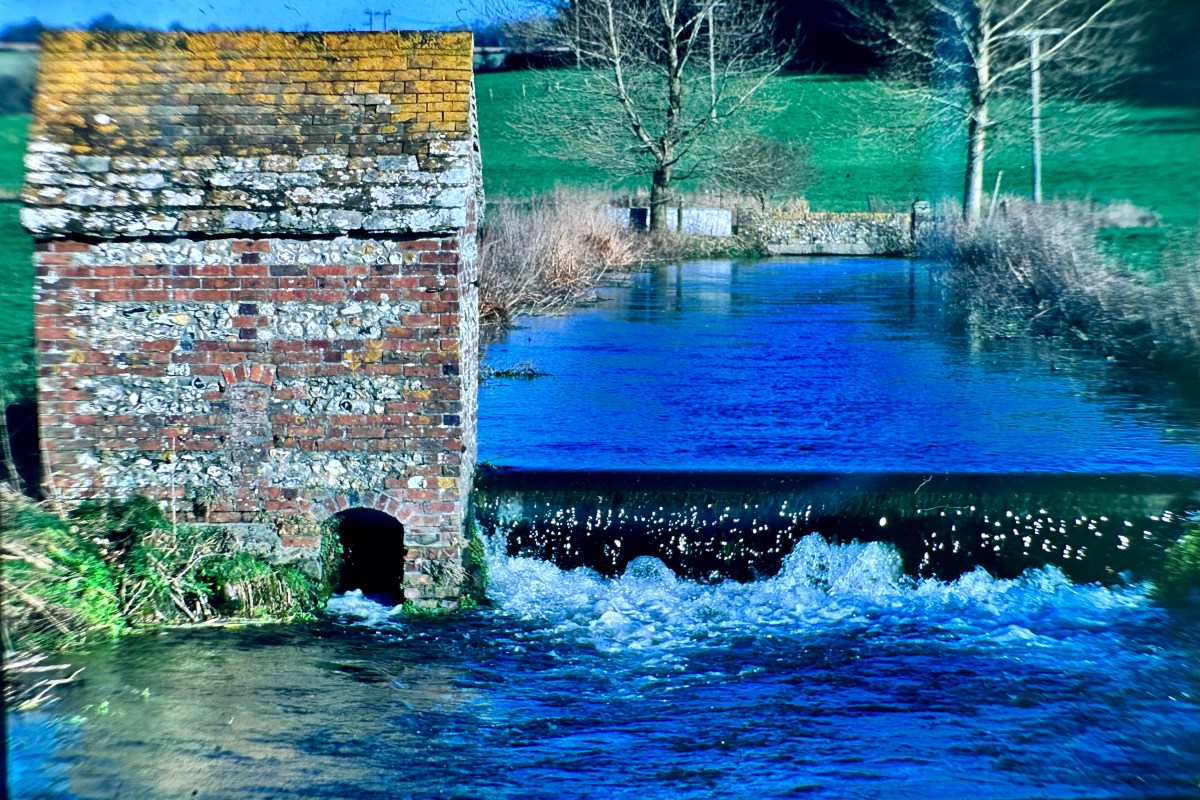
The Environment Agency (EA) has finally replied to the River Tarrant Protection Society (RTPS). The reply doesn’t reflect well on the EA.
The RTPS is a local group, campaigning for the protection of the River Tarrant, a Dorset chalk stream that historically supported 5 Domesday watermills and even now remains a spawning stream for Atlantic salmon, but which nowadays dries all too frequently because of abstraction. The RTPS has shown that before the 1950s the steam rarely, if ever, dried in its lower reaches. After the onset of groundwater abstraction the lower stream began to dry in extreme droughts – eg 1976, 1989 – catalysing the formation of the protection society.
The situation had been bad for decades. Now it is much worse. In 2018 Wessex Water completed work on an area ring-main, designed to relieve abstraction pressure on chalk streams in the neighbouring and highly protected Avon catchment. As a result, abstraction around the River Tarrant increased, since when the stream has dried in its lower reaches every single year.
The one year in the past ten when the stream did not dry was 2017, when the local pumps were turned off, and that was in spite of the fact that 2017 was drought year for chalk streams.
The RTPS has compiled a report consisting of historical evidence, ecological evidence, local testimony and modelling that collectively – in the opinion of the RTPS – suggests that abstraction is the cause of this increased drying.
RTPS has asked for a meeting with the EA to discuss their concerns, and for the potential abstraction impacts to be investigated more fully in the next round of AMP investigations. These are hardly unreasonable requests, especially in light of the fact that Atlantic salmon from chalk streams have very recently been shown to be a genetically unique and critically endangered sub-species. In the Stour catchment the salmon are on the very edge of survival.
My past few blogs have detailed the argument and the local EA’s inflexible and partisan approach to the matter. The area office commissioned a comparative and isolated review of the approaches to groundwater modelling taken by the Wessex Water / EA teams and John Lawson, the independent hydrologist working for RTPS. The review concluded that John Lawson’s approach was too simplistic, whilst also admitting that the Wessex model did not actually perform very well in its modelling of the impacts of the Black Lane abstraction.
The local EA didn’t consider any of the other evidence. As you can see below, the EA now considers the matter closed.
“Dear RTPS,
Thank you for your response* which I read with interest. I note the concerns you express but I find myself somewhat at odds with your assessment.
[*This being the RTPS response to the EA’s review of John Lawson’s modelling]
I feel it would be irresponsible for the Environment Agency to move away from a chalk basin groundwater model which is founded on accepted hydrogeological principles. Although the model created by John Lawson is of interest, I don’t feel it’s clearly based on conventional hydrogeological interpretation. I would also note that I do not feel that criticism of the independent reviewer as being justified, as she is highly qualified and respected in her field.
Although I personally felt the review of the two modelling approaches to be the fundamental issue that needed reviewing first, I should also point out that the status of the watercourse is constantly under ecological review, to assess any change in status under the Water Framework Directive. The element that leads to the water body not achieving overall good status is fish status. In this regard, it is annually reviewed by my fisheries colleagues and a lot of work has subsequently been carried out to address many of the concerns they identified over barriers, as well as some additional habitat restoration.
You have put forward a number of proposals relating to the operation of water company assets in the lower Stour. I think it’s important to clarify that the EA largely leaves the day-to-day operation of water supply sources to the water company to deliver, while our role is then to ensure they remain compliant within their licence conditions. How the water company choose to operate their sources varies throughout the year and from year-to-year dependent on many factors, which are laid down in their Water Resource Management Plans. These documents are reviewed and updated on a five yearly cycle, with work commencing again next year. You may contact the water company with your suggestions, but I suspect your proposal, though appearing simple on paper would have significant cost, infrastructure and resilience implications, especially in drier years. This could leave them exposed with the risk of not being able to supply their customers without breaching their licence conditions.
I think it should be mentioned, that when Wessex Water held the final meeting at the end of the five year AIM trial, the fundamental issue that they identified may have been overlooked or misinterpreted. The gauged data shows over time that the lower 3 kilometres of the river are become leakier. About ten years ago, at times when the river channel becomes perched, usually late summer to autumn, the losses amounted to around 1M/L per kilometre. So a 4ML/d flow entering this section would mean the lower river remained connected to the Stour. By the end of the period these losses had doubled or even tripled. Now once the groundwater level has fallen below the bed of the river, abstraction becomes irrelevant in this respect and it’s all about bed leakiness. The groundwater level can continue to fall beyond this point, but it won’t impact the river. It appears as if the riverbed has become leakier over time, possible due to vegetation clearance or other activities. Whether some form of natural lining trial might be an option such as chalk puddling I don’t know, but it could be considered. I have mentioned this to our chalk stream coordinator to review its feasibility. Please note no funds are currently available for such work but this may change in the future.
I feel now from a water resources perspective that we have exhausted all our options, following trials, investigations and extensive monitoring. Should some new data be brought to my attention I will give it due consideration, but the Environment Agency has a remit to protect all the watercourses within our area, and we need to concentrate our limited resources where they’ll achieve the best outcomes.
Kind regards … “
I should leave readers to form their own conclusions given the EA’s approach somewhat speaks for itself.
But I can’t help but point out:
The RTPS didn’t ask the EA to “walk away from their groundwater model”, rather RTPS suggested that the model may not be entirely correct. Who really thinks that groundwater models are infallibly accurate?
The RTPS didn’t criticise the independent reviewer, but rather her review and more especially the limited terms of her enquiry which were set by the EA.
These are classic straw man tropes and I am surprised by them given the loss of respect and credibility that will inevitably follow.
As to the alternative explanation that the riverbed “has become more leaky”* perhaps I really should let that speak for itself!
Of course the Tarrant has become more leaky. That’s the point. The question is WHY?
*This may be one for a more detailed rebuttal in another post. The idea that the separation of water table from river bed leads to an absolutely binary transition, is nonsense. Apart from anything else, it is perfectly obvious from the flow data that the water table peels away from the river bed, and that the drying extends by varying distances upstream depending on the water balance.
One thinks of Sisyphus.


Leaky river bed! Some mysterious unknown process is implied. We’ve heard the same on the River Ems. Anyone with a modicum of hydrogeological understanding can appreciate that if the ground water level is reduced sufficiently, the hyporheic zone is adversely affected and drys as flows become sub surface or non existent. What process would cause this reduction in GWL? Result, rivers dry, flow becomes subsurface or just plain disappears just like the neighbouring catchment for the Havant Lavant.
I suspect the upper surface geology as with the Ems is relatively porous (where the chalk layer dips and becomes confined/ paleogene/ Lambeth beds etc) as it desaturates compounded in our case by a local borehole used to augment natural flows. This of course causes a localised cone of depression and a cyclical exchange between local aquifer, borehole pump, nasty blue surface pipes, 1/2 km of non sustained brief river flow which rapidly disappears before the process is useless after 4-6 weeks.
The EA state they let the water companies make the day to day running and what a price we are paying! Where is the OEP in this continuing ecological disaster?
LikeLike