It doesn’t look like a lot of work, but it is … I’ve spent quite a few hours updating the index of English chalk streams, catalysed by an enquiry from the author Adam Nicholson: “exactly how many chalk streams are there?”
It’s not an easy question to answer (you’ll have to read to the end to get it), because where do you stop counting? Take a single, obvious main chalk stream: it is fed by many springs, in the river bed and valley sides. Some will be nameless rills and becks in their own right, perhaps only a few yards long, perhaps longer. I can think of springs and a small beck in the upper Piddle valley that in a different setting would be a “stream” in its own right. As it is, that little combe of chalk stream habitat is subsumed into the overall River Piddle: one chalk stream.
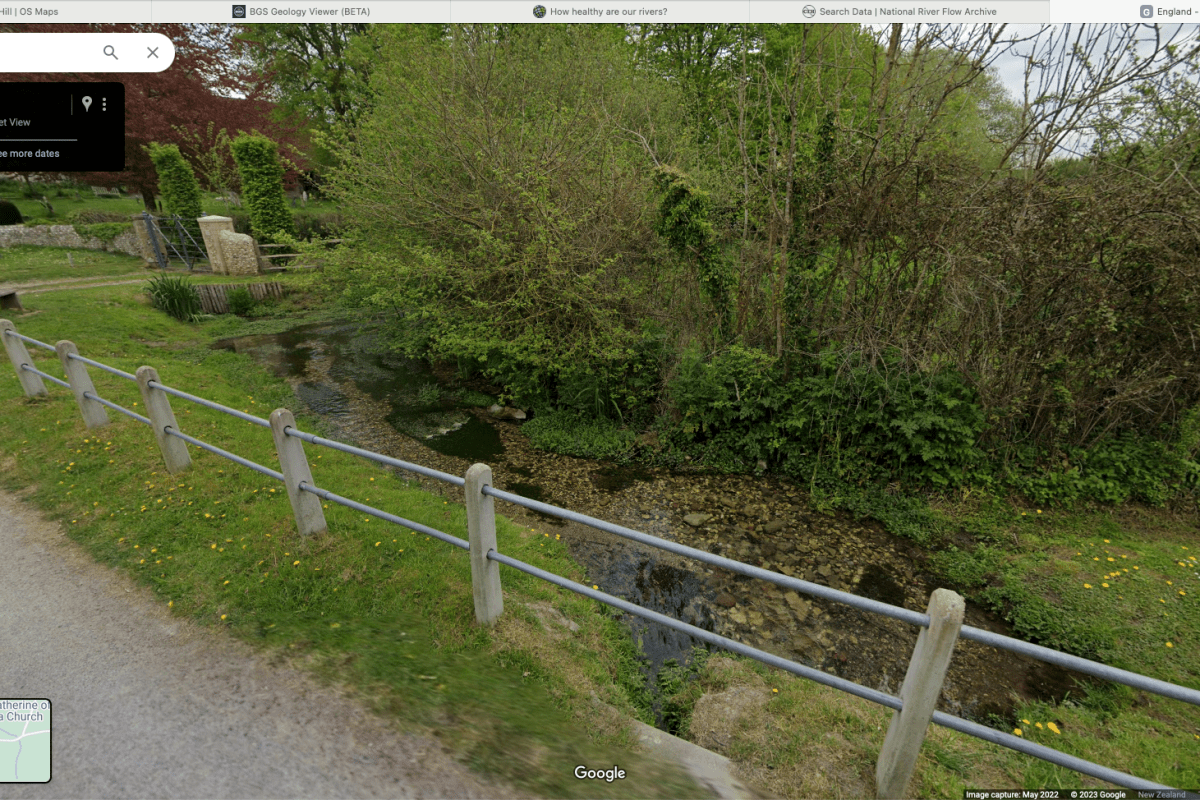
That different setting could be the scarp-face of the chalk in the Chilterns, Sussex (see the featured Image of a Sussex scarp-face chalk stream thanks to Google Street View), or Yorkshire where hundreds, if not thousands of tiny rills emanate from the chalk where it presses down on impermeable layers of older geology beneath: the water seeps as it would from a wet sponge placed on slate. But the valleys are truncated and rarely long enough for a stream to develop: not until that accretion of flow has stepped off the chalk onto clay, greensand and mudstone, and the bosky, incised streams that result are nothing like a chalk stream: though they may be chalk influenced.
Take another setting: north and east of Stevenage, at the edge of the retreating glaciers following the last glacial maximum, periglacial rivers dumped vast plains of gravel, sand and clay over a bedrock of chalk. Along the low ridge-back of chalk that runs from Hertford to Hunstanton and north under the Wash you get chalk streams. The superficials are thinner here and the streams – generally quite short – have a high base flow index and look like chalk streams: the Oughton, Hiz, Ivel, Shep, Mel, etc. But drift east and you range through what I would describe as a spectrum of chalk influenced rivers towards streams that – whilst they flow above chalk bedrock – are very incised, flashy and not at all like a chalk stream as we understand the concept. The very upper Lark, for example, is fed by what is essentially a gravel aquifer. Only downstream of Bury St Edmunds does it become hydrologically connected with the chalk. The Lark is certainly a chalk stream, but the Yare, the Tas, the Tud … what about these rivers? With baseflow indices of 0.60 they are certainly not at all like the Itchen, Test or Kennet.
Baseflow – which I have included in this index where I can find it – is the proportion of flow that derives from groundwater, as opposed surface run-off. If you look at the correlation between my proposed typology of chalk streams and their baseflow numbers, you’ll see it’s a pretty good indication of the “degree of chalkiness”.
What I have called classic Type A1 (I’ve added subclasses to the typology that I developed with Dr Haydon Bailey which appeared in the WWF 2014 report and the CaBA chalk strategy) streams rise almost exclusively on chalk and flow down the slope face of the chalk: so there is a very high degree of hydrological connectivity with the chalk aquifer. Their baseflow numbers are often over 0.9. Streams like the Itchen are 0.95. I have proposed a 0.85 cut-off.
Below 0.85 there is generally a greater degree of influence from superficial layers, which provide a measure of quickflow and surface run-off. These superficial layers also subtly change the landscape across which the chalk stream flows: the River Stiffkey or Bure, for example, flows from and through deep lenses of gravel. They are more incised and notably flashier than the purer chalk rivers Babingley or Nar to their west. I have proposed that these streams – with base flows between 0.70 and 0.85 are Type A2, slope-face streams.
Type A3 … these are the chalky streams like the aforementioned Yare, Tas, Tud etc. I would question whether we can describe them as true chalk streams, but I have called them Type A3.
Type B are the mixed geology rivers like the Frome, Avon, Kentish Stour, Darent. Generally they have greensand in their upper reaches, which makes them more flashy (baseflows of 0.80+/-) and it means they will have much higher phosphorus readings, as the sandstone doesn’t mitigate P as chalk does.
Finally the Type C are the scarp-face streams: they can also have very high baseflow numbers (indistinguishable from Type A), where the valley pushes far enough into the chalk for a stream to develop. I have counted all those I could find with names on the OS maps (ancient and modern). I have now included the most significant Sussex streams (identified by the late Nigel Holmes) and a few more north of the Chilterns (thanks to Allen Beechey and Richard Meredith-Hardy), as well as all the Yorkshire ones which I added to the WWF map in 2014.
This index is still – and will probably always be – a work in progress, but I hope fellow chalk stream nerds will appreciate this 2023 edition of the chalk stream index. I will be following it up with a really good map at some stage when I can find the time.
Meanwhile there is the Natural England map (link on the homepage), although that doesn’t actually name the rivers!
This index reads in such a way as to show were a stream is in the catchment, upstream to downstream, with the tributaries offset by column, first order, second order etc. It’s all pretty obvious.
If there isn’t an EA waterbody code, then the stream isn’t an EA waterbody. If there are several codes in one box, the single-named stream is divided into several waterbodies. I have stopped adding waterbody codes where I deem the stream is no longer a chalk stream (the Cam downstream of Cambridge for example, or the Bure downstream of Aylsham).
Answer: 274.
 Chalk-Streams
Dear Charles,
This was brilliantly done and we are very grateful for it. Thanks so much.
Stephen (and all your friends on the Cam)
Stephen P. Tomkins
Past Chairman: Cam Valley Forum Explore our CVF web page. https://camvalleyforum.uk/
my home 01223 276947. my mob. 0795176805
LikeLike
Thank you so much,Charles,for your wonderfull, informative post. Katerina. Xx
LikeLike