Full text from the House of Lords debate ref the protection of chalk streams and the Bishop of Norwich’s amendment to the Planning and Infrastructure Bill.

Extracted from Hansard Report – Planning and Infrastructure Bill – Hansard – UK Parliament

Amendment 93

Moved by

Baroness Grender 

93: Clause 52, page 73, line 22, at end insert—

“(6A) Where a strategy area includes a chalk stream, the spatial development strategy must include policies on permissible activities within the area of the stream for the purposes of preventing harm or damage to the stream or its surrounding area.”Member’s explanatory statement

This amendment would ensure spatial development strategies include policies to protect chalk streams.

Baroness Grender 

My Lords, Amendment 93, in my name and that of the noble Baroness, Lady Jones of Moulsecoomb, aims to secure the future of England’s chalk streams by enshrining specific protections and standards into our planning regime. As we made clear in Committee, these globally rare ecosystems—there are only 200 in the world—are often referred to as our country’s rainforests in terms of biodiversity and they face genuine risk from piecemeal development and inadequate water management. These are risks that will only intensify without a robust and specific legislative lever.

Relatively recently, I went for a customary walk in a beautiful green space in south-west London, only to discover that the beautiful River Wandle, home to brown trout and kingfishers, had been destroyed by a devastating diesel leak. The Government intend to streamline housebuilding and environmental measures in tandem, but the practical reality is stark.

Chalk streams are uniquely vulnerable. Abstraction of water, chronic pollution and unchecked development have led to tangible declines in many local areas. In 2023, the Liberal Democrats collected data through freedom of information requests, which revealed that one in 10 chalk stream sewage monitors were faulty, with some water companies having much higher rates of broken or uninstalled equipment.

Amendment 93 delivers a targeted solution: a statutory driver for sustainable drainage standards before any development interfaces with public sewers, closing a loophole that currently exists and has allowed cumulative harm to chalk streams. This amendment would ensure that developers are compelled to apply national standards for drainage and water treatment ahead of any permissions, rather than leaving mitigation as an afterthought.

Amendment 94 in the name of the right reverend Prelate the Bishop of Norwich complements this approach, and I thank him for the work he has done on this issue and his environmental expertise, which he has brought to this debate. Amendment 94 tightens oversight and demands full transparency in environmental impact reviews on watercourses at risk, an essential safeguard for communities whose local rivers are too often treated as collateral damage by the planning system’s inertia.

None of us should accept that cleaner, safer waterways are an optional extra and a nice to have. By adopting an amendment on chalk streams and supporting, out of these two amendments, Amendment 94, this House will signal that nature restoration, water quality and sustainable infrastructure are not in competition but can be advanced through co-ordinated and legally binding steps. I urge noble Lords to support these amendments for the sake of our streams and the communities they sustain.

If the right reverend Prelate the Bishop of Norwich moves to a vote, these Benches will support him. It is right that, with something as crucial as our unique chalk streams, we ask our colleagues in the House of Commons to think again and strengthen and protect in law this ecosystem that is almost unique to England. I hope that this House will unite in voting for Amendment 94 and protecting this rare heritage for future generations.

Amendment 94

The Lord Bishop of Norwich 

My Lords, I shall speak to Amendment 94, and I thank the noble Earl, Lord Caithness, the noble Viscount, Lord Trenchard, and the noble Baroness, Lady Willis of Summertown, for their support. I am most grateful to follow the noble Baroness, Lady Grender, who has just spoken so powerfully about her amendment, as well as offering her support for this amendment. Amendment 94 would require a spatial development strategy to list chalk streams in the strategy area, outline measures to protect them from environmental harm and impose responsibility on strategic planning authorities to protect and enhance chalk stream environments.

Chalk streams, as we have heard, are a very special type of river. Some 85% of the world’s chalk streams are in England. They are fed primarily by spring water from the chalk aquifer, not rain, which means that they have clear, cold water and very stable flows. These globally rare habitats are found in a broad sweep from Yorkshire and the Lincolnshire Wolds through Norfolk, the Chilterns, Hampshire and Dorset. The Bure, Glaven, Wensum, Test, Itchen and Meon are river names that come to mind flowing, as they do, through the tapestry of English history and in our literature, such as the River Pang-based Wind in the Willows. They are rich in minerals, especially calcium, and this “base rich” environment supports a distinctive and rich ecology.

It is no wonder that this amendment and a similar one in the other place have received such positive support, including in your Lordships’ Committee. What it seeks to do is such an obvious thing, for what we love, we should desire to protect; what we value, we should safeguard; what is of global significance, we should be deeply proud of.

I am grateful that the Minister responded to my letter to her about my amendment. However, her response was far from reassuring in two ways. First, the Government have pointed to local nature recovery strategies as a way of protecting chalk streams. These could, of course, in future be capable of considering, avoiding and otherwise mitigating for direct damage to these habitats, such as occurs from the footprint of a development near a chalk stream. However, to do so, LNRSs will need more bite in the planning system than they currently have. We are still waiting for the regulations designed to do precisely that, placing a duty on local planning authorities to take account of the nature strategy when making planning decisions. 

We are still waiting for that to be commenced, and it is now a full two years after these regulations were promised in the Levelling-up and Regeneration Act 2023.

Even once the regulations are passed, LNRSs will not be well placed to map, quantify and avoid or mitigate for the offsite impacts of development such as downstream pollution or the additional water that will be abstracted from chalk streams or their aquifers to serve new homes. These very real threats to our chalk streams, over areas much larger than are covered by strategies, cannot be addressed by LNRSs.

Secondly, the Government have pointed to their plans to limit overabstraction by water companies through amending licences, but their target achievement date is 2030. This could take far, far too long and be far, far too late for many threatened chalk streams. The current abstraction situation is grave. Water companies are not sourcing their water from chalk streams within sustainable limits. The Catchment Based Approach’s chalk streams annual review 2024-2—a mouthful of a title—published last week, reports that a third of chalk streams do not have healthy flow regimes. This CaBA report also highlights additional water bodies where, despite flows being classed as compliant overall, abstraction can cause significant local impacts in parts of the watercourse. For example, in the River Loddon, upstream areas are impacted by abstraction but, because of wastewater discharge downstream of them, flows at the assessment point are classed as compliant. If overabstraction occurs for a sustained period upstream, the whole chalk stream could well dry out.

In light of the growing and urgent challenges facing our chalk streams, we cannot afford to wait for LNRSs to have more planning bite, or for 2030, when the abstraction licence amendments come into effect. We need Amendment 94 so that spatial development strategies are equipped to enable planning authorities to direct development away from areas where development footprints, pollution and overabstraction could sound the death knell for declining chalk streams. I will certainly listen to the Minister’s response with care. However, if this amendment continues to secure wide support, I will look to test the opinion of the House.

Baroness Willis of Summertown 

I am pleased to add my name to the important amendment tabled by the right reverend Prelate the Bishop of Norwich, and to Amendment 92 in this group, because, let us be honest, we are not starting from a good place with chalk streams. As mentioned by my noble friend, the current status of these unique and extremely rare habitats in the UK is poor, with more than three-quarters failing to meet good ecological health standards. This is precisely why the chalk streams became such an important issue for debate in the Levelling-up and Regeneration Bill. I remember only too well the same Front Bench colleagues debating long and hard for their protection.

The chalk stream recovery plan, announced by the previous Government, was seen by many, including me, as a good step in the right direction. But here we are again, with chalk streams back in the firing line and, despite the reassurance from the Minister on Report that local nature recovery strategies could propose priorities for their protection, the problem with our planning system is that it requires local authorities only to have regard to our LNRSs, which is not strong enough to protect these vulnerable habitats. We came across this a number of times in the Levelling-up and Regeneration Bill. Those words are etched in my memory.

Also, although the NPPF recognises the importance of irreplaceable habitats, chalk streams, much to my alarm—and, I am sure, to that of many in this House—are not specifically listed as protected habitats. Therefore, they do not have the overarching level of protection in the Bill, through the spatial development strategies, in the same way other protected habitats do. The only hope left, therefore, is the chalk stream nature recovery plan, launched by the previous Government. However, in reply to the question on this asked in Committee by the noble Viscount, Lord Trenchard, who sadly cannot be here today, the Minister stated that even this is now on hold because it is out of step with the ambitious programme of water reforms proposed by the Government. Perhaps the Minister can say for how long it will be on hold, as a result permitting further damage to occur in these unique freshwater habitats.

I say this because time is of the essence here. As an ecologist, I went back to look at the literature. Research on chalk streams has demonstrated that while removing pollution can result in the improvement of water quality within a month to a few years, ecological recovery can take between 10 and 20 years. The more damage we do, the longer it will take for them to recover.

Lastly, surely there must be some no-go habitats in some of our river catchments, and these chalk streams should be one of them. I therefore urge the Minister to agree to this amendment, within which the spatial development strategy would mandate the sort of responsibilities that lead to the protection and enhancement of these unique and rare chalk stream habitats.

Lord Bellingham 

My Lords, I support both amendments. I made a speech in Committee in which I laid out very similar arguments to those put by the right reverend Prelate and the noble Baroness, Lady Willis. I will not repeat them now, except to say that the right reverend Prelate referred to a number of chalk streams in my old constituency of North West Norfolk. These incredible assets—these unique and precious assets—are at risk as we speak. I say to the Minister that neither amendment is particularly demanding. They are quite modest in their overall fabric and intent. If the Government are serious about their environmental credentials, and about trying to do something for the countryside, I urge them, please, to accept these amendments.

The Earl of Caithness 

My Lords, I have put my name to the right reverend Prelate’s amendment. I am delighted to see him back in the Chamber; we missed him in Committee.

My noble friend Lord Roborough was absolutely right when he said in Committee that all rivers are important. Yes, that is true, but chalk streams are that bit more important. The reason for that is that we have 85% of the world’s chalk streams. We are custodians for that majority, but 83% of those chalk streams do not meet good ecological standards. We have handled the whole situation very badly. I think we have taken a retrograde step with this Government, who have dispensed with the chalk stream recovery pack, which the noble Baroness just referred to.

I have written to the Minister and told her that I will ask her a number of questions. I have given her forewarning, so I expect replies. In what respect did that chalk stream recovery pack fall short? It was nearly ready to go when the Labour Government took over after winning the election. They could have pressed the button; that chalk stream pack focused on some difficult questions that nobody had fully addressed before, so why have they torpedoed it? What do they propose to do that will be better than that pack had proposed?

Let us go down to some specifics of the pack. It had time-bound commitments to reduce groundwater abstraction on numerous chalk streams which, according to the Environment Agency’s own data, are unsustainably extracted: for example, the Darent in Kent, where over half the rainfall that feeds the river is taken away for public water supply. There was a timescale for getting that right. Will the Government stick with that timescale or will there be something longer? Do the Government have plans to move water abstraction further downstream, rather than at the headwaters of these rivers?

The chalk stream pack also had a timebound commitment to address the hundreds of small sewage works in chalk streams that do not remove phosphorus in the treatment process and where there is currently no policy or incentive to drive investment. What are the Government going to do better to give a good timescale to get all those water treatment plants in good order? The pack also addressed run-off from highways and local roads, which I have spoken about before in your Lordships’ House, and how damaging it can be to chalk streams in particular because of the added silt. The CaBA chalk stream strategy recommends revised best practice guidelines for local councils that give more protection to chalk streams. Do the Government have better plans than that? The pack also put forward solutions to reform the farming rules for water, which are currently ineffective. What are the Government going to do to replace that recommendation?

I did not mention this question when I wrote to the Minister, but I will add it now: how do the Government intend to address the physical dysfunctionality of many chalk streams moved, straightened, dredged or dammed over the centuries and put them back to their natural state? In destroying the hard work of some very good, able and committed people who produced the chalk stream pack, the Government have alienated some potential friends in their effort to improve the environment. How are they going to get friends back onside when, after all that work, they have just dismissed it as though it did not matter? What plans do they have to include such people in the future to try to improve the whole river system for chalk streams? It is no good taking just one little area in one district or county council, because chalk streams do not understand those borders; they flow through lot of different councils. The whole thing has to be tackled on a holistic basis, and the only way to do that is by supporting the right reverend Prelate’s amendment.

Lord Roborough 

My Lords, I shall speak to the amendments in the names of the noble Baroness, Lady Grender, and the right reverend Prelate the Bishop of Norwich. I am grateful for their excellent, informative introductions. We on these Benches tabled similar amendments in Committee. The amendments share a vital purpose: to ensure that our planning system gives proper recognition and protection to chalk streams, one of our most distinct and rarest natural habitats. These streams help define our landscapes, support unique biodiversity and supply water to many communities. The amendments would require spatial development strategies to identify and protect chalk streams, setting out the responsibilities for planning authorities in their stewardship.

These are sensible, constructive proposals and I am grateful to those who have tabled and supported them. We will support the right reverend Prelate the Bishop of Norwich if he divides on his amendment this evening. Will the Minister say whether she considers chalk streams to be irreplaceable habitats, like ancient woodlands, and therefore deserving of similar policy protection? The case for stronger recognition of chalk streams within our planning system is compelling. They are an irreplaceable part of our natural heritage and a globally important asset, and the way we plan for growth must reflect that.

I hope the Minister has heard the House and will be able to accept these amendments, and explain, as the noble Baroness, Lady Willis, and my noble friend Lord Caithness have asked, why our chalk stream restoration strategy is on hold.

Baroness Taylor of Stevenage 

My Lords, I thank the noble Baroness, Lady Grender, and the right reverend Prelate the Bishop of Norwich for Amendments 93 and 94, which propose additional statutory obligations for strategic planning authorities in relation to the identification and safeguarding of chalk streams. With 85% of the world’s chalk streams found in England, these unique water bodies are not just vital ecosystems but are indeed a symbol of our national heritage. The Government are committed to restoring them, which is why we are taking a strategic approach to restoring chalk streams. Working in partnership with water companies, investors and communities, the Government will introduce a new water reform Bill to modernise the entire system so that it is fit for purpose for decades to come. This is essential to restoring chalk streams to better ecological health and addressing the multiple pressures facing these habitats.

Alongside the programme of ambitious reforms, the Government are continuing to deliver vital improvements and investment for chalk streams, including £1.8 million through the water restoration fund and water environment improvement fund for locally led 

chalk stream projects. Over the next five years, water companies will spend over £2 billion on chalk stream restoration.

The Government remain firmly committed to the restoration and protection of chalk streams. Plan-makers and decision-makers should recognise these habitats as valued landscapes and areas of high biodiversity. They deliver essential ecosystem services, contribute significantly to natural capital, and should be identified and protected through local plans.

As I emphasised in Committee, local nature recovery strategies provide a tool for identifying and enhancing chalk stream habitats. These strategies map priority areas for nature and are informed by key environmental data, such as the assessments carried out under river basin management plans. Under Section 12D(11) of the Planning and Compulsory Purchase Act 2004, spatial development strategies must already take account of relevant local nature recovery strategies.

In answer to the points made by the right reverend Prelate, local nature recovery strategies are a legal requirement and are prepared by responsible authorities, typically county or combined authorities appointed by the Defra Secretary of State. There are 48 LNRS areas and lead authorities covering the whole of England; there are no gaps, and no overlaps. LNRS responsible authorities work closely with local partnerships, involving all local planning authorities, to identify and map proposed areas for habitat management, enhancement, restoration and creation for biodiversity and the wider natural environment. The West of England Combined Authority published the first LNRS in November 2024. Five more have since followed: North Northamptonshire Council, Cornwall, Isle of Wight, Essex and Leicestershire. The remaining 42 are expected to be published by the end of 2025, or shortly thereafter.

I will also address the right reverend Prelate’s point about the provisions in the LURA. The Act created a duty requiring plan-makers to take account of LNRS. This builds on the existing requirement on all public authorities to have regard to LNRS in complying with their duty to conserve and enhance biodiversity. This duty will be commenced as part of wider planning reforms later this year.

Where a strategic authority considers chalk stream protection to be of strategic importance, Section 12D(1) requires that spatial development strategies include policies on land use and development that address such strategic priorities. Authorities will therefore be able to include such policies where appropriate.

Furthermore, planning policy is clear that decisions should prevent new and existing development contributing to unacceptable levels of water pollution. Where water quality has the potential to be a significant planning concern, an applicant should explain how the proposed development would affect a relevant water body in a river basin management plan and how they propose to mitigate the impacts.

Fixing systemic issues is essential to addressing the multiple pressures facing these habitats, and restoring our chalk streams to better ecological health is part of our overall programme of ambitious reforms for the water sector.

I will respond to the points made by the noble Earl, Lord Caithness. I am more than willing to answer all his points—I will try to do so briefly. It might have been more helpful to have them in writing before today, but I will cover the points he has raised. First, on the time-bound commitments to reduce ground water abstraction, we are tackling one of the biggest threats to chalk streams by reducing harmful abstractions by an estimated 126 million litres daily by 2030, protecting vital water flows to these fragile ecosystems.

Companies covering chalk stream areas, such as Affinity Water and South Staffs Water, have made specific commitments to reduce abstraction from chalk streams. Affinity Water has committed to reducing abstraction by 34% by 2050. Portsmouth Water is building a new reservoir in Hampshire to protect the River Test and the River Itchen—this is the first new reservoir to be built since the 1970s. In June 2025, the Environment Agency updated its national framework for water resources, which set out the importance of chalk streams and how we will include their needs in water resources planning and decision-making.

On time-bound commitments to address hundreds of small sewage works in chalk streams that do not remove phosphorus, under the Environment Act, to achieve the 80% reduction in phosphorus load discharge, the phosphorus improvement driver prioritises action for catchments that meet one or more of the following criteria: catchments with water framework directive regulations—phosphorus standard failures; catchments with identified nutrification issues under the Urban Waste Water Treatment Regulations; and catchments where phosphorus targets set by conservation policy advisers are exceeded. That prioritisation ensures targeting to achieve the best environmental outcomes.

In addressing run-off from highways and local roads, the Defra Secretary of State has committed to including a regional element in the new water regulator. We are considering how road or highway run-off and urban diffuse pollution can be managed at a regional or local level as part of moving to a catchment-based approach.

Lastly, on the reform of farming rules for water—which the noble Lord said in his letter are currently ineffective—the levels of water pollution from agriculture are unacceptable. We are looking at reforming the regulations, including the farming rules for water, as a priority within a suite of broader interventions. We are also working with farmers, environmental groups and other parties to improve the farm pollution regulations to make sure that they are simple and effective. This will allow us to deliver pollution reductions and clean up our waters while supporting farm businesses to grow. I hope that is helpful to the noble Lord.

We need to continue to tackle the biggest impacts on chalk streams, including reducing the risk of harmful abstraction, and we are doing so, as I said, by 126 million litres through the amendment of water company abstraction licences, and rebuilding the water network with a record £104 billion investment to upgrade crumbling pipes and cut sewage spills. In light of all this, I hope noble Lords will not press their amendments.

Baroness Grender 

My Lords, I thank the Minister. It is very clear there is a strong feeling within this House that there is a need for something to shift and be enshrined in law. I beg leave to withdraw my amendment in order to hand over and support the right reverend Prelate the Bishop of Norwich if he decides to press his.

Amendment 93 withdrawn.

Amendment 94

Moved by

The Lord Bishop of Norwich 

Sharethis specific contribution

94: Clause 52, page 73, line 22, at end insert—

“(6A) A spatial development strategy must—(a) list any chalk streams identified in the strategy area;(b) identify the measures to be taken to protect any identified chalk streams from pollution, abstraction, encroachment and other forms of environmental damage; and(c) impose responsibilities on strategic planning authorities in relation to the protection and enhancement of chalk stream habitats.”Member’s explanatory statement

This amendment would require a spatial development strategy to list chalk streams in the strategy area, outline measures to protect them from environmental harm, and impose responsibility on strategic planning authorities to protect and enhance chalk stream environments.

The Lord Bishop of Norwich 

My Lords, I thank all who have contributed to this important debate and the Minister for her response. However, I am not convinced by her arguments; we cannot wait for a water reform Bill and have these arguments again at that stage. Amendment 94 seeks to protect chalk streams, this precious habitat which we are the custodians of. It aims to restore biodiversity and create a planning system that works with nature, not against it. At present, I am afraid, the Bill before us fails to do this for chalk streams. Thus, I seek to test the opinion of the House.

Time for a new chair to steer the CaBA chalk stream project.

I have decided it is time to hand on the chair of the CaBA chalk stream group.

It is five years since I agreed to chair the then brand new CaBA chalk stream restoration group (CSRG). Five years is a good chunk of time to dedicate to something like this: long enough to get stuff done, short enough to remain fresh, focused and driven. But I have always thought that turnover of leadership in these kinds of roles is a good idea. It stops one from getting stale, and it brings in new ideas and new approaches. 

There can be no one better to take the reins than the exceptionally capable Ali Morse (above), who has been supporting me so brilliantly as vice-chair. Ali will be a brilliant chair. She is Water Policy Manager at the Wildlife Trusts and she also chairs Blueprint for Water. She has been vice-chair of the CaBA chalk group for the past two years, during which time I have relied heavily on her in-depth knowledge and thoughtful, pragmatic approach.

She will be very ably supported by Alison Matthews, who joined us last year as the CaBA chalk stream project manager and who has well and truly got her feet under the table organising our work and pushing ahead with our initiatives. 

They will make a great team.

As for me, I’m not going far or even really leaving the ship. I want to give Ali space to do her own thing, but I’ll be around to help wherever I can. 

I’m also looking forward to refocussing on campaigning for reducing abstraction in vulnerable chalk streams. This is kind of where I started, going back to 1995 and my very first campaign feature published in Trout & Salmon about the over abstraction of a small chalk stream in Dorset called the River Tarrant.

It is a measure of how this battle to protect chalk streams lies eternally uphill that the River Tarrant is still suffering. Over the past decade it has run dry in its lower reaches 9 years out of ten, whereas through the 1970s 80s and 90s it dried – as in trout-killingly bone dry – only twice. 

The pressure on our water resources is going only one way: we have to run just to stand still. 

So, what has the CaBA chalk stream initiative achieved, and has it been worth it?

Before CaBA there had been many other campaigns for chalk streams over the years and I was involved in several. It wasn’t for lack of protestations that chalk stream protection was scant. When we started compiling the CaBA chalk strategy I looked back at all that had been asked for in these campaigns and how much had been delivered (page 29 to 30 of the main CaBA Strategy, if you want to check). The answer was some things, but patchily. Flow targets, an Ofwat duty of care for the environment and a power to revoke abstraction licences were all significant, even if they didn’t actually appear to be making the hoped for difference.

It struck me that a weakness of these campaigns had been their unilateral nature, and that a strength of the CaBA project could be that it would have to involve agreement from all parties. In that sense it was a big achievement to publish, after a year of deliberation, a strategy that regulators, industry and eNGOs all signed up to. This strategy comprised 30+ recommendations that will, if we actually manage to deliver them, make a big difference to chalk stream protection and restoration.

That’s a big “if”. No one should make the mistake of wishing for some Damascene moment or even a moment in time when we get to say “our work is done”. It never will be. That patchy progress we had made before? That was all part of the achingly slow process of easing pressure on a far too seductive and easy source of water and receptor of pollution in the busiest of landscapes. As to the degree anything has been or will be delivered, we inch forwards.

We haven’t had “our big wish” of an unambiguous higher status of protection for chalk streams. But we have banked some components of what that would amount to.

In the planning regime, chalk streams have been singled out for protection in the Levelling Up and Regeneration Act, via the potential tool of Environmental Outcome Reports. These Reports are at the discretion of the Secretary of State and we wait – anxiously – to see if the government follows through and makes use of its new powers in the framing of an EOR for chalk streams. This commitment would have been in the (still missing-in-(in)action) chalk stream recovery pack.

We are still collectively pushing for amendments to the new planning and infrastructure bill.

In terms of water resources, the Environment Agency has responded to the relevant recommendation and reviewed and now adjusted the anomalous abstraction bensitivity banding (ABS) that had mistakenly been applied to many chalk streams.

Very significantly the Environment Agency has also raised the status of chalk streams over and above the current (baseline) scenario in the revised National Framework for Water Resources, by imposing higher targets for flow compliance in both the “intermediate” and the “full” scenarios. This is techie but it means that – providing the catchment partnerships push for these higher levels of ambition – water companies must now factor in significant reductions.

Even better, within the “full” scenario, discharges will be excluded from flow calculations in chalk streams headwaters. This goes towards answering our recommendation for reviewing assessment points and water boundaries and ensuring they reflect the actual condition of the stream. A problem well illustrated by the alleged “good” flow status of the frequently dry upper River Ivel. It is only good because the assessment point is downstream of a tributary and a sewage discharge.

Defra has also now designated all chalk streams catchments as water stressed, which at least enables – even if it doesn’t compel – the roll-out of water metering in all chalk regions.

As for the timetabled commitments to abstraction reduction, that was something I really hoped to get published as targets (my word) or goals (Defra’s word) in the Defra chalk stream recovery pack that never was.

In terms of water quality chalk streams were made “high priority sites” – alongside SSSIs and SACs – in the Defra Storm Overflows Discharge Reduction Plan. This means that target-failing discharges must be addressed by 2035. That was very much a win. 

In recent months over 70 sewage works have been given phosphorus licence limits for the first time.

There are individual instances of success too. That plan the EA briefly had of revoking an abstraction reduction on the River Chess because of localised flooding issues? That was shelved amidst of storm of protest, not least the point we raised that abstraction licences are not granted to alleviate flooding. It is also fantastic to see that the sewage works at the head of the River Chess in Chesham is now operating to the highest technical standards of phosphorus stripping. 

Elsewhere we’ve made less progress.

We haven’t got far in our request to the government to more generally provide a policy incentive to water companies to target their legally required reductions in phosphorus discharges towards the ecologically fragile chalk stream headwaters. Literally everyone on the planet thinks this is a good idea and yet no one at Defra seems able or willing to make it happen.

We haven’t got far, either, in our request for better targeted “farming rules for chalk streams”. Another set of no-brainer suggestions – “smart” buffer-strips based on mapping of run-off risk and flow pathways –  that can’t quite see the light of day.

Finally, in terms of physical habitat restoration, I think we are making bigger strides. It’s less controversial, for a start. No one disagrees with the idea of restoring physical habitat. Through Flagship Projects and now Landscape Recovery, we have the opportunity to take on catchment-scale restoration and prove what a difference good physical habitat can make. The barriers here are funding, know-how and the consenting process. All these are nuts that can be and should be cracked.

The Defra chalk stream recovery pack would have been an important mark in the sand. I am very sad that we didn’t quite get it published before the election and frustrated that the new administration has buried it for what feels like party political reasons. Their response to the chalk stream petition contained warm words, but no explanation for why a policy document that took almost a year to negotiate was dropped.

Having said that, I have a feeling and a hope that we may see much of what was in it, or even what should have been in it, over the next few years. Minister Emma Hardy and the new chalk streams lead at Defra both seem genuinely committed and positive. Their hands may be tied by funding restrictions, but I believe there is a lot the government can do that picks off low hanging fruit. I will write about that and the Chalk Stream Recovery Pack that never was in my next post.

There is much, therefore, for Ali to get her teeth into. I am sure she is just the right person to work with Defra and others to eke out more concessions, in favour of chalk streams. That’s how it happens: one stitch at a time.

Thanks everyone for all the support over the last five years. Onwards …

The future for chalk streams? A response from Government

Last evening the government responded to Sophia Holloway’s petition (currently standing at over 12,000 signatures) “Don’t abandon the Chalk Stream recovery pack”

This is what they said … I’ll comment in numbered notes below.

Government responded

This response was given on 1 July 2025

The government has secured £2 billion from water companies over the next five years to deliver more than 1,000 targeted actions for chalk stream restoration as part of our Plan for Change. (1)

Chalk streams are a source of national pride.  As one of Britain’s most nature rich habitats, they support some of our rarest wildlife – from chalk salmon to trout, they are home to beloved and endangered species.  

This Government will restore our chalk streams to better ecological health as part of our mission to clean up rivers, lakes and seas for good.  Fixing the systemic issues in the water system is essential to address the multiple pressures facing chalk streams. (2)

We are taking action to hold water companies and other polluters to account through the Water (Special Measures) Act 2025 and delivering an ambitious programme of reforms will fix the water system, managing and resetting the water sector. (3)

The Government has launched the largest crackdown on water companies in history. The era of profiting from pollution is over. Unfair bonuses have now been banned for six polluting water companies. In the largest criminal action against water companies in history, a record 81 criminal investigations have been launched into sewage pollution. Polluting water bosses who cover up their crimes now face two-year prison sentences. (4.)

Alongside our programme of reforms we are taking immediate action to clean up chalk streams. Water companies will invest £2 billion over the next 5 years to deliver more than 1,000 targeted actions for chalk stream restoration as part of our Plan for Change. (5)

Furthermore, the government is investing £1.8 million through the Water Restoration Fund and Water Environment Improvement Fund for locally-led chalk stream clean-up projects across affected regions. And over £100m in fines and penalties levied against water companies will be reinvested into projects to clean up our waters which could include local programmes to address pollution in chalk streams. (6)

Our Environmental Land Management (ELM) schemes, funding for which will increase by 150% to £2bn by 2028/2029, are providing incentives for farmers and land managers to farm more sustainably – six of our Landscape Recovery projects are being developed in chalk stream catchments, with potential to benefit up to 350km of chalk stream habitat. (7)

We’re tackling one of the biggest impacts on chalk streams by reducing the risk of harmful abstraction by an estimated 126 million litres daily, through the amendment of water company abstraction licences, protecting vital water flows to these fragile ecosystems. (8)

Our Storm Overflows Discharge Reduction Plan ensures chalk streams are prioritised for improvement as part of the record £11 billion investment to improve nearly 3,000 storm overflows nationwide. (9)

From June 2025, the Environment Agency’s updated Water Resource National Framework will place chalk stream environmental needs at the heart of all water resource planning and decision making. (10)

Our protections through the Water (Special Measures) Act will hold polluters accountable and ensure these iconic British habitats are preserved for future generations. (11)

Department for Environment, Food and Rural Affairs

My notes on the above:

  1. This is the amount due for investment through the WINEP (Water Industry National Environment Programme) in the next five-year cycle. It is part of a record-breaking sum (the size of which is to be welcomed and is largely due to the tireless campaigning of the eNGOs and others), but it is not a new announcement. In fact, most companies will have had to trim back their programmes as Ofwat examines and passes the proposals.
  2. Reforming the water system was not on our list of recommendations in the chalk stream strategy and doesn’t address our central ask, which is for greater protection for chalk streams, though clearly it is related. And few would argue with the idea that reform is necessary. There are indeed “systemic issues” and the current system is obviously not working as well as it could in a number of key respects. Monitoring, regulation and enforcement being key. The system also lacks joined up thinking. Empowering the catchment partnership structures would be a good thing.
  3. As above – reform in regard to governance and financial transparency is clearly needed.
  4. Personally I don’t think we should ever kid ourselves that we don’t all “profit from pollution”. We all enjoy clean water and flushing loos. Half the increase in human longevity since the middle of the 19th century is down to improved water sanitation, during which time the environment has picked up most of the bill through diminished natural flows in rivers and by serving the job of national lavatory for treated (and untreated) water. Arguably, it was historically inevitable that things would evolve this way. New towns built over forgotten chalk streams. Natural flows diminished until all the dishwashers and loos discharge their stolen water back into the river. The real cost of water to the environment is not even slightly reflected in water bills. The question is what value does society NOW place on living, healthy rivers? It’s a much higher value than it used to be and half our battle is persuading government to catch up with public opinion.
  5. See 1.
  6. This sounds encouraging. In 2022/23 £242 million in fines was levied on to the water industry only £11 million of which found its way into the Water Restoration Fund, £1.8 million (roughly 18%) of which is finding its way to chalk stream projects. Everyone has been asking, where’s the money gone? Dare we hope for 18% of this new figure? £18 million? You could totally re-naturalise the floodplains and re-meander 6 medium sized chalk streams top to bottom for that kind of sum.
  7. We knew about Landscape Recovery already. It does offer the potential for significant restoration of the chalk streams within LR projects. I’m writing reports for a few of these streams and will be scoping and recommending exactly what I have described in the last line of point 6 above.
  8. This is mostly the reduction of abstraction license headroom rather than actual abstraction reduction. 106 Ml/d of headroom reduction. 20 Ml/d of actual abstraction reduction.
  9. Good stuff but we knew about it already. One component of our request for better protection for chalk streams was delivered by the previous administration when it included chalk streams in the “high priority sites” in the Storm Overflows Discharge Reduction Plan.
  10. This is really interesting, if cryptic. We have asked for chalk streams to be prioritised in the environmental destination scenarios in the National Framework for Water Resources. What that means in plain English is that we have asked for chalk streams to be prioritised in the delivery of the abstraction reductions that must be met as part of a process called the National Framework: the construction of a joined up water resources network, where new sources and reservoirs and inter-regional transfers are developed in order to take pressure off the environment. There is a potential “business as usual” scenario which none of us wants to see when it comes to vulnerable chalk streams. This statement by the government is new and encouraging but so far rather vague. It could potentially be another piece in the jigsaw of greater protection (adding to 9. above) for chalk streams.
  11. See 2 and 3 above.

So … possible incremental progress in a couple of respects, one of which could be key, though the statement too is too vague to say either way. It doesn’t amount to the bespoke and specific policy document that the Defra chalk stream recovery pack would have been. Albeit, as I have said, that pack had itself been watered down more to series of commitments to review than to act, it nevertheless would have amounted to a clear steer from the government as to the importance of chalk streams. This response and the Minister’s letter (see previous post) are clearly progress relative to a few months ago when one might have got the impression that chalk streams had slipped through a gap in the floorboards at Defra. Call me blindly optimistic but I’m still holding out for a bespoke document.

A letter from Minister Emma Hardy

I met with Minster Emma Hardy on a Yorkshire chalk stream earlier in June to discuss what this government might do to help chalk streams. The meeting was mentioned in parliament as excerpted below and I have also received a letter from the Minister setting out the government’s ambition for chalk streams, also below.

I’m obviously as disappointed as anyone that government has dropped the Defra chalk stream recovery pack. I’m still not sure why it has chosen to when the fate of our fragile and unique chalk streams is so obviously important to such a broad range of people and to so many people … including Sir David Attenborough.

Encouragingly, however, Minister Hardy has written “chalk streams will continue to be fundamental to our mission to reform the water system”.

The proof of the pudding, as they say …

I have heard good things about what may in the pipeline (following the Cunliffe and Corry reviews) in terms of revitalised and empowered catchment management, and the easing of the treacle-wading bureaucracy that is a sheet anchor to river restoration efforts. Both much needed. So, it may well be – fingers very crossed – that the progress we make through this term will move things forward for chalk streams.

Nevertheless, the CaBA chalk group continues to feel that the gist of its recommendations – greater protection for chalk streams, prioritised abstraction reduction and phosphate reduction targeted to where it will most benefit ecology (not some obtuse economic algorithm) are all very much in the gift of Defra and Ofwat, and are total no-brainers if we want to restore our chalk streams and deliver on the collegiate, universally supported work of the past 5-years.

Dear Minister Hardy, can we have both?

The Parliamentary Under-Secretary of State for Environment, Food and Rural Affairs (Emma Hardy): Chalk streams are not only a beautiful and iconic part of our precious natural landscape; they are symbols of our national heritage. The protection and restoration of our cherished chalk streams is a core ambition in our overall programme of reform to the water sector.

Luke Murphy: I am grateful to the Minister for her response. In Hampshire, we are blessed with several rare and irreplaceable chalk streams, including the River Loddon, the River Itchen and the River Test. The Minister will be aware of the campaigns to secure greater protection for these irreplaceable habitats, including during the passage of the Planning and Infrastructure Bill, and I pay tribute to the Hampshire & Isle of Wight Wildlife Trust, Greener Basingstoke, and Natural Basingstoke for all their work. Can the Minister confirm that this Government are committed to the protection of chalk streams, and set out what further steps they will take to restore these precious habitats?

Emma Hardy: My hon. Friend is quite right: chalk streams are a source of beauty and national pride. Just a few weeks ago, I had the privilege of visiting a chalk stream restoration project with Charles Rangeley-Wilson, who is a passionate campaigner for chalk streams. Under this Labour Government, water companies will spend more than £2 billion to deliver over 1,000 actions for chalk stream restoration, and will reduce their abstraction from chalk streams by 126 million litres per day.

Mr Gagan Mohindra (South West Hertfordshire) (Con): The River Chess in Rickmansworth is one of the chalk streams that goes through my constituency. The volunteers at the Rickmansworth Waterways Trust are keeping our canal heritage alive, despite funding for the Canal & River Trust being cut. I believe the cut is short-sighted, because these waterways tackle water shortages, boost biodiversity and protect 2,500 miles of national assets for a modest cost. Will the Minister rethink the funding cuts and back the Fund Britain’s Waterways campaign, so that local champions like David Montague and his team at Batchworth lock are not left to sink or swim on their own?

Emma Hardy: The hon. Gentleman is quite right to say how important volunteers are in supporting our natural environment up and down the country. He will be aware that the decision to reduce the funding for the Canal & River Trust was taken by the previous Government, and that was extended under this Government. There will be a tapering off of some of the funding, but we continue to support water projects up and down the country. As I have already mentioned, the changes that we are introducing for water companies will help to protect not only our beautiful chalk streams, but all our rivers, lakes and seas.

How dry is south-east England?

I enjoy Simon Cooper’s chalk stream focussed newsletters, for a variety of reasons, not least that they are well written, sardonic and interesting. No matter what he writes – unarguable truth or arrant nonsense – there’s never a dull moment.

On the 6th June Simon asked “where do all the water company fines go?”. Good question! The Conservative gov’t introduced the idea that these fines ought to go to improving the environment damaged by water company malpractice. But the sums aren’t ring-fenced. So, of the £242-million levied on the industry in 2022/23, only £11-million found its way into the Water Restoration Fund. We need to ask this question repeatedly: “who is trousering the fines?”

This week Simon is on the water company case again, lampooning Southern Water’s Tim McMahon. McMahon had claimed that the south-east of England was “drier than Istanbul”. Simon called this “Southern Water Fantasy Maths”. 

“McMaths,” he wrote “who probably hones his calculating skills watching endless repeats of the numbers game on quiz show Countdown had to perform two feats of contorted logic to arrive at this implausible claim. Firstly, he had to include the population of London in his calculations. The last time I looked our capital was most definitely not in the south-eastern portion of England but hey-ho Tim perhaps you are lining yourself up for a Nobel Prize double to include geography. Secondly, Tim has used the historic average for Istanbul rainfall but compares it to one of the driest periods on record for South-East England.”

In fact Tim had said to the BBC: “If you look at the south-east of England, it’s drier than Sydney, Istanbul, Dallas, Marrakesh. We have got a very densely populated area and we need to start investing to cater for that. We need to reduce customer usage. Otherwise we will have to put other investments in place, which will not be good for customers and might not be the best thing for our environment.”

If I were to pick that statement apart, it would not be to make a petty objection to the “drier than …” statement.

The point is kind of obviously rhetorical, not literal. Tim is also clearly referring to the geographical reality, not the regional concept. London is undeniably in south-east England. It is a region in itself, however, so it is not technically in the region described as “the South-East”.

To match the pedantry I looked up the “centre of England” and found it – deemed so by Ordnance Survey – to be a village in Leicestershire called Fenny Drayton, definitely above and to the left of London.

As for the rainfall, across the south-east of England it is generally a bit less than 650mm a year. Sydney’s average rainfall is 1150mm, Istanbul’s 820mm, Dallas’ 880mm, and Marrakesh’s average is 250mm.

So, McMahon was wrong about Marrakesh.

To his wider point, however: south-east England is undeniably dry. Why object to someone saying that blindingly obvious truth? 

And I’m glad Tim has pulled London into his justification, because it is around London that our chalk streams are most damaged by abstraction. That’s because there are too many tea-pots, basins, showers, loos, baths and gardens relative to how much rain falls in the Thames basin.

The Misbourne is regularly dry. As are the upper Beane and Darent. Abstraction in the upper Lea is 90% of average recharge. The poor-old Lea doesn’t really become a river until the Luton sewage works discharge. 

That’s why we do need investment, a national grid for water, pipelines, reservoirs and de-salination. The lot.

The part of Tim’s statement that is of concern is the idea that if we don’t trim usage we may have to put other investments in place, which might be bad for customers.

That’s the bit to focus on.

Demand reduction per head of itself solves only one problem: demand increase through development. On it’s own trimming customer usage just allows the government to build more houses.

To see chalk streams flowing naturally again, we need to reduce the amount of water we take out of chalk aquifers. And we can’t do that without investment.

Sophia’s petition

Last Friday afternoon 30th May Sophia’s petition “please don’t abandon the chalk stream recovery pack” passed 10,000 names. By Monday almost another 1000 names had been added.

This is fantastic news. It means that the government must now respond.

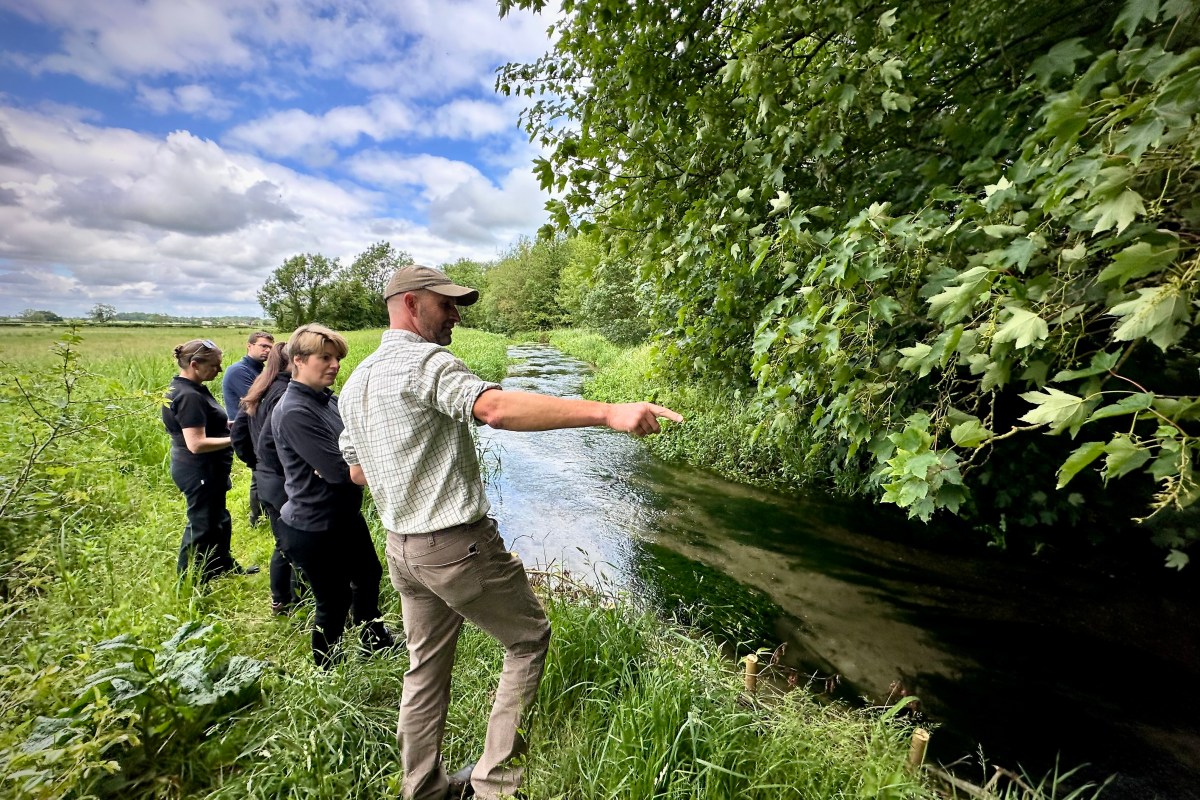
And maybe they have, to a degree. On Monday I met Minister Emma Hardy by a Yorkshire chalk stream. Many thanks to our guide Matt Arnold from the East Yorkshire Rivers Trust.

Though we were standing beside the Boston beck, perhaps one of the least pressured chalk streams in England, Minister Hardy was genuinely keen to know more about the multiple threats to chalk streams and what we should be doing to make things better.

We discussed the extreme levels of abstraction that exist on some chalk streams, especially those near London, and the suffocating nutrient pollution that comes from innumerable small sewage works where there is no phosphorous limit or where, if one exists, it is absurdly lax. We especially focussed on the lack of clarity in catchment level decision-making, something I feel the government could help with by unambiguously signalling the importance of chalk streams.

That signal should have taken the form of the Defra chalk stream recovery pack, of course, but I’m not holding my breath for a change of heart regarding its publication. Though you never know.

I will certainly continue to push, arguing why many of the measures in the pack were low-cost no-brainers: stuff that builds on existing policy with greater clarity and purpose, that would remove blockers in bureaucracy or give clear signals to water resource groups and water companies on where to prioritise abstraction reduction or target better water quality in vulnerable headwaters or that gives support to stakeholders.

My guess is that the treasury has put more or less everything on hold while it tries to prioritise growth through development.

This is worrying. Water efficiency through demand and leak reduction, for example – THE big plays in our national framework for water resources over the next two decades – means nothing for nature, unless accompanied by actual abstraction reduction. Of itself water efficiency simply makes headroom for development. And in the current climate this is almost certainly what it will be used to deliver.

Similarly, if the water industry is left to meet the previous government’s laudable nutrient reduction targets (as set out in the Environmental Improvement Plan) via “highest technical standards” at large works downstream of large population centres where highish standards exist already, then of course this will be the preferred “cost-effective” pathway for all parties.

All parties except fish and insects who might prefer those chemicals are removed upstream of where they live. The point is, you can create a great headline figure for phosphorus removal where it makes little ecological benefit, but why not direct the targets towards their purpose?

Without direction from government or its regulators on how to prioritise either abstraction or phosphorus reduction, economic efficiency of a decidedly anthropogenic kind will decide. River life will receive little benefit from initiatives intended to restore it.

Frustratingly, it’s all about economics – no matter who’s in charge – and so long as water is as cheap as it is, and so long as imaginative and economically-efficient ideas like Chalk Streams First or nutrient treatment wetlands or risk-based buffer strips (all measures a recovery pack might have given prominence to) are starved of oxygen, then nature will pick up the bill.

And thus the can is kicked down the road.

It doesn’t have to be this way. The chalk recovery pack would have been Defra’s first bespoke policy document for chalk streams. This government could yet dig it out, add some oomph to the stuff that got watered down, and defy my cynicism. No one would be happier to be proved wrong.

In the meanwhile, it was a pleasure to meet the Minister and I’m very much hoping we can meet again soon on one of the Flagship project sites, the Chess, for example where Kate Heppell is leading amazing citizen science research, or the Anton, where Simon Cain and Bob Wellard are concocting imaginative re-wilding schemes. And then perhaps the beleaguered Ivel which barely flows, or the Ver whose headwaters this winter have been constantly polluted with raw sewage.

Sophia’s petition to the government.

An open letter to everyone who cares about chalk streams:

Dear friends,

I’m writing to you to ask a favour. A few days ago I received an email out of the blue from a lady called Sophia Holloway. I don’t know Sophie but she tells me that she was so angered by the government’s decision (reported and commented on in The Times over Christmas – links below) to drop the Defra chalk recovery strategy work that she has started a petition. 

This is so heartening and is so very kind of her.

But the petition will go nowhere without support from everyone who cares. If there’s not enough support, I fear the government may double down on their timid and unpopular decision not to publish the now oven-ready chalk stream recovery pack and even their other chalk stream work.

We need people to hear about Sophia’s petition. So, please will you:

  • sign the petition
  • give the petition a plug, even repeated plugs, in your social media platforms and share in any other way you can.

Let’s see if we can do justice to Sophia’s anger and good faith?

https://petition.parliament.uk/petitions/711368

There’s an album of chalk stream images at the foot of this page: of beautiful chalk streams to show why we should look after them and of knackered streams to show what we need to protect them from. Anyone is welcome to grab and use them for social media posts (an attribution to chalk streams.org would be appreciated and may even spread the word)

•••

A bit of background in case it is needed …

A few years ago I was invited to chair and oversee the creation of a national strategy for protecting and restoring chalk streams. Countless passionate people and all the key players, the regulators, industry and eNGOs worked together to create a collaborative national restoration plan that will – if the actions are followed on – make a considerable difference to chalk stream protection and health.

It is a simple strategy for addressing – in practical and pragmatic ways – abstraction, water pollution and habitat restoration. Under the last government we even got to the point where the then Minister Rebecca Pow promised a Defra policy document in support called the Defra Chalk Stream Recovery Pack. I know what was in that document because I negotiated with Defra over its contents and wrote it for and with them.

But foot-dragging over certain key issues delayed publication and then, when the election came along, the plan was put on hold. Now the new government has shelved it, or in fact – apparently – abandoned it. See The Times pieces below:

https://www.thetimes.com/uk/environment/article/labour-shelves-rescue-plan-for-globally-rare-chalk-streams-58537f56k

https://www.thetimes.com/comment/the-times-view/article/the-times-view-saving-chalk-streams-6mzjrhk8x

This is no way to deliver environmental improvement. No matter one’s politics it is obvious that we will only resolve the issues that impact our rivers if the government of the day rises above party politics and builds continuity into our approach to protecting and restoring the environment.

I really hope you can support Sophia’s initiative. Thank you so much.

With very best wishes as ever,

Charles.

The counter-intuitive (and heretical) idea that could unlock abstraction reduction.

It took me a while to get my head around the concepts in this post, so bear with me. This is aimed especially at eNGOs and other campaigners for chalk streams, because the more people there are who understand this counter-intuitve idea, the better. 

Here it is: you can save many chalk streams from unsustainable abstraction by conceivably using the aquifer in times of low flows and drought.

That is a head-muddler. But this idea could unlock real abstraction reduction, making the bad much better in the foreseeable future. This is far, far preferable in my view than holding out for a perfection (natural aquifers) that will never come.

It starts with my best attempt at explaining what I understand of the complexities of the interactions between groundwater, river flow and groundwater abstraction. Given that I vainly spent a long night in a hut in Iceland trying to explain the very same ideas to two angling friends of mine (they were belligerently uncomprehending in a (successful) effort to annoy me), this will be no easy task.

It is complex … kind of. It’s also quite simple really. Rather as the moon affects the tides, a simple idea leads to a complex set of manifestations.

Idea 1. Chalk streams flow from underground.

If you’re reading this blog you’ll already know that chalk streams derive most of their flow from groundwater. Rain sinks into the ground filling fractures in the underlying chalk and then lower down the slope it seeps out again as springs to create a chalk stream.

Idea 2. The level of the groundwater drives the flow in the river.

This is pretty simple. I used the bucket analogy before. Drill a single hole in the base of a bucket. Fill the bucket with water. As the bucket fills gravity drives water at an increasing velocity out of the hole. Now stop filling and let it empty. The flow diminishes to a trickle. EVERYONE gets this because it’s the same when you pee!

The rate of flow from springs in a chalk valley is driven by the hydraulic head of the groundwater above the springs. The higher the level, the greater the flow
… In more or less the same way as the water level in the bucket determines the force at which the water is driven through holes in the side of the bucket.

Idea 3. Groundwater rises in winter and falls in summer.

If you pour water into the bucket faster than water can leave it through the hole(s), the level in the bucket rises. If you stop pouring water in, the level falls as the bucket drains. This is exactly the same with a chalk aquifer. In winter, when it rains a lot, and it’s cold and the ground is wet and nothing is growing, more rain flows into the aquifer than can leave it and so the groundwater level rises. In summer, much less rain – if any – reaches the aquifer and so the groundwater level falls.

Groundwater rising. This chalk valley is dry most of the time but in February 2021 when recharge vastly exceeded discharge, it had filled to overflowing.

Idea 4. The higher the groundwater rises up the valley, the more the water pours out of it.

As groundwater level rises, stream flow increases. But not in a linear way as it would with a single hole at the base of a columnar bucket. In fact for every unit of rise in groundwater level, flow will increase by approximately X2 to 2.5 . Kind of like having twice as many holes at each level in the bucket as the level below.

There are a number of reasons for this which were debated at a recent groundwater conference. There is a summary of these ideas in Section 2 of John Lawson’s report Flow Recovery Following Abstraction Reduction which we updated following the conference and contributions from the likes of Rob Soley and Alessandro Marsili.

In short, this non-linear response is probably caused by a combination of: 

• the shape of the valley – if you imagine the groundwater filling the valley bottom and hillsides, assuming a perfect V- shape valley, for every unit increase the groundwater rises the area of saturated zone exposing springs rises two-and-a-half fold. Chalk valleys are not quite V-shaped but that’s the general idea.

• the fracture density in the chalk – which increases in the valley bottoms and with altitude. At depth chalk is very solid, but in the valley bottoms and higher up the slope and where water has flowed for thousands of years, the fracture density is much greater and the flow pathways are bigger.

• layering within the chalk – chalk accreted in layers under varying climatic / geological conditions and these layers are in turn interrupted by bands of clay and flint. These layers and the varying permeability and transmissivity can influence the way groundwater reaches with the surface.

• as the surface flow pathways lengthen (winterbournes rising higher and higher up the valley) the groundwater pathways shorten.

The fracture density and layering in the chalk, the shape of the valley and the length of flow pathways, all conspire to mean that when chalk valleys fill, flows will rise exponentially.

Idea 5. The impact of a constant groundwater abstraction has a varying impact on varying flows through the year

This is where things gets a bit more discombobulating. All of the above essentially means that as groundwater rises, flows increase exponentially. If that is true, then the reverse is true. For every unit of decrease in groundwater level, flows decrease exponentially.

This means …. drum roll … groundwater abstraction (which lowers groundwater levels) has a greater impact on high flows than low flows! This is a totally skull-tightening idea. Everyone thinks the reverse must be true. But it isn’t.

Groundwater levels and groundwater abstraction

Let’s start with the impact of groundwater abstraction on groundwater levels. In a natural aquifer system, the discharge from the valley must equal the recharge over time. Natural recharge = natural discharge / Time. This stands to reason: if it didn’t the valley would either fill to overflowing or empty (because over time one would exceed the other). 

Natural recharge derives from rain and natural discharge from river flow (and some evapotranspiration and flow through the ground). If I add another form of discharge in the form of abstraction, then the former natural discharge MUST go down. If it didn’t, the aquifer would progressively empty until there was no water left (an aside … hydrogeological literature generally describes anything less than draining the aquifer “sustainable”, because the aquifer is being lowered to a new dynamic balance, not mined. This is not the same as ecologically sustainable, however).

Look at it as simple numbers.

Natural recharge (10) = natural discharge (10) / Time.

Natural recharge (10) = abstraction (5) + natural discharge ? / Time.

What’s the new natural discharge? 5, obviously.

Now, as I showed with the bucket, the ONLY way in which the former natural discharge can go down is through a reduction in groundwater levels. If groundwater levels didn’t go down, then because the discharge is driven by the groundwater level the natural discharge would remain the same. As shown above, that is impossible.

Theis, the Isaac Newton of groundwater theory, wrote all this in 1940. The only way that the former natural discharge can go down (and balance the equation) he wrote, is by a reduction in the “thickness of the aquifer”. 

Okay, so pause and get your head round all that. 

• a single unit of rise or fall in groundwater level has a (very roughly) two-and-a-half fold impact on flows. 

• groundwater abstraction lowers groundwater levels.

ipso facto a single unit of reduction in groundwater level at high groundwater levels has a much greater impact on flows than a single unit of reduction in groundwater level at low groundwater levels.

It still hurts the head, but the discombobulating stuff above means that at high groundwater levels groundwater abstraction reduces flows by quite a lot more than 100% of the amount abstracted. And conversely, at low groundwater levels groundwater abstraction reduces flows by quite a lot less than 100% of the amount abstracted. Albeit over time groundwater abstraction must reduce flows by (essentially) 100% of the amount abstracted (it’s generally less than that for reasons that aren’t that important to the general concept, but basically because not all discharge occurs in the form of flow).

See the chart below to see what the Chalk Streams First modelling indicates % flow recovery would be if abstraction was reduced to zero in the River Ver. It varies through the flow cycle.

The above chart from Page 52 of John Lawson’s report shows that the % flow recovery (green line) at high flows (l/h end of X axis) is well over 100% and at very low flows (r/h end of X axis) is about 30% – 20%.

Idea 6. Groundwater abstraction at low flows is like a credit card.

The obvious question is … if groundwater abstraction at low flows reduces those flows by a lot less than 100% of the amount being abstracted, where the bloody hell is the rest of the water coming from? The answer: if it’s not a direct reduction from flows at the time, it is coming from aquifer storage.

This is easy to understand if you think of a large abstraction next to a small and diminishing stream. In the winter when the stream is gushing, there is more than enough water to satisfy the pumping. In the summer the stream reduces to a trickle or perhaps even dries up. But the pumping continues. At this point the abstraction is clearly not taking water from stream flow because there isn’t any. Another aside … I’ve read hydrogeologists describe this state as abstraction having “no further effect on flows”. This might be literally correct at the time. But it is misleading. The abstraction is effecting future flows. 

When a chalk stream dries but abstraction continues it is clear that the abstraction is no longer subtracting water from the river’s flow, but from aquifer storage: this is basically a debt to future flows.

At times of low flow and into droughts, groundwater abstraction increasingly draws on storage, upon which future flows are built. If you unnaturally drain the aquifer, it will clearly take longer to fill when it starts raining again, all before the flows in the river can respond to the rise in groundwater levels.

Therefore groundwater abstraction at low flows is like a credit card: much more a debt against future flows than an impact on present flows. This is a key idea behind the confusing concept of using groundwater abstraction to unlock abstraction reduction .

Idea 7. If you turn off the pumps you get greater flow recovery at high flows than low flows.

Essentially what all this means is that when you cease or lower abstraction you get well over 100% of the amount no longer abstracted at high flows and much less than 100% at low flows. That is what the chart above shows on the River Ver.

And this is the Achilles Heel of the Chalk Streams First idea. 

Water resources needs a constant supply of water. Groundwater abstraction gives that. Chalk Streams First says “turn off (or down) the pumps and take the water from river flows much lower down the catchment”. And while you get loads of water back in winter, you get less back in summer. Generally, you must have a storage reservoir to make it work and balance out the varying recovery rates into a constant and reliable supply. 

John Lawson – who came up with the Chalk Streams First idea – has long known this. We argue (with empirical evidence) that the flow recovery at low flows is actually much higher than the most pessimistic predictions claim, but nevertheless this variation in response is an issue we have to address. The answer is a reservoir.

BUT … then you get to the prolonged droughts when water companies are under real pressure. In these times, the flow recovery could conceivably drop even lower. What to do? The public must have water. This low flow recovery at very low flows in long droughts threatens the whole idea of reducing abstraction through schemes like Chalk Streams First. Especially now that we have to plan according to 1:500 year contingencies.

Idea 7. In droughts use groundwater abstraction to guarantee public water supply … so long as you’ve turned the abstraction right down to ecologically sustainable levels 95% of the time.

The insurance against the Achilles Heel of low flow recovery in a drought is a groundwater-fed public water supply scheme. There is one in existence already called the West Berkshire Groundwater Scheme (WBGWS). It is a series of wells in the Berkshire chalk that can, in extremis, be turned on and deliver a large amount of aquifer water into the Berkshire chalk streams, from where it flows to the Thames to be captured into the London reservoirs. The scheme is used very, very rarely: no more than once every 25 years. But it’s there. And it guarantees water in a drought.

The West Berkshire Groundwater Scheme wellfield: this scheme is rarely used but guarantees water in extreme droughts. It is a counter-intuitive idea that could unlock abstraction reduction in the Colne, Lea and Ouse chalk streams.

The impacts on the chalk streams are a) one of flow relief in the drought, because the flows get boosted. Albeit – and I have to emphasise this – flow augmentation in not the aim of the scheme, it is a bi-product. And b) at the end of the drought, when the pumps are turned off, the aquifer must recover before flows return to natural levels, so you get lower flows the following year.

But this is crucial: in modelled scenarios, the flows in the year of recovery are still better than they would be if abstraction ran all the time as happens at the moment in streams like the Ver, Misbourne and Beane.

So WBGWS type schemes could unlock Chalk Streams First type abstraction reduction in other settings, such as on the chalk streams of the Colne, Lea and Ouse (even the Darent). As such a scheme would insure against the public supply deficit in droughts created by replacing upper catchment groundwater abstraction with lower catchment surface water abstraction (the Chalk Streams First concept).

BUT …the Environment Agency is very cautious of such schemes

This is understandable because there have been some bad schemes in the past. But flow augmentation to compensate for the collateral damage of abstraction is a different thing altogether. 

Some schemes were developed in the past whereby to compensate for abstraction (which had dried the stream) water was pumped from the aquifer into a losing reach of stream and the whole thing was a highway to nowhere.

Other times the concept of augmentation is used to justify continuing, unsustainable abstraction. These schemes have given the whole idea of flow augmentation a bad rap, and one that has stuck like glue.

RevIvel claim that a flow augmentation scheme putting 0.5 ml/d into a dry river bed is not a good type of augmentation scheme, especially if it delays a proper solution to the unsustainable abstraction. This is the kind of scheme is very different from the idea promoted in this blog post.

BUT, I would argue that we need to be more pragmatic and open minded than a presumption against these schemes if we are to achieve the heretofore irreconcilable goals of reliable public water supply and restored chalk streams. Aquifers in the south east are managed one way or another. We need to make sure they are managed mindfully to achieve the specific outcomes we want and in this regard holding out for “natural” when a more flexible approach would unstick hopeful schemes such as Chalk Streams First would surely be counter-productive?

I understand the Environment Agency may be consulting on this topic later in the year. I know from many discussions I have had with chalk stream advocates that the ideas I have outlined above will be surprising and counter-intuitive to most of us, as indeed they are to me.

But it is vital we give the EA the encouragement to take a flexible, if ultra cautious approach, because the gains of doing so could be massive.

Dark waters

Guest blog by Rev. Paul Cawthorne.

Paul – a vicar and environmentalist – read my blog about Defra’s shelving of the chalk stream recovery pack and wrote to tell me of his own frustrations with officialdom. I offered him a guest blog. His story is fascinating and concerning. CRW.

I’ve been leading a team researching the persistent industrial chemical pollution of U.K. watercourses for the last five years. Our research was the basis of the recent ten part Radio 4 series Buried: The Last Witness.  

Now that the ongoing neurotoxic PCB problem in U.K. watercourses and wildlife is garnering attention again (what a UN Environment Programme factsheet called a conveniently “forgotten legacy”) I’d like to explain how this ongoing watercourse pollution has been allowed by government to happen. 

The identification of contaminated land under Environmental Protection Act 1990 Part 2A has been radically undermined by its own statutory guidance. The Act itself is admirable. That makes it all the more surprising that two of its key clauses were rescinded in 1995 during Lord Deben’s tenure as Environment Secretary, after a sustained industry lobbying operation during Lord Howard’s tenure. How that was done was chronicled in the Journal of Environmental Law at the time by the chair of the Environment Select Committee, Sir Hugh Rossi:

Implementation of the Act was delayed for ten years from 1990 until 2000 and the statutory guidance was written strangely in several aspects.

1. Most obviously and damagingly divergent from the original Act, it excludes as receptors (SG 3.8b) of pollution all watercourse lengths that do not come within a highly restrictive designation:

See Environmental Protection Act 1990

This means the majority of river lengths in the UK which do not come within this tight Table 1 definition may be polluted by industrial neurotoxic chemical leachate to an infinite extent: they are excluded from recognition within the Act as a receptor of that pollution.

Thus over half of the U.K. rivers by length and most of the downstream lengths of most of our major rivers are excluded from the primary legislative protection of the environment from chemical pollution.

2. The guidance states that Councils should “give priority to particular areas of land that it considers most likely to pose the greatest risk to human health or the environment”.  

Sadly, especially in Wales, that last word “environment” gets systematically deprioritised in the detail of the guidance and its implementation. The preamble to the guidance sets a subtly chilling tone.  Multiple councils in England and Wales, after reading the guidance, instruct their favoured consultants in such a way that only human risk gets reported on, fully in contrast to the Act’s comprehension of human AND environmental harm potential.

For example

For example PCB continued to trickle into the Foxhill brook towards the Mersey from Alvanley Commonside unlined PCB dump for decades without remediation.

A consultancy report written by Helsby-headquartered RSK for the local Council was used tacitly to determine that a leaching neurotoxic chemical waste dump is not contaminated land within EPA Part 2A. There is no written record in 2009 that Cheshire West Council or its predecessor even made a determination decision after the helpful consultancy report was received. This 2024 Cheshire West and Chester Borough Council.Council PR summary retrospectively summarises: 

“In 2009, we concluded that, based on the assessments undertaken, the tip did not meet the definition of Contaminated Land and investigations were drawn to a close”

It’s seems to me a national scandal kept in place by a surprisingly wide-ranging official code of silence. A housing estate is currently being built over a PCB-contaminated factory site with extremely high readings at nearby Helsby, without purchasers even being made aware.

A variety of Councils use strategies to keep the false negatives in place.

3. Wrexham council claimed that it has an infinite timescale to even reach a decision, ie to comply with the law (see SG 2.9);

4. Newport said that it’s “not a priority” to decide whether the site of the largest PCB factory in Europe (which has continued to pump a particularly toxic chemical cocktail down a 3km pipe straight into the lower Severn estuary with NRW blessing) comes within the Act’s definition of contaminated land.

5. NRW has had Caerphilly council area data on file since 1994 showing that wildlife in the river Sirhowy is contaminated with elevated PCB levels. Yet bizarrely it didn’t even share that data with Caerphilly council until my team resurfaced the data via an FoI and intervened. As toxicdocs.org discloses, it seems as if a payment was made by Monsanto to the predecessor Council. We can’t know for sure because many details of NRW’s formal agreement with Monsanto are hidden under lengthy redactions.

NRW still claim there’s no wildlife or sediment PCB for the entire river Usk including where it runs past the site of the biggest PCB factory in Europe – do you believe that absence of data? O is it FOFO – fear of finding out? 

6. Another way the statutory guidance undermines the Act is in defining what environmental damage qualifies as damage. Unless the pollutant is increasing the contamination doesn’t officially exist (SG 4.38b “sustained upward trend”). So a plateaued high chemical leachate flow would not qualify within the wording of this statutory guidance section, however damaging to invertebrates or fish the leachate may be. Thankfully Councils seem so embarrassed by this drafting error which misrepresents the Act wording that they tend simply not to follow it. It’s no wonder the Law Commission concludes in report:

“The first issue is at the very least a policy reform issue, which may involve elements of law reform (including a role for the Law Commission).”

– Henni Ouahes, Head of Public Law, 12/4/24

7. Additionally, the main EA method for testing for the mainly insoluble heavy congeners of indicator neurotoxin PCB is midwater, not testing in the sediment where PCB adsorbs into the vegetative silt. Dangling a test tube off Cefn Mawr bridge every week won’t tell whether the PCB used at the factory there (Monsanto’s European PCB research headquarters) has leached underground and into the river Dee:

The Environment Agency systemically using suboptimal testing protocols which potentially miss the main flow of a particular neurotoxin is surprising, especially given the reproduction disruption characteristic of PCB as it biomagnifies, known to EA chief scientist Gideon Henderson. I’ve emailed Gideon and EA Senior Chemicals Adviser Richard Hawkins about it several times without acknowledgment.

https://www.thenorthernecho.co.uk/news/23253376.monsanto-pcb-chemical-spill-1970s-cleaned-teesside/

Using a type of testing which intrinsically misses the main benthic zone presence of this immunosuppressant contaminant greatly helps underestimate the scale of the UK national contamination problem. Regulatory toleration of UK POP pollution is perplexing. It’s all so different in America

Here the EA, NRW, MMO and Cefas all appear to tolerate the pollution. My team may soon be testing whether this is legal, supported by a kind new philanthropist. But I’d prefer it if our legislators faced into the problem and sorted it themselves. Why have politicians issued this ongoing distorted mandatory ‘guidance’ – a passport to ongoing river pollution? Will our Lords Deben, Howard, Young and Mills and senior civil servants dare to now fess up for the public good and move to helping civil society to solve the problem they’ve allowed? 

The EA now claim in a new information release refusal this month not to have the key American court action document, Appendix B listing sites where the main polluter should be held liable, despite Baroness Young having written to assure The Ecologist magazine in 2007 that the EA had an official plan.

This whole narrative – especially the failings in the statutory guidance – has significant practical impacts for the ecological health of us, and for the wildlife of iconic rivers like the Severn, Dee, Tees, Thames, Mersey, Usk, Taf, Ely, Sirhowy. 

Prioritising abstraction reduction: we need common sense more than we need evidence.

It’s brilliant that the Environment Agency has, through the national framework, identified the flow deficits that exist on our chalk streams. 

It’s great that Environment Agency has signalled to the national framework groups that chalk streams should become a priority in terms of addressing those deficits.

Thus far, however, the Environment Agency has inclined to stand back – at least publicly – from guiding the decision-making that will be needed to apportion those abstraction reductions strategically and cost-effectively over time. This is being left to regional groups and partnerships, but it is not yet clear how these decisions will actually be made or if they will be consistent and logical.

Our CaBA chalk stream strategy called for the collaborative development of a prioritisation process and while everyone agrees the need, it still hasn’t quite happened.

In all of the meetings I have ever attended in which abstraction reduction is discussed the idea is aired that we will need evidence to justify and ensure wise decision-making, including evidence that ecological gains will follow mooted abstraction reductions.

On the face of it, the call for evidence seems only prudent and sensible – after all public money is at stake. 

But the idea that such evidence could ever exist is a chimera.

Clear cause-and-effect evidence according to a robust, before / after / control / impact method of proof, is – I argue – impossible to acquire. And it is so, precisely because of the infinitely complex web of cause and effect that is leant upon to justify the call for evidence.

Water companies will argue, and rightly, that reducing abstraction is expensive and, therefore, that there’s no point doing it if no benefit follows. Or if the potential benefit is neutered by some other factor such as a heavily modified river channel, or pollution from farms.  In certain settings we run a real danger of spending millions reducing abstraction, when other factors – like the fact that the river is navigable and impounded by locks and weirs – are as big or even a bigger brake on the ecological health of the system from which there is no possible relief. 

There are also settings where the cost of reducing (some of) the abstraction could be more cost-effectively spent (in terms of ecological gain per buck) improving the physical habitat. We have transformed canal-like channels in Norfolk into vibrant, wild and free-flowing streams for modest amounts of money, all things considered. £200,000 per km is dwarfed by the £4 million cost of replacing 1Ml/d of water. For that you could rebuild 20 km of knackered chalk stream.

I’m all for the intelligent and undogmatic trade-offs and counter-intuitive thinking that will be needed if we really are to balance the needs of society and nature.

But the call for evidence is self-deluding at best and a delaying tactic at worst.

Why? 

In the insanely busy and pressured landscapes we are talking about it is virtually impossible to strip out the variables: the physical condition of the channel; the micro and macro stressors of water quality which are highly complex and some of which we barely understand; shifts in the global agricultural markets which might generate or ease an agricultural pressure beyond one’s control or easy quantification; road run-off which might be terrible in a year when a local farmer is rearing pigs, or not too bad when the farmer gets rid of the pigs or in a mild, dry winter; the weather; the climate; the impact of invasive species like signal crayfish, or predation from cormorants when a cold winter forces them off the reservoirs: etc. etc. etc.

I defy anyone to design an experiment into the teeth of those variables, that could possibly isolate the beneficial or non-beneficial impacts over time of one single action. 

The only way you could construct such an experiment would be to select a stream where abstraction is pretty much the only pressure and a significant one, gather baseline data for at least five years, ideally a decade and then COMPLETELY TURN OFF THE ABSTRACTION in that stream and all nearby streams (because you need the signal to be significant to rise above the variables you can’t eliminate no matter how hard you try) and study for another five to ten years. The study periods would have to either equally include or exclude periods of drought and very wet years too. 

When helping to write Defra’s now scandalously abandoned chalk stream recovery pack, I was looking for exemplar case studies of where abstraction reduction had made a significant and demonstrable beneficial impact to ecology. I struggled to find a slam-dunk example, mostly because the reductions that have been made – though significant – have been made from very high totals and are actually quite small against the volumes still abstracted. For example, on the River Ver, while abstraction once exceeded 50% of recharge, it is still 30% of recharge.

This reach of the River Piddle used to dry regularly in the late 1980s early 1990s.

I cited the River Piddle in the end, even though the changes made there since the dark days of the late 20thC when the river dried up regularly, include flow augmentation as much as abstraction reduction. The Piddle, however, is indeed much better now than in 1989 – 93. I know because I’m lucky enough to co-own the bit that used to dry up and it is now an exemplar of chalk stream health. It is an example.

But even so, water companies and others will often say abstraction reductions made thus far haven’t yielded the hoped-for results. Either in terms of flow or clear ecological gains.

In terms of flows, this is not true. John Lawson’s analysis of the flow-recovery following abstraction reductions shows unarguably that flows do recover in proportion to abstraction reduction. But when the abstraction is really high and you only reduce it a bit … hmmm.

John’s report also shows that the reductions made, though significant and expensive in water resource terms, have been far too small relative to the size of the overall catchment abstraction and far too small to rise above the “noise” made by all the other variables (and many of these variables haven’t been attended to properly, either. We still have a lot to learn about high-quality and cost-effective process-based habitat restoration).

In the only really good long-term BACI type flow scenario that exists, flows on the River Ver reduced and then recovered exactly in sync with the abstraction increase and then reduction. Of course they did: where else would the water have gone to?

So, if slam-dunk cause and effect evidence that reducing abstraction Y will lead to X ecological recovery doesn’t exist and can’t be found, how do we approach the problem? 

Without knocking the idea that data and evidence are useful tools to guide our decision-making, we should not abdicate our own common sense. In the same way that we don’t need science to tell us that it’s warmer in summer (though we need science it to tell us why) we don’t need science to tell us that abstraction adversely impacts the ecology of a river (though we do need it to tell us why).

Many fine minds have spent a lot of time discussing and agreeing that sustainable abstraction in chalk streams should generally cause less than a 10% reduction in natural low flows, (which also, give or take, amounts to 10% or less of the average aquifer recharge). That is why we have the Environment Agency’s Environmental Flow Indicator, which is based on the UK Technical Advisory Groups deliberations on exactly this flow / ecology balancing act.

What we need beyond this work (that has already been done!) is not so much more impossible-to-find evidence but rather a screening process that aids and brings logic, common sense and consistency to the thorny issue of how to spend public money most cost-effectively in our collective goal of achieving sustainable abstraction on chalk streams. 

To give a really obvious example: we need a screening process that stops us spending billions of pounds reducing abstraction in a river that is navigable and therefore doesn’t really have a flow-dependent ecology, but compels us to crack on with spending millions of pounds reducing abstraction in iconic chalk streams which can also be physically restored for 200k per km!

That really shouldn’t be too difficult.

I have made a start below … comments welcome.