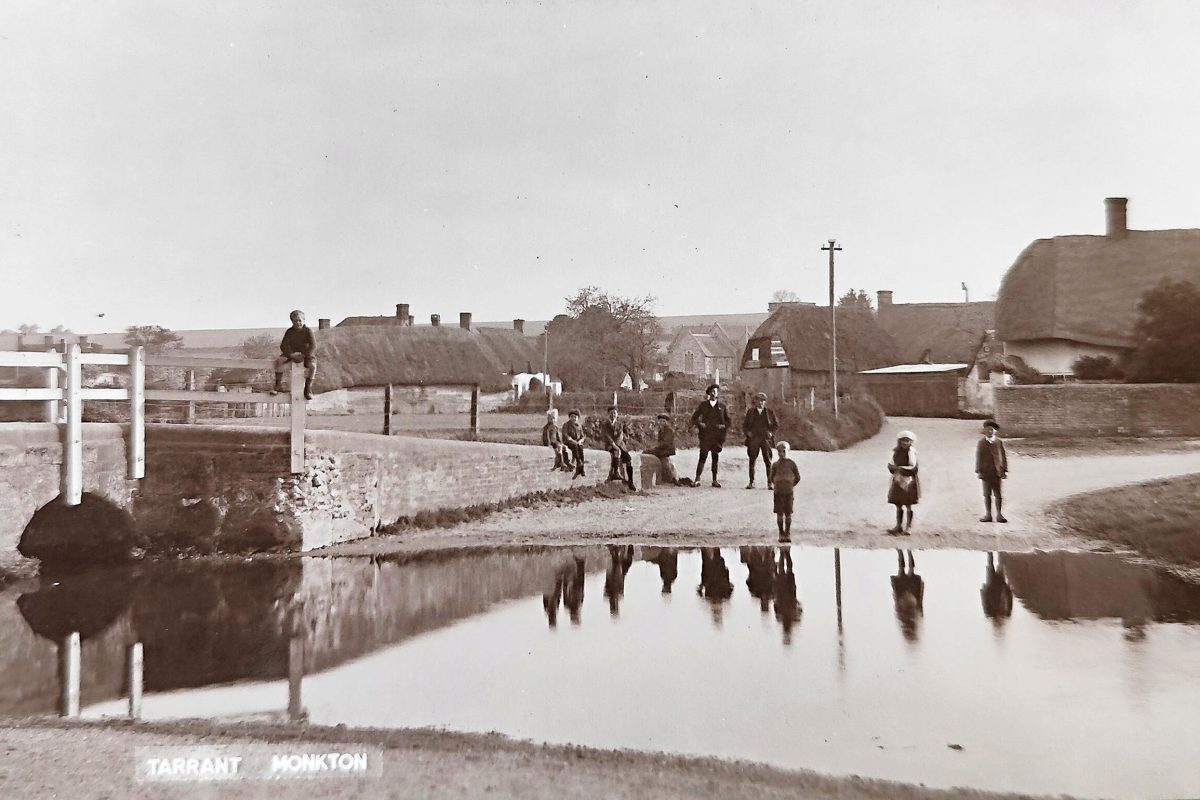
With uncanny timing (following my post Tuesday last week), on Friday the Environment Agency forwarded to the River Tarrant Protection Society the adjudicatory report of their independent expert. (I’ve posted a copy at the foot of the page but have redacted a few personal details)
I received a lot of interested feedback from last week’s post. My intention had partly been to help inform other groups facing similar struggles in other parts of the Chalk, so I was very pleased that I seemed to have done that and to have catalysed a conversation about the uneven, David versus Goliath contests we face.
I’m uneasy about the EA’s approach to this case. Why take so long to respond? Why be so apparently reluctant to engage with the proactive, positive suggestions in the River Tarrant Protection Society (RTPS) report? Why not agree to a meeting? Why set out with an adjudicatory contest between models – which is almost bound to find in favour of the status quo – instead of addressing the full package of evidence?
A quick bit of background.
Please read my previous post for the fuller picture, but in short:
- The River Tarrant is a chalk stream in Dorset where locals have long been concerned (50+ years) about the impact of abstraction.
- It is a breeding stream for critically endangered Atlantic salmon.
- The lower stream is drying far more frequently now than it did in the past. We don’t know for certain the flow patterns before the era of abstraction but there are no records of lower river drying before the 1950s (by contrast, there are records of natural upper river drying, for example in 1929) and there are five Domesday mill sites on the middle and lower river, which suggests the stream was reliably perennial.
- As abstraction has increased from the 1970s to today the drying frequency has climbed from about once per decade (1976, 1989, 1995) to every year (2015, 2016, 2018, 2019, 2020, 2021, 2022, 2023, 2024, 2025).
- In 2018 Wessex Water was obligated to lower public water abstraction in the Bourne and Wylye catchments. To achieve this they constructed a grid to move water north from “under-utilised sources” in the Stour valley.
- As part of this process the Environment Agency asked Wessex Water to produce an environmental impacts report into any possible impacts on the chalk streams of the Middle Stour, specifically the River Tarrant, the Pimperne Brook and the North Winterbourne.
- The review concluded that:
- only a single, small and long-running pump impacted flows in the Tarrant and by only a negligible amount.
- a single, much larger pump had no impact on flows in the Pimperne winterbourne (nor the neighbouring Tarrant)
- impacts on the North Winterbourne were negligible.
- The grid went ahead, since when the Tarrant has dried every year.
- In 2024 the River Tarrant Protection Society sent an independent report authored by John Lawson to the Environment Agency which questioned the Wessex Water assertion that the abstractions were having no impact on either the Tarrant or Pimperne. The report used the results of relatively simple “lumped parameter” modelling to show that there may indeed be an impact, and added a considerable weight of historical and recent empirical evidence to back up its claims
- In the face of this uncertainty the RTPS has asked for more detailed investigations and has also proposed a scheme of abstraction realignment that would alleviate the drying in the Tarrant.
The Environment Agency has taken a long time to respond and thus far the terms of reference for their investigation have been very limited.
Independent review
Jane Dottridge, an expert hydrogeologist with Mott McDonald, was asked to compare the two modelling approaches: Wessex Water’s modelling (developed with the EA) compared with John Lawson’s modelling. To quote Christopher Greenwell, the EA Water Resources Lead, “I wanted to focus on the two modelling approaches first, since this formed one of the most fundamental challenges within the RTPS report … What Jane has done is not simply to consider John Lawson’s alternative approach but also to reassess the approach undertaken by Wessex Water during their investigation of the impacts of the Middle Stour sources.”
The RTPS was not consulted on the scope, terms of reference or the choice of reviewer.
Jane Dottridge previously reviewed the Wessex Water Middle Stour report in 2018. She has stated in her letter / report that she draws on her prior work as external reviewer to the Wessex Basin Model and her knowledge of that model.
More than that, Jane has encountered John’s work before, in another context. In preparation for a meeting convened by Affinity Water about the River Ivel in 2022, Jane was recommended to me as someone who might take an independent, helpfully critical view of John’s work and modelling approach. She sent some very useful notes of quite a technical nature. Arguably, her in-a-nutshell verdict was summed up in her statement: “My problem with this model is that it is very 1-d and doesn’t report any water balances. But it is a neat little model and much more satisfactory than some of the others I’ve seen recently.”
This we thought fair enough. John’s modelling wasn’t intended to rival, let alone replace the more complex 3-D modelling used by water companies and the Environment Agency. Instead it is proposed as a solid sense check, especially when the claims of water companies seem questionable, a tool for grass-roots organisations that can be used to usefully question unjustified certainties around these oft repeated claims of “no impact”.
In the meeting itself Jane was more critical of John’s modelling than she had been in our correspondence, describing it as a circular argument with a fitted-up recession to make calibration look right and “pop out some numbers”. It took Rob Soley to propose that the lumped parameter model had its value as a “first pass” to identify potential issues. Another hydrogeologist who we had spoken with before the meeting – Andy Binley – also defended John’s model for what it is, a simple, numerical model calibrated to predict flows, not all the other complexities of an aquifer system. Jane suggested the idea of a tiered approach to modelling – begin with simpler lumped parameter models, progressing to more complex physics-based models if simpler models don’t provide enough certainty.
Finally she added – and I have related this discussion not only because the roles of different complexities of modelling were not judged as mutually exclusive by Jane, Rob or Andy, but also because of Jane’s final point: she said that “models should be backed up by data and monitoring“.
So, why limit the scope of the review?
Christopher Greenwell stated that he wanted to focus on a review of the modelling approaches since “this formed one of the most fundamental challenges in the RTPS report”. RTPS weren’t given an opportunity to influence this decision, or to argue that John’s modelling outputs were part of a rounded package of evidence that included historic testimony, news reports and empirical observations.
We can see in Jane’s letter that the scope of the review did indeed focus solely on hydrogeology and groundwater modelling and that it excluded ecological, historical and qualitative evidence. This has the effect of narrowing the debate to something more like “which model is better” instead of addressing the more appropriate question: “what does the the sum of the various strands of evidence say about possible or probable abstraction impacts?”
Clearly, hydrogeology is an inexact science, is inherently uncertain. Groundwater systems — especially chalk — are structurally very complex and models of them are really only crude approximations of the living entity, no matter how much refinement is built in. They are dependent on assumptions and do not constitute primary evidence. Good scientific practice, therefore, should integrate the modelling with the other evidence. Which is exactly what the RTPS report did.
The EA’s approach – at least thus far – is a sort of backwards hydrogeology. It excludes archaeology, geomorphology, ecology, historical records, empirical evidence, testimony and conflates modelled output with evidence in the real world.
Besides, the RTPS model was never intended to win a modelling contest. It was intended to demonstrate that an alternative conceptual model can reproduce the observed behaviour of the stream and suggest that therefore the Wessex Water conclusions may be unsafe.
WFD rules
It is also worth pointing out that WFD assessment rules specifically state that decisions should be made on the weight of evidence, not a single line of analysis. If there is credible uncertainty, plausible mechanisms of impact and observational evidence consistent with impact – all very clearly set out in the RTPS report – then a regulator cannot safely conclude “no impact”.
The legitimate role of historical and qualitative evidence
The RTPS report uses various strands of evidence to try and establish:
- the baseline condition of the stream
- changes in the flow regime over time
- the timing of the changes relative to the advent and then increases in abstraction.
For example:
- The lower river dried rarely, if at all, before 1950 when abstraction began.
- Between 1970 and 2000 the lower river dried about once per decade.
- In the last decade, when abstraction has increased yet further, it has dried almost every year.
- The exception of 2017 coincided with a long-term shutdown of Black Lane pumping station
This is very solid evidential reasoning, layering historical, hydrological, circumstantial and mechanistic evidence. The RTPS report advances a very legitimate scientific hypothesis, of which the modelling is just one part.
Thus far the Environment Agency’s approach:
Places too much reliance on model supremacy. The review as framed thus far implies that a model provides a more reliable basis for conclusions than any other strand of evidence. Models are inherently uncertain.
Fails to apply “weight of evidence”. The EA review evaluates the models but does not integrate them with the unarguable flow-regime changes, the ecological evidence, the historical evidence, the observed anomalies (2017).
Narrows the focus to short-term datasets. Historical evidence, for example Domesday mills and the presence of Atlantic salmon, provide a legitimate long-term context and capture a picture of the system behaviour before any monitoring record. This is really valuable information and should not be ignored. If you exclude these you bias analysis to short-term datasets that are all influenced by abstraction.
Misunderstands the RTPS objective. The RTPS model is criticised for its simplification of aquifer properties and structure and lack of conceptual detail. However, the RTPS model was not intended to outscore the Wessex Basin mode, rather to challenge and question its unjustified certainties.
Excludes the RTPS from dialogue. The RTPS sent their report 7-months ago and requested a meeting. Thus far the only meaningful engagement has been the receipt of this report.
By turning this into a modelling contest the EA – thus far – appears to have stacked the deck in favour of the status quo. The EA’s approach is at odds with the more inclusive way forward agreed in during the framing of the multi-lateral CaBA chalk streams restoration strategy. Recommendation 11 in the strategy advocated the importance of knowledge and model sharing and said it was important to “include stakeholders in the discussion and decision-making”.
**
In my next post I will take a look at the Wessex Basin Report, the RTPS report and Jane Dottridge’s adjudication and try to show why – even under the terms of the comparison – the RTPS case is strong and should not be dismissed.

