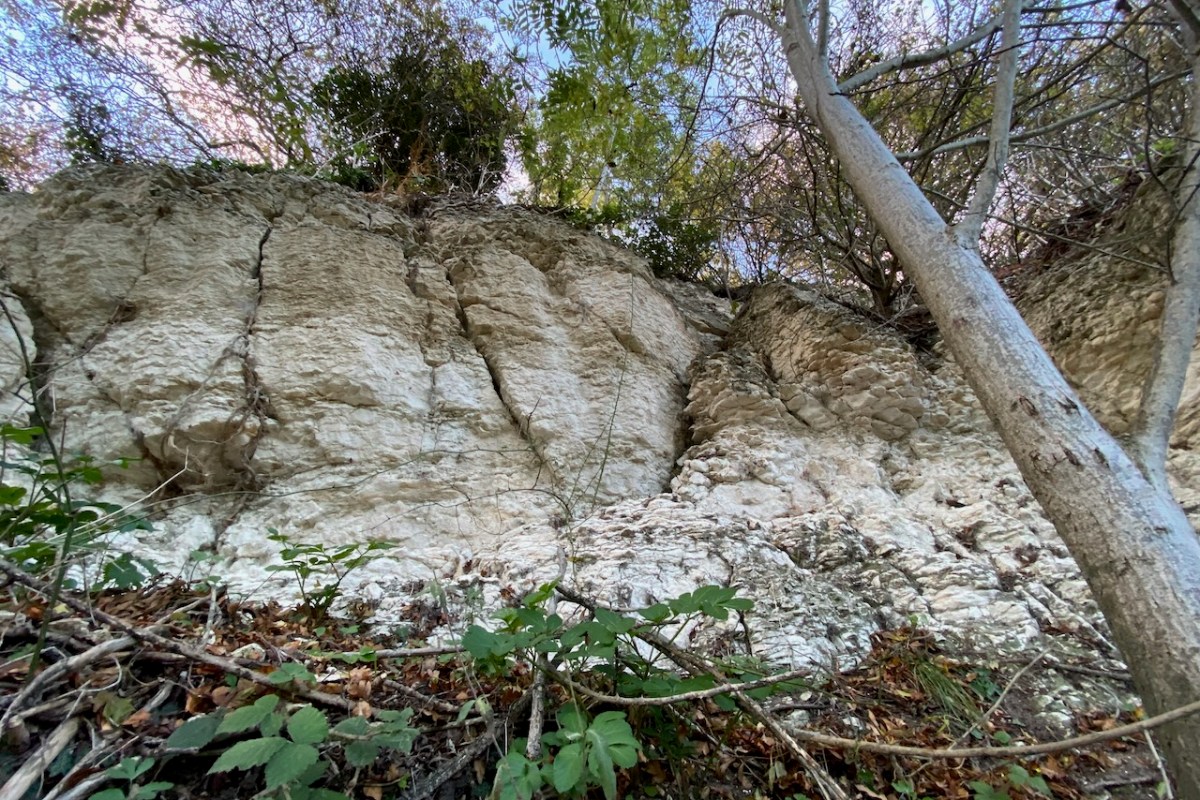
As this photo of an exposed chalk face shows, chalk aquifers are pretty darn complex. But that doesn’t mean simple models can’t tell us useful things about their fundamental behaviour or that sophisticated models are, per se, more accurate.
In my last post I questioned why the Environment Agency confined its review of the River Tarrant Protection Society (RTPS) report to a comparison between two modelling approaches.
I argued that the Chalk Streams First (CSF) model—a simple, lumped parameter model—was never intended to replace the more complex 3-D model used by Wessex Water, but rather to highlight uncertainty. Several hydrogeologists, including the independent reviewer, have previously suggested that such approaches can be used in a complementary, tiered way, with monitoring data providing essential context.
In that light, it makes little sense to treat this as a modelling contest in which the limitations of one approach invalidate its findings. Model outputs should be interpreted alongside other lines of evidence.
The independent review compared:
- the Wessex Water Middle Stour report (the official position), and
- the RTPS report on low flows and drying
with a focus on hydrogeological data and modelling.
In this post I consider that comparison in the light of Jane Dottridge’s review (attached to my previous post), focusing specifically on the conceptual and methodological validity of the CSF model.
Assessment versus indicator
Jane was asked to comment on the validity of the RTPS findings on abstraction impacts, and to consider the Wessex report by comparison. She concluded that the CSF model does not “provide a more reliable assessment of abstraction impacts than the Wessex model”.
However, the RTPS report did not claim to provide a more reliable assessment, but rather a more reliable indicator. That distinction matters. An assessment implies a definitive evaluation; an indicator signals a relationship or pattern without claiming certainty.
The CSF model was presented as part of a broader evidential framework. Its outputs, taken together with other observations, were used to question the certainty of Wessex Water’s conclusions. Judging it as if it were intended to deliver a standalone assessment risks setting up a straw-man comparison.
The conceptual model
Jane states that the CSF model is highly simplified and suggests first of all that it has no conceptual basis, then later that it lacks a sound conceptual basis. There is some ambiguity here: whether no conceptual model exists, or whether the one used is considered inadequate.
In practice, the CSF model is based on a clearly defined—if simple—conceptual model. It assumes:
- a fixed groundwater catchment based on topography
- uniform transmissivity
- a broadly synchronous rise and fall in groundwater levels
- a distributed pattern of spring discharge across the valley
These are simplifications of a complex system. In reality, groundwater catchments shift, transmissivity varies, and flow processes are spatially heterogeneous. But the question is not whether the model captures every detail—it does not—but whether it is appropriate for its intended purpose.
There is ample precedent in groundwater science for simplified conceptual models, particularly where the aim is to identify dominant controls or test the plausibility of observed relationships.
Model complexity should be proportionate to the question being asked.
Empirical relationship between groundwater and flow
The CSF approach is grounded in an empirical observation: that groundwater level and streamflow are closely correlated in chalk streams.
John Lawson has shown – using historical data – that, within relatively tight bounds, when groundwater levels are at a given elevation, streamflows fall within a given range. This close relationship appears to hold across long time series and across multiple different chalk stream catchments. John has looked in detail at the Rivers Kennet, Og, Misbourne, Chess, Ver, Mimram, Beane, Ivel and Darent, with some examples shown below.
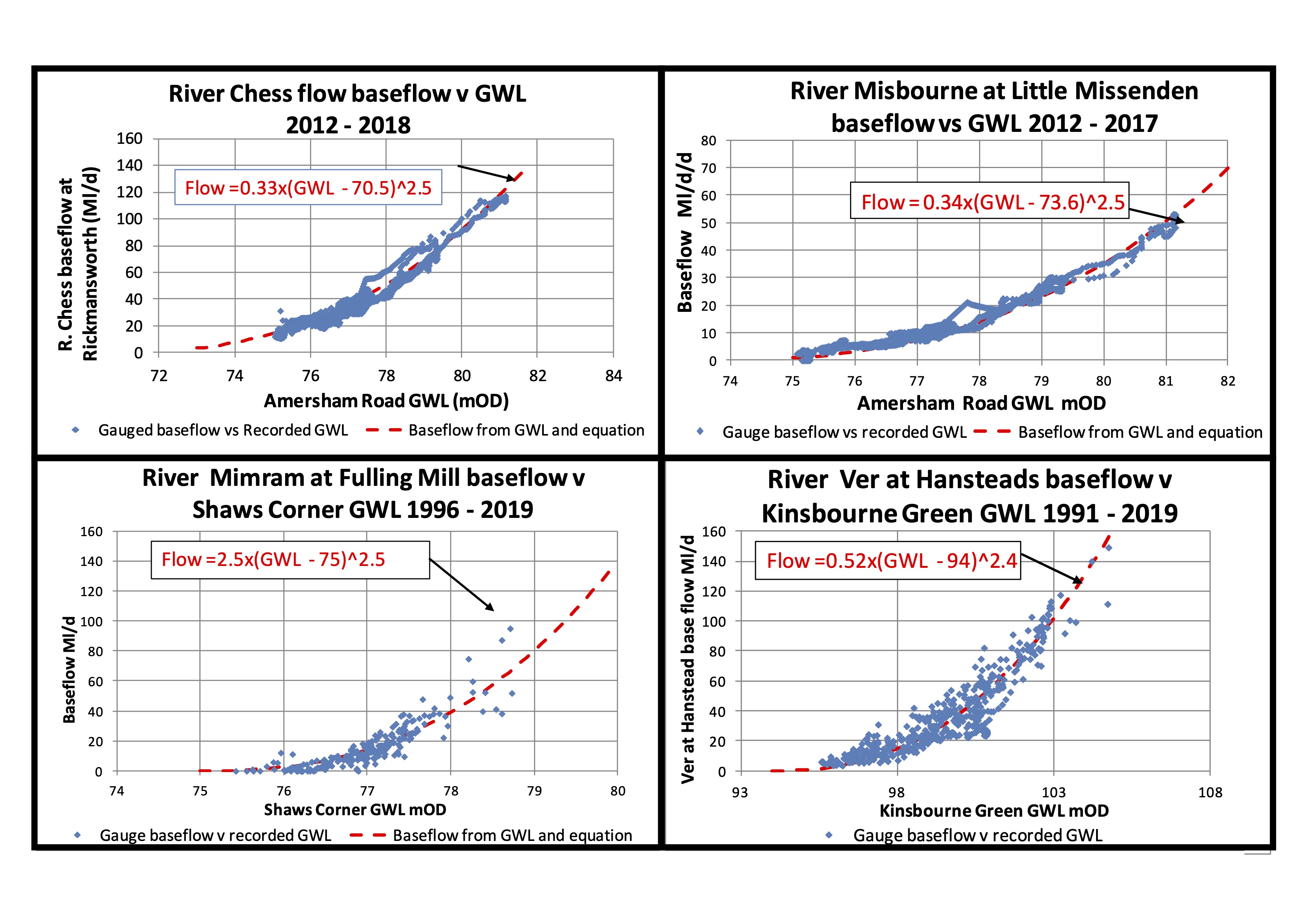
And, of the course the River Tarrant.
The implication is that groundwater level is the dominant control on flow, with abstraction largely affecting flows indirectly by lowering groundwater levels relative to their natural state.
This is not a theoretical construct imposed on the system, but a pattern observed in the data and then represented mathematically.
The CSF equation and non-linearity
The CSF model expresses this relationship in the form:
Q = a(GWL – b)^c
where the constants are calibrated to fit observed data, where the constants are calibrated to fit observed data. Q is flow and (GWL – b), is the height (h) of the groundwater at the observation point over the stream bed at the discharge point.
As shown on the above plots for the Rivers Chess, Misbourne, Mimram and Ver. The relationships between GWLs and baseflows is very strong for “pure” chalk streams with baseflow indices over 90%, like the Chess and Misbourne in the above plots. In rivers like the Darent, with mixed geology including some tertiary deposits, the baseflow indices are below 80% and the relationships show more scatter, but are still plain to see.
A key feature of the relationship is that it is non-linear: increases in groundwater level produce disproportionately larger increases in flow. The model captures this behaviour through the exponent (c), which typically lies between 2 and 2.5 as seen on the plus above.
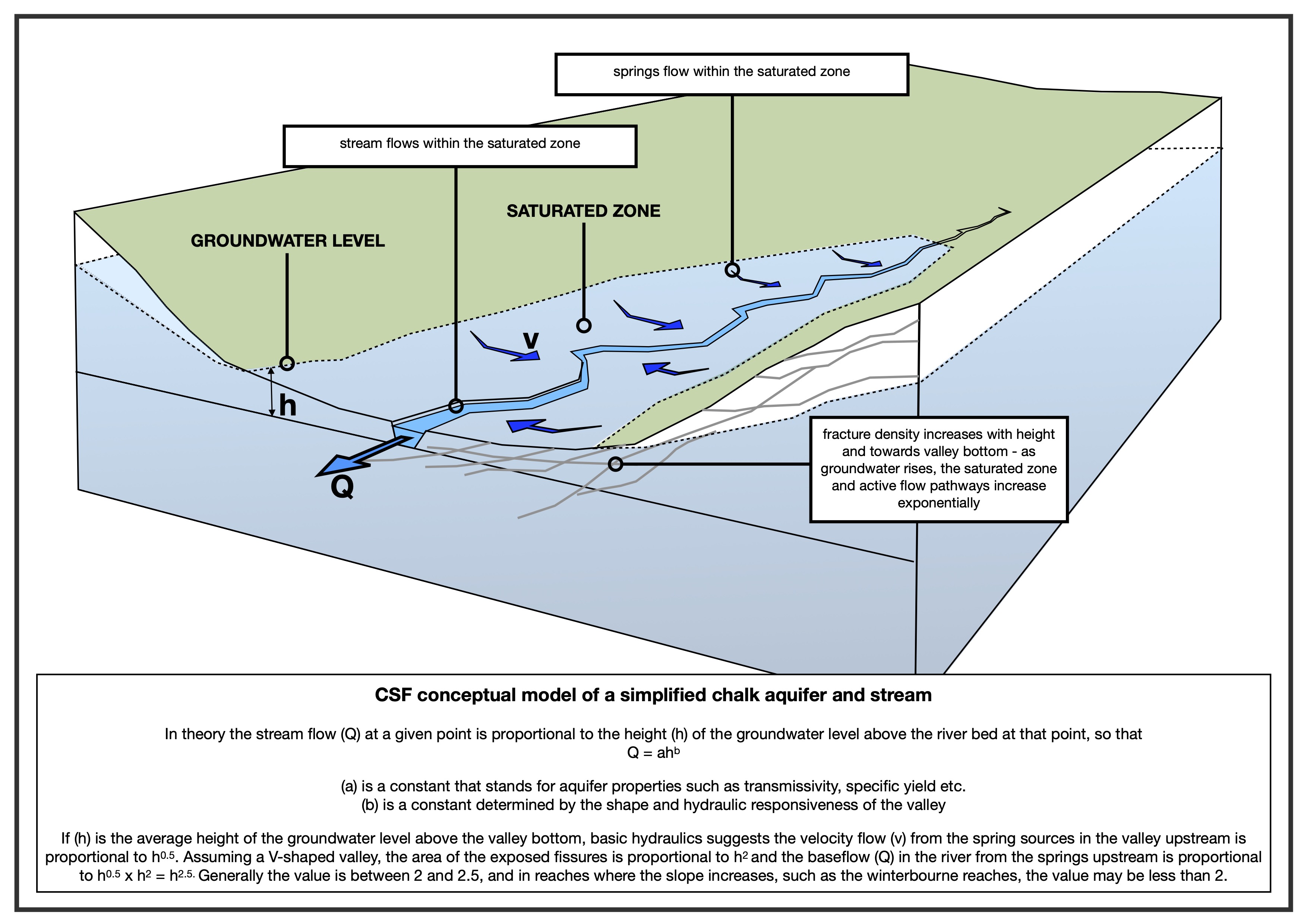
This non-linearity can be understood heuristically. As groundwater levels rise:
- the area of saturated ground contributing to spring flow increases, and
- the hydraulic response of the system becomes more pronounced
Together these effects produce a more-than-linear increase in discharge. While the precise physical mechanisms are debated — ranging from valley geometry to fracture density—the existence of non-linear behaviour is widely observed in the data.
The CSF model does not claim to resolve all underlying processes, but it does provide a consistent way of representing this empirical relationship.
Calibration and transparency
Jane raises concerns about how model parameters — such as subsurface flow and specific yield— are derived.
In the CSF model, these parameters are obtained through calibration: the constants are adjusted until the model reproduces the observed relationship between groundwater levels and streamflows over historic records.
This is a standard empirical approach. The parameters effectively encapsulate the combined influence of aquifer properties such as permeability, transmissivity and storage (a) and valley shape combined with other components of the non-linearity, such as fracture density rising with altitude (b).
The method is described in the RTPS report (page 22), including the treatment of throughflow and specific yield. While simple, it is transparent: the model is designed to reproduce observed system behaviour rather than simulate all underlying processes explicitly.
The key question is therefore not how the parameters are derived in isolation, but whether the calibrated model reproduces reality with sufficient fidelity. On that measure, the fits to historic data are strong.
Is simplicity a weakness?
Prior to the Affinity Water conference in 2022, the CSF model was reviewed by several hydrogeologists. While they noted its simplicity and raised questions about parameter estimation, they did not dismiss the approach. On the contrary, they regarded the results as promising and worthy of further consideration.
Andy Binley wrote: “I must say that the modelling results and analysis of historic data appear convincing to me. You have modelled a substantial set of historic records using a simple lumped approach – the fits to data are impressive and appear to outperform the EA model.”
Jonathan Paul wrote “The reports showcase an interesting, if highly simplified, analytical relationship between groundwater level and river discharge. Initial results look very promising, but greater clarity in how your exponents a and b were obtained would be welcome.”
Jane herself noted in earlier correspondence that the model was “a neat little model” and more satisfactory than some alternatives, albeit highly simplified.
This highlights a tension in the review. The same simplicity that was previously seen as acceptable — within a defined scope — is later treated as a fundamental weakness.
Yet simplified models have a recognised role. They are often used in early-stage assessment, to identify key controls and sense-check more complex analyses. If they can reproduce observed behaviour reliably, they can provide a valuable benchmark against which more elaborate models can be tested.
Conclusion
The CSF model is not a replacement for detailed 3-D modelling, nor does it claim to be. It is a simplified, empirically calibrated tool designed to capture the dominant relationship between groundwater levels and streamflow.
Its conceptual basis is explicit, if simplified. Its parameters are derived transparently through calibration. And its outputs align closely with observed data across multiple catchments.
In that context, the key issue is not whether the model is simple, but whether it is useful. If it consistently reproduces observed behaviour, then it has a legitimate role — particularly in testing the robustness of conclusions drawn from more complex models.
To dismiss it on the basis of its simplicity alone risks overlooking precisely the kind of evidence that can help identify uncertainty in groundwater impact assessments.


Very interesting indeed
LikeLike