
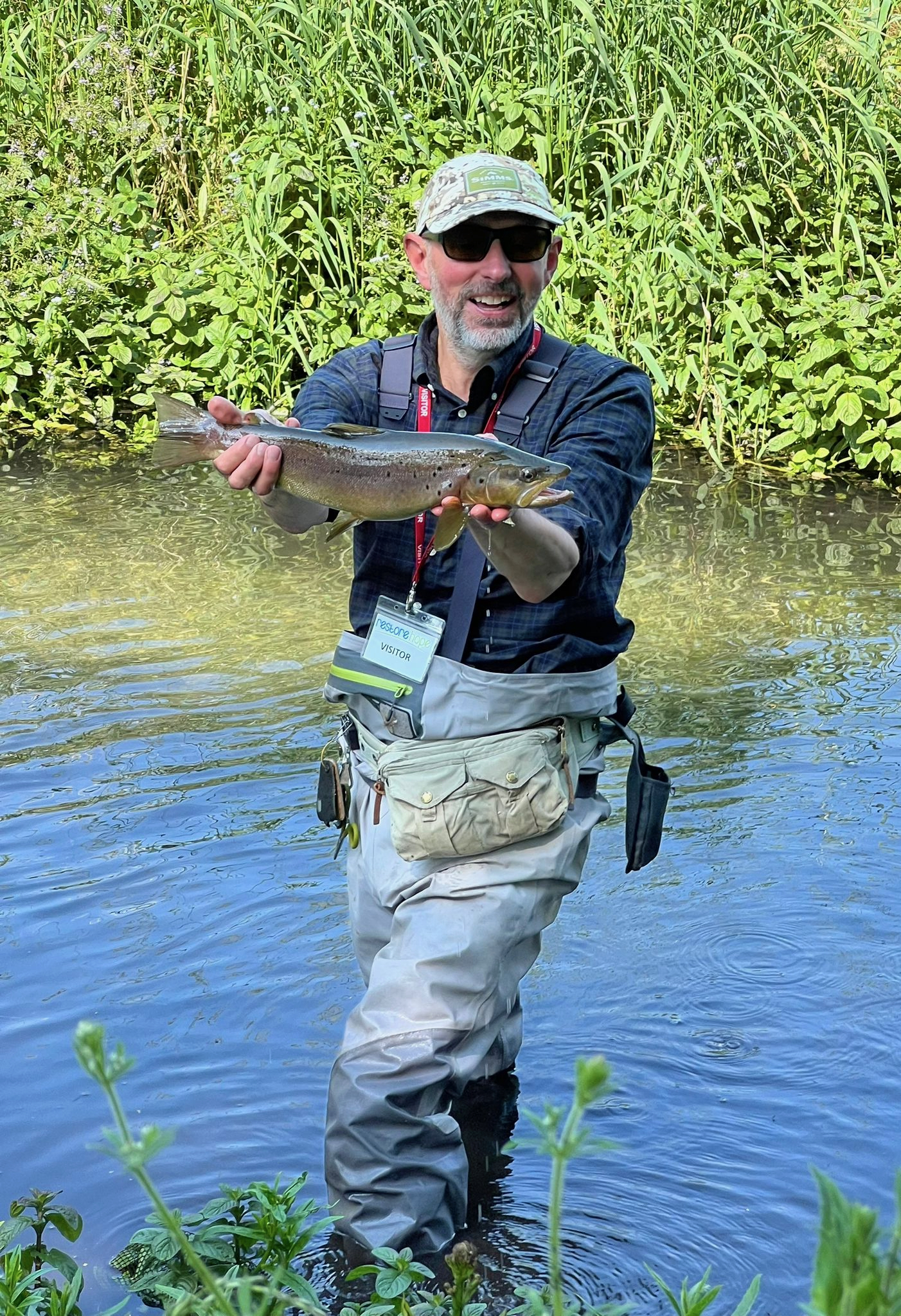
Above: The River Chess in June 2025, a river whose story is a beacon of hope in the long struggle to restore our chalk streams
Chalks Streams First – as regular readers will know – is a radical but pragmatic way to realign abstraction pressure in chalk streams, allowing the streams “first” use of their water, without removing the water from the public supply network.
The idea was conceived and theoretically tested by John Lawson using the catchments of the Colne and Lea as examples. I joined in with John to help give the idea traction with Ofwat, the EA and eNGOs. There is now a Chalk Streams First coalition of eNGOs who support the concept and variations on the idea have been absorbed into regional planning, albeit few have been fully realised as yet.
Chalk Streams First works by greatly reducing aquifer abstraction in chalk stream headwaters and upper valleys – the cheap and easy way to abstract water – and moving the point of abstraction to the lower, less environmentally sensitve reaches of the same catchments, where it is taken from the surface flow and recirculated, via reservoirs, treatment and network infrastructure to the places formerly supplied by the groundwater abstraction.
Across the full hydrological cycle a large % of the water not taken from the aquifer will manifest as surface flow (known as flow recovery) but that % is much higher in winter (over 100%) than summer (25% to 40%). Hence the need for the reservoir which stores that winter excess and becomes, essentially, a man-made version of the aquifer.
It’s the water resources verison of cakeism. Rivers and taps continue to flow.
There are a number of theoretical variations on this general concept of cakeism: for example, the upper valley groundwater abstraction could feasibly be replaced by lower valley groundwater abstraction where the rises and falls in the water table are much smaller, and the supply more reliable in summer.
It is this version of the concept that is currently being developed by Affinity Water. Affinity Water’s central region operates largely to the north-west of London and historically has been very much reliant on chalk aquifer abstraction from the chalk hills of Bucks and Herts: the Misbourne, Colne, Lee and Stort units in the map below.

To date, Affinity – which supplies 970 million litres of water per day to almost 4-million people – has reduced its take from chalk groundwater sources by 100 Ml/d by investing in new assets and network reinforcement and increasing imports from Grafham and Ardleigh reservoirs.
Stream by stream these reductions have amounted to:
- Hughenden Stream – a 100% reduction of 1.6 Ml/d
- Misbourne – a 50% reduction of 13 Ml/d
- Upper Chess – a 100% reduction of 6.38 Ml/d
- Upper Gade – a 31% reduction of 6.4 Ml/d
- Ver – a 67% reduction of 28 Ml/d
- Upper Lea – a 27% reduction of 10.2 Ml/d
- Hiz and Oughton – a 13% reduction of 1.3 Ml/d
- Mimram – a 50% reduction of 9 Ml/d
- Beane – a 70% reduction of 16 Ml/d

Of course many of those reductions were from very high totals. For example the Ver’s once total abstraction of 42 Ml/d was well over half the catchment recharge in an average year, meaning the 15 Ml/d still abstracted remains a high % of the stream’s recharge. We (Chalk Streams First) have argued that “sustainable” abstraction should generally amount to no more than 10% of aquifer recharge, ideally less.
However, Affinity hasn’t finished. In AMP8 it will be cracking on with a further 35 Ml/d of reduction from the chalk streams feeding the Colne, including 14 Ml/d of license relocation following the Chalk Streams First principle, which is allowing Affinity to fast-forward these reductions before other strategic resource options (ie reservoirs and transfers) come online.

Planned reductions in AMP9 are also very encouraging, totalling 45 Ml/d.
Affinity deffo deserves credit for pursuing these reductions in the face of severe logistical dificulties and contortions. They inherited a system that was developed in a different era when the resource was thought to be more than abundant. Times have changed. Affinity Water must continue to supply water – its primary statuory duty – whilst finding an environmentally more sensitive way to do it.
The battle aint over, however. The ecological response of the streams will be carefully monitored and the inclination – I’m fairly sure of this – will be to suggest that the response has not been as good as expected. That’s because the economic forces and need to supply water are urgent and are only going one way but also because it is very difficult to tease apart all the environmental stresses on chalk streams and ascribe cause and effect to only one.
The real point is that to get the best value from the investments necessary to reduce and relocate abstraction we MUST also ensure that the water in the streams and aquifers is clean and that physical habitat is restored. Only when all three happen can we expect to see true ecological recovery.
Meanwhile, congrats and chapeau to Affinity Water, for engaging so positively with the chalk stream restoration strategy. The trout will thank you. Maybe one day, the salmon!


Thank you Charles, this gives me hope that my specific philosophy on flow isn’t so very far off the mark, at least for the circumstances in which the Gaywood River in West Norfolk finds itself. Once upon a time, when God and I were at school together, the Gaywood flowed clear and strong from the springs along the edge of the chalk ridge right down into and through King’s Lynn before ultimately discharging into the the tidal river Great Ouse. Since it’s inception the town had been dependent on that good clean water which for centuries had been drawn at Kettlewell Lane, named after an early contraption comprising buckets arranged around a turning wheel that lifted water from the river and poured it into the supply. More recently the municipal waterworks was located at the same spot, again drawing the water and processing it before putting it into the main. Then someone must have had a bright idea, “if we pump the water out of the aquifer up on the chalk ridge, we can pipe it into the town and serve it to the grateful populous. What’s more it will come out the ground so clean that it will need hardly any processing and this time next year we’ll be millionaires!” What’s more, they were able to build a rudimentary sewage works only a mile or so from the source from which they could pour almost anything into the river since it was no longer being used for drinking. And so it worked, rather well really, from a business perspective … until the weather started changing. As the winters became wetter and the summers drier, discharges of untreated sewage (2,823 hours from that one small STW in 2024) have become an issue mirroring seriously depleted flow from the springs during the summer. With water temperatures rising, seriously raised levels of phosphate and commonplace peaks in E. Coli counts, especially in the SSIs through which the river flows, it’s in trouble. Farmers are even putting home-made weirs into the stream to create pools from which they can suck the remaining water for their potatoes. There is little sign of acceptance that the game is up but I have a simple two part suggestion for them. Close the STW and pipe the raw stuff from this mini STW to the mega plant in the town and see the river’s nutrient load and ecology improve switch off the pumps at the current abstraction point tom increase flow and draw the water again from a point close to the final discharge into the Ouse. They could even call it the Kettlewell Water Works if they like. Yes, the cost would make any water company CEO’s eyes water, but you surely can’t deny the logic or am I just being recklessly naive?
Peter Clitheroe
>
LikeLike
Hi Peter, I think there’s a lot to be said for moving the point of abstraction downstream on the Haywood and other north-west Norfolk streams. The flow recovery % would be high because there’s little aquifer through-flow below the spring-line, which lies on the transition to far less permeable ground: any water left in the aquifer would leave the aquifer through springs. As for the sewage works, it is at an unnatural level in the floodplain on incised channel in the wrong place. If the river was returned to its natural pathway, you could take the sewage discharge off-line for most of the natural chalk stream, even split it altogether all the way to the sea.
LikeLike