I’m honoured to have been asked to chair the Test and Itchen Catchment Partnership (Strategic Leadership Group) and help efforts to create a re-booted catchment restoration strategy spearheaded by the Wessex Rivers Trust and Hampshire and Isle of Wight Wildlife Trusts in partnership with all the key stakeholders, landowners, fisheries interests, water company, regulators and local groups.
These two rivers are the jewels in the English chalk stream crown (and I say that as a Norfolk lad) of iconic national and international importance. Collectively the partnership has formulated a restoration vision that is to:
“to restore these rivers to a state where natural processes, ecology and biodiversity are maximised and human impacts minimised: to create rivers and floodplains that are havens for abundant wildlife, that help manage floods, store carbon and intercept sediment, that retain their extraordinary cultural value, and that are resilient to the pressures that lie ahead”
That’s a high ambition and to use a cliché … words are cheap. Turning it into reality is the hard part. What I have learned from trying to do exactly the above (albeit at a smaller scale) on chalk streams in Norfolk is the immense value of a really good plan, one that is simple, doable and relentlessly correlated to reality.
Without a plan there are a zillion rabbit holes one can vanish down. A great deal of money can be spent doing the wrong things well, or doing the right things badly, or fixing an enormously expensive minor issue at the expense of a much more resolvable major issue. And so on.
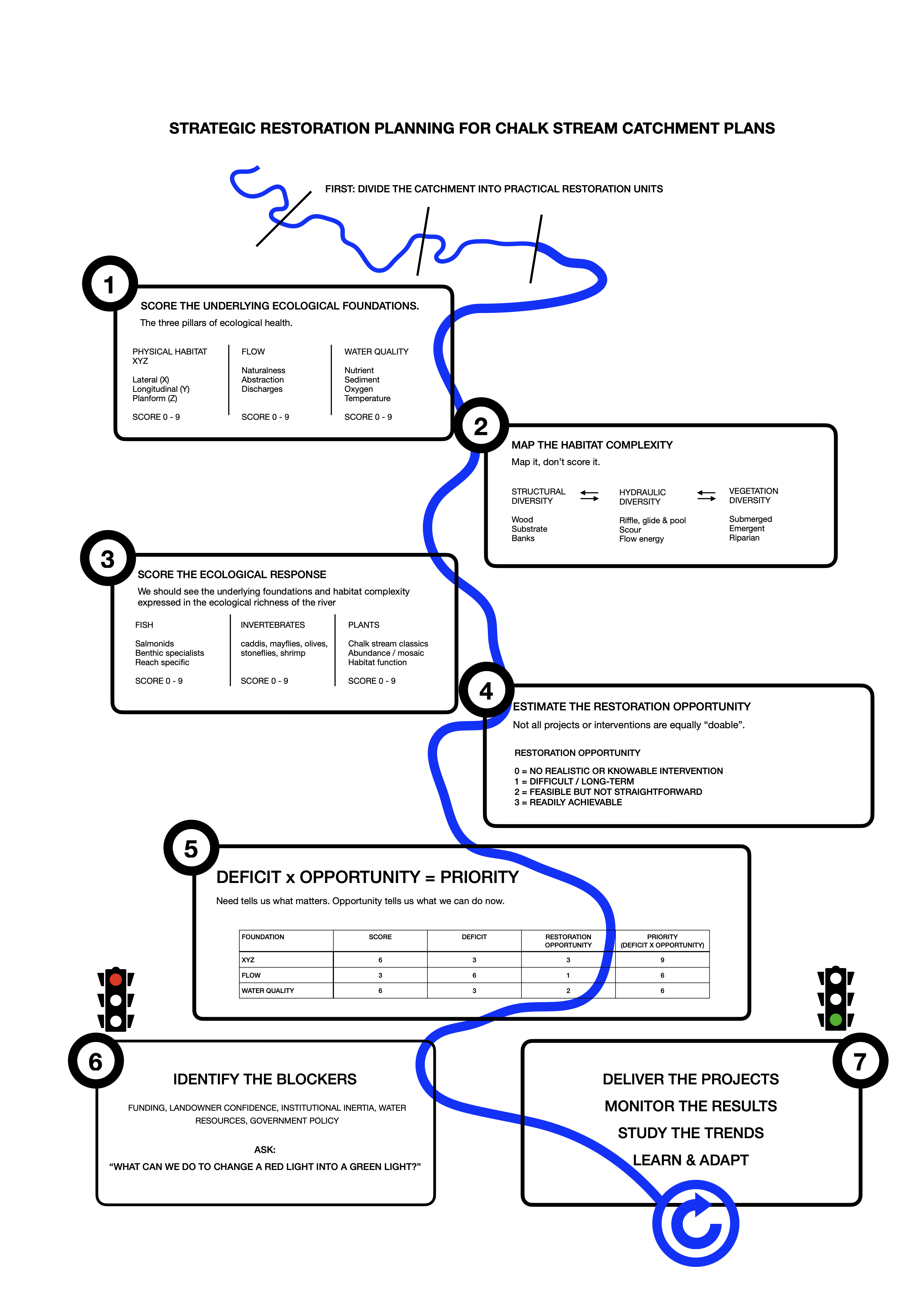
So, I’ve been working on a methodology for constructing a restoration strategy that is simple, objective, repeatable, that makes use of existing datasets and assessments but reassembles the information in such a way as to clear signals about what to fix, where and in what order. A catchment restoration planning tool, if you like.
I sketched out the idea at the inaugural meeting of the Test and Itchen Strategic Leadership Group last week, to an exacting audience of river restoration experts, ecologists, regulators and various other key decision makers and was very pleasantly surprised by the positive reception.
I’ve set out the concept below: a) as a simple graphic and b) as a longer text explainer. I’d be very happy to incorporate feedback to help make it as useable and useful as possible.