I enjoy Simon Cooper’s chalk stream focussed newsletters, for a variety of reasons, not least that they are well written, sardonic and interesting. No matter what he writes – unarguable truth or arrant nonsense – there’s never a dull moment.
On the 6th June Simon asked “where do all the water company fines go?”. Good question! The Conservative gov’t introduced the idea that these fines ought to go to improving the environment damaged by water company malpractice. But the sums aren’t ring-fenced. So, of the £242-million levied on the industry in 2022/23, only £11-million found its way into the Water Restoration Fund. We need to ask this question repeatedly: “who is trousering the fines?”
This week Simon is on the water company case again, lampooning Southern Water’s Tim McMahon. McMahon had claimed that the south-east of England was “drier than Istanbul”. Simon called this “Southern Water Fantasy Maths”.
“McMaths,” he wrote “who probably hones his calculating skills watching endless repeats of the numbers game on quiz show Countdown had to perform two feats of contorted logic to arrive at this implausible claim. Firstly, he had to include the population of London in his calculations. The last time I looked our capital was most definitely not in the south-eastern portion of England but hey-ho Tim perhaps you are lining yourself up for a Nobel Prize double to include geography. Secondly, Tim has used the historic average for Istanbul rainfall but compares it to one of the driest periods on record for South-East England.”
In fact Tim had said to the BBC: “If you look at the south-east of England, it’s drier than Sydney, Istanbul, Dallas, Marrakesh. We have got a very densely populated area and we need to start investing to cater for that. We need to reduce customer usage. Otherwise we will have to put other investments in place, which will not be good for customers and might not be the best thing for our environment.”
If I were to pick that statement apart, it would not be to make a petty objection to the “drier than …” statement.
The point is kind of obviously rhetorical, not literal. Tim is also clearly referring to the geographical reality, not the regional concept. London is undeniably in south-east England. It is a region in itself, however, so it is not technically in the region described as “the South-East”.
To match the pedantry I looked up the “centre of England” and found it – deemed so by Ordnance Survey – to be a village in Leicestershire called Fenny Drayton, definitely above and to the left of London.
As for the rainfall, across the south-east of England it is generally a bit less than 650mm a year. Sydney’s average rainfall is 1150mm, Istanbul’s 820mm, Dallas’ 880mm, and Marrakesh’s average is 250mm.
So, McMahon was wrong about Marrakesh.
To his wider point, however: south-east England is undeniably dry. Why object to someone saying that blindingly obvious truth?
And I’m glad Tim has pulled London into his justification, because it is around London that our chalk streams are most damaged by abstraction. That’s because there are too many tea-pots, basins, showers, loos, baths and gardens relative to how much rain falls in the Thames basin.
The Misbourne is regularly dry. As are the upper Beane and Darent. Abstraction in the upper Lea is 90% of average recharge. The poor-old Lea doesn’t really become a river until the Luton sewage works discharge.
That’s why we do need investment, a national grid for water, pipelines, reservoirs and de-salination. The lot.
The part of Tim’s statement that is of concern is the idea that if we don’t trim usage we may have to put other investments in place, which might be bad for customers.
That’s the bit to focus on.
Demand reduction per head of itself solves only one problem: demand increase through development. On it’s own trimming customer usage just allows the government to build more houses.
To see chalk streams flowing naturally again, we need to reduce the amount of water we take out of chalk aquifers. And we can’t do that without investment.
Last Friday afternoon 30th May Sophia’s petition “please don’t abandon the chalk stream recovery pack” passed 10,000 names. By Monday almost another 1000 names had been added.
This is fantastic news. It means that the government must now respond.
And maybe they have, to a degree. On Monday I met Minister Emma Hardy by a Yorkshire chalk stream. Many thanks to our guide Matt Arnold from the East Yorkshire Rivers Trust.
Though we were standing beside the Boston beck, perhaps one of the least pressured chalk streams in England, Minister Hardy was genuinely keen to know more about the multiple threats to chalk streams and what we should be doing to make things better.
We discussed the extreme levels of abstraction that exist on some chalk streams, especially those near London, and the suffocating nutrient pollution that comes from innumerable small sewage works where there is no phosphorous limit or where, if one exists, it is absurdly lax. We especially focussed on the lack of clarity in catchment level decision-making, something I feel the government could help with by unambiguously signalling the importance of chalk streams.
That signal should have taken the form of the Defra chalk stream recovery pack, of course, but I’m not holding my breath for a change of heart regarding its publication. Though you never know.
I will certainly continue to push, arguing why many of the measures in the pack were low-cost no-brainers: stuff that builds on existing policy with greater clarity and purpose, that would remove blockers in bureaucracy or give clear signals to water resource groups and water companies on where to prioritise abstraction reduction or target better water quality in vulnerable headwaters or that gives support to stakeholders.
My guess is that the treasury has put more or less everything on hold while it tries to prioritise growth through development.
This is worrying. Water efficiency through demand and leak reduction, for example – THE big plays in our national framework for water resources over the next two decades – means nothing for nature, unless accompanied by actual abstraction reduction. Of itself water efficiency simply makes headroom for development. And in the current climate this is almost certainly what it will be used to deliver.
Similarly, if the water industry is left to meet the previous government’s laudable nutrient reduction targets (as set out in the Environmental Improvement Plan) via “highest technical standards” at large works downstream of large population centres where highish standards exist already, then of course this will be the preferred “cost-effective” pathway for all parties.
All parties except fish and insects who might prefer those chemicals are removed upstream of where they live. The point is, you can create a great headline figure for phosphorus removal where it makes little ecological benefit, but why not direct the targets towards their purpose?
Without direction from government or its regulators on how to prioritise either abstraction or phosphorus reduction, economic efficiency of a decidedly anthropogenic kind will decide. River life will receive little benefit from initiatives intended to restore it.
Frustratingly, it’s all about economics – no matter who’s in charge – and so long as water is as cheap as it is, and so long as imaginative and economically-efficient ideas like Chalk Streams First or nutrient treatment wetlands or risk-based buffer strips (all measures a recovery pack might have given prominence to) are starved of oxygen, then nature will pick up the bill.
And thus the can is kicked down the road.
It doesn’t have to be this way. The chalk recovery pack would have been Defra’s first bespoke policy document for chalk streams. This government could yet dig it out, add some oomph to the stuff that got watered down, and defy my cynicism. No one would be happier to be proved wrong.
In the meanwhile, it was a pleasure to meet the Minister and I’m very much hoping we can meet again soon on one of the Flagship project sites, the Chess, for example where Kate Heppell is leading amazing citizen science research, or the Anton, where Simon Cain and Bob Wellard are concocting imaginative re-wilding schemes. And then perhaps the beleaguered Ivel which barely flows, or the Ver whose headwaters this winter have been constantly polluted with raw sewage.
An open letter to everyone who cares about chalk streams:
Dear friends,
I’m writing to you to ask a favour. A few days ago I received an email out of the blue from a lady called Sophia Holloway. I don’t know Sophie but she tells me that she was so angered by the government’s decision (reported and commented on in The Times over Christmas – links below) to drop the Defra chalk recovery strategy work that she has started a petition.
This is so heartening and is so very kind of her.
But the petition will go nowhere without support from everyone who cares. If there’s not enough support, I fear the government may double down on their timid and unpopular decision not to publish the now oven-ready chalk stream recovery pack and even their other chalk stream work.
We need people to hear about Sophia’s petition. So, please will you:
sign the petition
give the petition a plug, even repeated plugs, in your social media platforms and share in any other way you can.
Let’s see if we can do justice to Sophia’s anger and good faith?
There’s an album of chalk stream images at the foot of this page: of beautiful chalk streams to show why we should look after them and of knackered streams to show what we need to protect them from. Anyone is welcome to grab and use them for social media posts (an attribution to chalk streams.org would be appreciated and may even spread the word)
•••
A bit of background in case it is needed …
A few years ago I was invited to chair and oversee the creation of a national strategy for protecting and restoring chalk streams. Countless passionate people and all the key players, the regulators, industry and eNGOs worked together to create a collaborative national restoration plan that will – if the actions are followed on – make a considerable difference to chalk stream protection and health.
It is a simple strategy for addressing – in practical and pragmatic ways – abstraction, water pollution and habitat restoration. Under the last government we even got to the point where the then Minister Rebecca Pow promised a Defra policy document in support called the Defra Chalk Stream Recovery Pack. I know what was in that document because I negotiated with Defra over its contents and wrote it for and with them.
But foot-dragging over certain key issues delayed publication and then, when the election came along, the plan was put on hold. Now the new government has shelved it, or in fact – apparently – abandoned it. See The Times pieces below:
This is no way to deliver environmental improvement. No matter one’s politics it is obvious that we will only resolve the issues that impact our rivers if the government of the day rises above party politics and builds continuity into our approach to protecting and restoring the environment.
I really hope you can support Sophia’s initiative. Thank you so much.
It took me a while to get my head around the concepts in this post, so bear with me. This is aimed especially at eNGOs and other campaigners for chalk streams, because the more people there are who understand this counter-intuitve idea, the better.
Here it is: you can save many chalk streams from unsustainable abstraction by conceivably using the aquifer in times of low flows and drought.
That is a head-muddler. But this idea could unlock real abstraction reduction, making the bad much better in the foreseeable future. This is far, far preferable in my view than holding out for a perfection (natural aquifers) that will never come.
It starts with my best attempt at explaining what I understand of the complexities of the interactions between groundwater, river flow and groundwater abstraction. Given that I vainly spent a long night in a hut in Iceland trying to explain the very same ideas to two angling friends of mine (they were belligerently uncomprehending in a (successful) effort to annoy me), this will be no easy task.
It is complex … kind of. It’s also quite simple really. Rather as the moon affects the tides, a simple idea leads to a complex set of manifestations.
Idea 1. Chalk streams flow from underground.
If you’re reading this blog you’ll already know that chalk streams derive most of their flow from groundwater. Rain sinks into the ground filling fractures in the underlying chalk and then lower down the slope it seeps out again as springs to create a chalk stream.
Idea 2. The level of the groundwater drives the flow in the river.
This is pretty simple. I used the bucket analogy before. Drill a single hole in the base of a bucket. Fill the bucket with water. As the bucket fills gravity drives water at an increasing velocity out of the hole. Now stop filling and let it empty. The flow diminishes to a trickle. EVERYONE gets this because it’s the same when you pee!
The rate of flow from springs in a chalk valley is driven by the hydraulic head of the groundwater above the springs. The higher the level, the greater the flow …… In more or less the same way as the water level in the bucket determines the force at which the water is driven through holes in the side of the bucket.
Idea 3. Groundwater rises in winter and falls in summer.
If you pour water into the bucket faster than water can leave it through the hole(s), the level in the bucket rises. If you stop pouring water in, the level falls as the bucket drains. This is exactly the same with a chalk aquifer. In winter, when it rains a lot, and it’s cold and the ground is wet and nothing is growing, more rain flows into the aquifer than can leave it and so the groundwater level rises. In summer, much less rain – if any – reaches the aquifer and so the groundwater level falls.
Groundwater rising. This chalk valley is dry most of the time but in February 2021 when recharge vastly exceeded discharge, it had filled to overflowing.
Idea 4. The higher the groundwater rises up the valley, the more the water pours out of it.
As groundwater level rises, stream flow increases. But not in a linear way as it would with a single hole at the base of a columnar bucket. In fact for every unit of rise in groundwater level, flow will increase by approximately X2 to 2.5 . Kind of like having twice as many holes at each level in the bucket as the level below.
There are a number of reasons for this which were debated at a recent groundwater conference. There is a summary of these ideas in Section 2 of John Lawson’s report Flow Recovery Following Abstraction Reduction which we updated following the conference and contributions from the likes of Rob Soley and Alessandro Marsili.
In short, this non-linear response is probably caused by a combination of:
• the shape of the valley – if you imagine the groundwater filling the valley bottom and hillsides, assuming a perfect V- shape valley, for every unit increase the groundwater rises the area of saturated zone exposing springs rises two-and-a-half fold. Chalk valleys are not quite V-shaped but that’s the general idea.
• the fracture density in the chalk – which increases in the valley bottoms and with altitude. At depth chalk is very solid, but in the valley bottoms and higher up the slope and where water has flowed for thousands of years, the fracture density is much greater and the flow pathways are bigger.
• layering within the chalk – chalk accreted in layers under varying climatic / geological conditions and these layers are in turn interrupted by bands of clay and flint. These layers and the varying permeability and transmissivity can influence the way groundwater reaches with the surface.
• as the surface flow pathways lengthen (winterbournes rising higher and higher up the valley) the groundwater pathways shorten.
The fracture density and layering in the chalk, the shape of the valley and the length of flow pathways, all conspire to mean that when chalk valleys fill, flows will rise exponentially.
Idea 5. The impact of a constant groundwater abstraction has a varying impact on varying flows through the year
This is where things gets a bit more discombobulating. All of the above essentially means that as groundwater rises, flows increase exponentially. If that is true, then the reverse is true. For every unit of decrease in groundwater level, flows decrease exponentially.
This means …. drum roll … groundwater abstraction (which lowers groundwater levels) has a greater impact on high flows than low flows! This is a totally skull-tightening idea. Everyone thinks the reverse must be true. But it isn’t.
Groundwater levels and groundwater abstraction
Let’s start with the impact of groundwater abstraction on groundwater levels. In a natural aquifer system, the discharge from the valley must equal the recharge over time. Natural recharge = natural discharge / Time. This stands to reason: if it didn’t the valley would either fill to overflowing or empty (because over time one would exceed the other).
Natural recharge derives from rain and natural discharge from river flow (and some evapotranspiration and flow through the ground). If I add another form of discharge in the form of abstraction, then the former natural discharge MUST go down. If it didn’t, the aquifer would progressively empty until there was no water left (an aside … hydrogeological literature generally describes anything less than draining the aquifer “sustainable”, because the aquifer is being lowered to a new dynamic balance, not mined. This is not the same as ecologically sustainable, however).
Now, as I showed with the bucket, the ONLY way in which the former natural discharge can go down is through a reduction in groundwater levels. If groundwater levels didn’t go down, then because the discharge is driven by the groundwater level the natural discharge would remain the same. As shown above, that is impossible.
Theis, the Isaac Newton of groundwater theory, wrote all this in 1940. The only way that the former natural discharge can go down (and balance the equation) he wrote, is by a reduction in the “thickness of the aquifer”.
Okay, so pause and get your head round all that.
• a single unit of rise or fall in groundwater level has a (very roughly) two-and-a-half fold impact on flows.
• ipso facto a single unit of reduction in groundwater level at high groundwater levels has a much greater impact on flows than a single unit of reduction in groundwater level at low groundwater levels.
It still hurts the head, but the discombobulating stuff above means that at high groundwater levels groundwater abstraction reduces flows by quite a lot more than 100% of the amount abstracted. And conversely, at low groundwater levels groundwater abstraction reduces flows by quite a lot less than 100% of the amount abstracted. Albeit over time groundwater abstraction must reduce flows by (essentially) 100% of the amount abstracted (it’s generally less than that for reasons that aren’t that important to the general concept, but basically because not all discharge occurs in the form of flow).
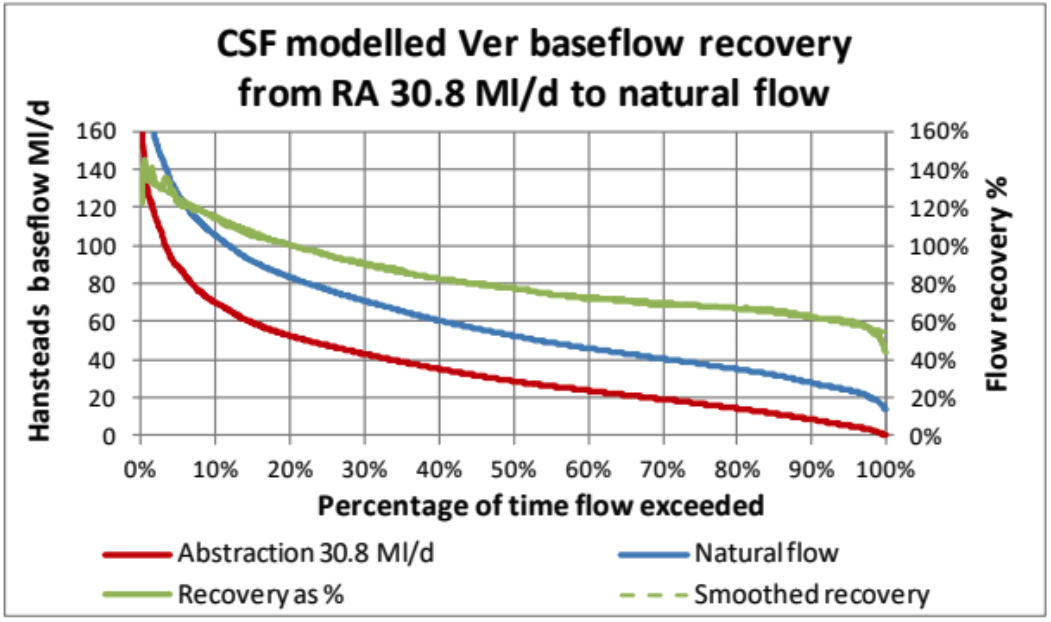
See the chart below to see what the Chalk Streams First modelling indicates % flow recovery would be if abstraction was reduced to zero in the River Ver. It varies through the flow cycle.
The above chart from Page 52 of John Lawson’s report shows that the % flow recovery (green line) at high flows (l/h end of X axis) is well over 100% and at very low flows (r/h end of X axis) is about 30% – 20%.
Idea 6. Groundwater abstraction at low flows is like a credit card.
The obvious question is … if groundwater abstraction at low flows reduces those flows by a lot less than 100% of the amount being abstracted, where the bloody hell is the rest of the water coming from? The answer: if it’s not a direct reduction from flows at the time, it is coming from aquifer storage.
This is easy to understand if you think of a large abstraction next to a small and diminishing stream. In the winter when the stream is gushing, there is more than enough water to satisfy the pumping. In the summer the stream reduces to a trickle or perhaps even dries up. But the pumping continues. At this point the abstraction is clearly not taking water from stream flow because there isn’t any. Another aside … I’ve read hydrogeologists describe this state as abstraction having “no further effect on flows”. This might be literally correct at the time. But it is misleading. The abstraction is effecting future flows.
When a chalk stream dries but abstraction continues it is clear that the abstraction is no longer subtracting water from the river’s flow, but from aquifer storage: this is basically a debt to future flows.
At times of low flow and into droughts, groundwater abstraction increasingly draws on storage, upon which future flows are built. If you unnaturally drain the aquifer, it will clearly take longer to fill when it starts raining again, all before the flows in the river can respond to the rise in groundwater levels.
Therefore groundwater abstraction at low flows is like a credit card: much more a debt against future flows than an impact on present flows. This is a key idea behind the confusing concept of using groundwater abstraction to unlock abstraction reduction .
Idea 7. If you turn off the pumps you get greater flow recovery at high flows than low flows.
Essentially what all this means is that when you cease or lower abstraction you get well over 100% of the amount no longer abstracted at high flows and much less than 100% at low flows. That is what the chart above shows on the River Ver.
Water resources needs a constant supply of water. Groundwater abstraction gives that. Chalk Streams First says “turn off (or down) the pumps and take the water from river flows much lower down the catchment”. And while you get loads of water back in winter, you get less back in summer. Generally, you must have a storage reservoir to make it work and balance out the varying recovery rates into a constant and reliable supply.
John Lawson – who came up with the Chalk Streams First idea – has long known this. We argue (with empirical evidence) that the flow recovery at low flows is actually much higher than the most pessimistic predictions claim, but nevertheless this variation in response is an issue we have to address. The answer is a reservoir.
BUT … then you get to the prolonged droughts when water companies are under real pressure. In these times, the flow recovery could conceivably drop even lower. What to do? The public must have water. This low flow recovery at very low flows in long droughts threatens the whole idea of reducing abstraction through schemes like Chalk Streams First. Especially now that we have to plan according to 1:500 year contingencies.
Idea 7. In droughts use groundwater abstraction to guarantee public water supply … so long as you’ve turned the abstraction right down to ecologically sustainable levels 95% of the time.
The insurance against the Achilles Heel of low flow recovery in a drought is a groundwater-fed public water supply scheme. There is one in existence already called the West Berkshire Groundwater Scheme (WBGWS). It is a series of wells in the Berkshire chalk that can, in extremis, be turned on and deliver a large amount of aquifer water into the Berkshire chalk streams, from where it flows to the Thames to be captured into the London reservoirs. The scheme is used very, very rarely: no more than once every 25 years. But it’s there. And it guarantees water in a drought.
The West Berkshire Groundwater Scheme wellfield: this scheme is rarely used but guarantees water in extreme droughts. It is a counter-intuitive idea that could unlock abstraction reduction in the Colne, Lea and Ouse chalk streams.
The impacts on the chalk streams are a) one of flow relief in the drought, because the flows get boosted. Albeit – and I have to emphasise this – flow augmentation in not the aim of the scheme, it is a bi-product. And b) at the end of the drought, when the pumps are turned off, the aquifer must recover before flows return to natural levels, so you get lower flows the following year.
But this is crucial: in modelled scenarios, the flows in the year of recovery are still better than they would be if abstraction ran all the time as happens at the moment in streams like the Ver, Misbourne and Beane.
So WBGWS type schemes could unlock Chalk Streams First type abstraction reduction in other settings, such as on the chalk streams of the Colne, Lea and Ouse (even the Darent). As such a scheme would insure against the public supply deficit in droughts created by replacing upper catchment groundwater abstraction with lower catchment surface water abstraction (the Chalk Streams First concept).
BUT …the Environment Agency is very cautious of such schemes
This is understandable because there have been some bad schemes in the past. But flow augmentation to compensate for the collateral damage of abstraction is a different thing altogether.
Some schemes were developed in the past whereby to compensate for abstraction (which had dried the stream) water was pumped from the aquifer into a losing reach of stream and the whole thing was a highway to nowhere.
Other times the concept of augmentation is used to justify continuing, unsustainable abstraction. These schemes have given the whole idea of flow augmentation a bad rap, and one that has stuck like glue.
RevIvel claim that a flow augmentation scheme putting 0.5 ml/d into a dry river bed is not a good type of augmentation scheme, especially if it delays a proper solution to the unsustainable abstraction. This is the kind of scheme is very different from the idea promoted in this blog post.
BUT, I would argue that we need to be more pragmatic and open minded than a presumption against these schemes if we are to achieve the heretofore irreconcilable goals of reliable public water supply and restored chalk streams. Aquifers in the south east are managed one way or another. We need to make sure they are managed mindfully to achieve the specific outcomes we want and in this regard holding out for “natural” when a more flexible approach would unstick hopeful schemes such as Chalk Streams First would surely be counter-productive?
I understand the Environment Agency may be consulting on this topic later in the year. I know from many discussions I have had with chalk stream advocates that the ideas I have outlined above will be surprising and counter-intuitive to most of us, as indeed they are to me.
But it is vital we give the EA the encouragement to take a flexible, if ultra cautious approach, because the gains of doing so could be massive.
Paul – a vicar and environmentalist – read my blog about Defra’s shelving of the chalk stream recovery pack and wrote to tell me of his own frustrations with officialdom. I offered him a guest blog. His story is fascinating and concerning. CRW.
I’ve been leading a team researching the persistent industrial chemical pollution of U.K. watercourses for the last five years. Our research was the basis of the recent ten part Radio 4 series Buried: The Last Witness.
Now that the ongoing neurotoxic PCB problem in U.K. watercourses and wildlife is garnering attention again (what a UN Environment Programme factsheet called a conveniently “forgotten legacy”) I’d like to explain how this ongoing watercourse pollution has been allowed by government to happen.
The identification of contaminated land under Environmental Protection Act 1990 Part 2A has been radically undermined by its own statutory guidance. The Act itself is admirable. That makes it all the more surprising that two of its key clauses were rescinded in 1995 during Lord Deben’s tenure as Environment Secretary, after a sustained industry lobbying operation during Lord Howard’s tenure. How that was done was chronicled in the Journal of Environmental Law at the time by the chair of the Environment Select Committee, Sir Hugh Rossi:
Implementation of the Act was delayed for ten years from 1990 until 2000 and the statutory guidance was written strangely in several aspects.
1. Most obviously and damagingly divergent from the original Act, it excludes as receptors (SG 3.8b) of pollution all watercourse lengths that do not come within a highly restrictive designation:
This means the majority of river lengths in the UK which do not come within this tight Table 1 definition may be polluted by industrial neurotoxic chemical leachate to an infinite extent: they are excluded from recognition within the Act as a receptor of that pollution.
Thus over half of the U.K. rivers by length and most of the downstream lengths of most of our major rivers are excluded from the primary legislative protection of the environment from chemical pollution.
2. The guidance states that Councils should “give priority to particular areas of land that it considers most likely to pose the greatest risk to human health or the environment”.
Sadly, especially in Wales, that last word “environment” gets systematically deprioritised in the detail of the guidance and its implementation. The preamble to the guidance sets a subtly chilling tone. Multiple councils in England and Wales, after reading the guidance, instruct their favoured consultants in such a way that only human risk gets reported on, fully in contrast to the Act’s comprehension of human AND environmental harm potential.
A consultancy report written by Helsby-headquartered RSK for the local Council was used tacitly to determine that a leaching neurotoxic chemical waste dump is not contaminated land within EPA Part 2A. There is no written record in 2009 that Cheshire West Council or its predecessor even made a determination decision after the helpful consultancy report was received. This 2024 Cheshire West and Chester Borough Council.Council PR summary retrospectively summarises:
“In 2009, we concluded that, based on the assessments undertaken, the tip did not meet the definition of Contaminated Land and investigations were drawn to a close”
It’s seems to me a national scandal kept in place by a surprisingly wide-ranging official code of silence. A housing estate is currently being built over a PCB-contaminated factory site with extremely high readings at nearby Helsby, without purchasers even being made aware.
A variety of Councils use strategies to keep the false negatives in place.
3. Wrexham council claimed that it has an infinite timescale to even reach a decision, ie to comply with the law (see SG 2.9);
5. NRW has had Caerphilly council area data on file since 1994 showing that wildlife in the river Sirhowy is contaminated with elevated PCB levels. Yet bizarrely it didn’t even share that data with Caerphilly council until my team resurfaced the data via an FoI and intervened. As toxicdocs.org discloses, it seems as if a payment was made by Monsanto to the predecessor Council. We can’t know for sure because many details of NRW’s formal agreement with Monsanto are hidden under lengthy redactions.
NRW still claim there’s no wildlife or sediment PCB for the entire river Usk including where it runs past the site of the biggest PCB factory in Europe – do you believe that absence of data? O is it FOFO – fear of finding out?
6. Another way the statutory guidance undermines the Act is in defining what environmental damage qualifies as damage. Unless the pollutant is increasing the contamination doesn’t officially exist (SG 4.38b “sustained upward trend”). So a plateaued high chemical leachate flow would not qualify within the wording of this statutory guidance section, however damaging to invertebrates or fish the leachate may be. Thankfully Councils seem so embarrassed by this drafting error which misrepresents the Act wording that they tend simply not to follow it. It’s no wonder the Law Commission concludes in report:
“The first issue is at the very least a policy reform issue, which may involve elements of law reform (including a role for the Law Commission).”
– Henni Ouahes, Head of Public Law, 12/4/24
7. Additionally, the main EA method for testing for the mainly insoluble heavy congeners of indicator neurotoxin PCB is midwater, not testing in the sediment where PCB adsorbs into the vegetative silt. Dangling a test tube off Cefn Mawr bridge every week won’t tell whether the PCB used at the factory there (Monsanto’s European PCB research headquarters) has leached underground and into the river Dee:
The Environment Agency systemically using suboptimal testing protocols which potentially miss the main flow of a particular neurotoxin is surprising, especially given the reproduction disruption characteristic of PCB as it biomagnifies, known to EA chief scientist Gideon Henderson. I’ve emailed Gideon and EA Senior Chemicals Adviser Richard Hawkins about it several times without acknowledgment.
Using a type of testing which intrinsically misses the main benthic zone presence of this immunosuppressant contaminant greatly helps underestimate the scale of the UK national contamination problem. Regulatory toleration of UK POP pollution is perplexing. It’s all so different in America …
Here the EA, NRW, MMO and Cefas all appear to tolerate the pollution. My team may soon be testing whether this is legal, supported by a kind new philanthropist. But I’d prefer it if our legislators faced into the problem and sorted it themselves. Why have politicians issued this ongoing distorted mandatory ‘guidance’ – a passport to ongoing river pollution? Will our Lords Deben, Howard, Young and Mills and senior civil servants dare to now fess up for the public good and move to helping civil society to solve the problem they’ve allowed?
The EA now claim in a new information release refusal this month not to have the key American court action document, Appendix B listing sites where the main polluter should be held liable, despite Baroness Young having written to assure The Ecologist magazine in 2007 that the EA had an official plan.
This whole narrative – especially the failings in the statutory guidance – has significant practical impacts for the ecological health of us, and for the wildlife of iconic rivers like the Severn, Dee, Tees, Thames, Mersey, Usk, Taf, Ely, Sirhowy.
It’s brilliant that the Environment Agency has, through the national framework, identified the flow deficits that exist on our chalk streams.
It’s great that Environment Agency has signalled to the national framework groups that chalk streams should become a priority in terms of addressing those deficits.
Thus far, however, the Environment Agency has inclined to stand back – at least publicly – from guiding the decision-making that will be needed to apportion those abstraction reductions strategically and cost-effectively over time. This is being left to regional groups and partnerships, but it is not yet clear how these decisions will actually be made or if they will be consistent and logical.
Our CaBA chalk stream strategy called for the collaborative development of a prioritisation process and while everyone agrees the need, it still hasn’t quite happened.
In all of the meetings I have ever attended in which abstraction reduction is discussed the idea is aired that we will need evidence to justify and ensure wise decision-making, including evidence that ecological gains will follow mooted abstraction reductions.
On the face of it, the call for evidence seems only prudent and sensible – after all public money is at stake.
But the idea that such evidence could ever exist is a chimera.
Clear cause-and-effect evidence according to a robust, before / after / control / impact method of proof, is – I argue – impossible to acquire. And it is so, precisely because of the infinitely complex web of cause and effect that is leant upon to justify the call for evidence.
Water companies will argue, and rightly, that reducing abstraction is expensive and, therefore, that there’s no point doing it if no benefit follows. Or if the potential benefit is neutered by some other factor such as a heavily modified river channel, or pollution from farms. In certain settings we run a real danger of spending millions reducing abstraction, when other factors – like the fact that the river is navigable and impounded by locks and weirs – are as big or even a bigger brake on the ecological health of the system from which there is no possible relief.
There are also settings where the cost of reducing (some of) the abstraction could be more cost-effectively spent (in terms of ecological gain per buck) improving the physical habitat. We have transformed canal-like channels in Norfolk into vibrant, wild and free-flowing streams for modest amounts of money, all things considered. £200,000 per km is dwarfed by the £4 million cost of replacing 1Ml/d of water. For that you could rebuild 20 km of knackered chalk stream.
I’m all for the intelligent and undogmatic trade-offs and counter-intuitive thinking that will be needed if we really are to balance the needs of society and nature.
But the call for evidence is self-deluding at best and a delaying tactic at worst.
Why?
In the insanely busy and pressured landscapes we are talking about it is virtually impossible to strip out the variables: the physical condition of the channel; the micro and macro stressors of water quality which are highly complex and some of which we barely understand; shifts in the global agricultural markets which might generate or ease an agricultural pressure beyond one’s control or easy quantification; road run-off which might be terrible in a year when a local farmer is rearing pigs, or not too bad when the farmer gets rid of the pigs or in a mild, dry winter; the weather; the climate; the impact of invasive species like signal crayfish, or predation from cormorants when a cold winter forces them off the reservoirs: etc. etc. etc.
I defy anyone to design an experiment into the teeth of those variables, that could possibly isolate the beneficial or non-beneficial impacts over time of one single action.
The only way you could construct such an experiment would be to select a stream where abstraction is pretty much the only pressure and a significant one, gather baseline data for at least five years, ideally a decade and then COMPLETELY TURN OFF THE ABSTRACTION in that stream and all nearby streams (because you need the signal to be significant to rise above the variables you can’t eliminate no matter how hard you try) and study for another five to ten years. The study periods would have to either equally include or exclude periods of drought and very wet years too.
When helping to write Defra’s now scandalously abandoned chalk stream recovery pack, I was looking for exemplar case studies of where abstraction reduction had made a significant and demonstrable beneficial impact to ecology. I struggled to find a slam-dunk example, mostly because the reductions that have been made – though significant – have been made from very high totals and are actually quite small against the volumes still abstracted. For example, on the River Ver, while abstraction once exceeded 50% of recharge, it is still 30% of recharge.
This reach of the River Piddle used to dry regularly in the late 1980s early 1990s.
I cited the River Piddle in the end, even though the changes made there since the dark days of the late 20thC when the river dried up regularly, include flow augmentation as much as abstraction reduction. The Piddle, however, is indeed much better now than in 1989 – 93. I know because I’m lucky enough to co-own the bit that used to dry up and it is now an exemplar of chalk stream health. It is an example.
But even so, water companies and others will often say abstraction reductions made thus far haven’t yielded the hoped-for results. Either in terms of flow or clear ecological gains.
In terms of flows, this is not true. John Lawson’s analysis of the flow-recovery following abstraction reductions shows unarguably that flows do recover in proportion to abstraction reduction. But when the abstraction is really high and you only reduce it a bit … hmmm.
John’s report also shows that the reductions made, though significant and expensive in water resource terms, have been far too small relative to the size of the overall catchment abstraction and far too small to rise above the “noise” made by all the other variables (and many of these variables haven’t been attended to properly, either. We still have a lot to learn about high-quality and cost-effective process-based habitat restoration).
In the only really good long-term BACI type flow scenario that exists, flows on the River Ver reduced and then recovered exactly in sync with the abstraction increase and then reduction. Of course they did: where else would the water have gone to?
So, if slam-dunk cause and effect evidence that reducing abstraction Y will lead to X ecological recovery doesn’t exist and can’t be found, how do we approach the problem?
Without knocking the idea that data and evidence are useful tools to guide our decision-making, we should not abdicate our own common sense. In the same way that we don’t need science to tell us that it’s warmer in summer (though we need science it to tell us why) we don’t need science to tell us that abstraction adversely impacts the ecology of a river (though we do need it to tell us why).
Many fine minds have spent a lot of time discussing and agreeing that sustainable abstraction in chalk streams should generally cause less than a 10% reduction in natural low flows, (which also, give or take, amounts to 10% or less of the average aquifer recharge). That is why we have the Environment Agency’s Environmental Flow Indicator, which is based on the UK Technical Advisory Groups deliberations on exactly this flow / ecology balancing act.
What we need beyond this work (that has already been done!) is not so much more impossible-to-find evidence but rather a screening process that aids and brings logic, common sense and consistency to the thorny issue of how to spend public money most cost-effectively in our collective goal of achieving sustainable abstraction on chalk streams.
To give a really obvious example: we need a screening process that stops us spending billions of pounds reducing abstraction in a river that is navigable and therefore doesn’t really have a flow-dependent ecology, but compels us to crack on with spending millions of pounds reducing abstraction in iconic chalk streams which can also be physically restored for 200k per km!
As far as I have been told Defra has abandoned publication of the promised chalk stream recovery pack. A great shame for beleaguered chalk streams like the Ivel (above), the Lea, the Ver, the Darent, the Misbourne, the Cam, the Granta and dozens of other globally unique but over-abstracted and polluted rivers. Is the door open for a change of mind? I truly hope so.
That dogged river warrior Feargal Sharkey – who will no doubt be leading the river of people through London this weekend – repeatedly asked the last government after the fate of the chalk stream recovery pack that had been promised by then Minister Rebecca Pow.
Twenty-one times he asked on Twitter what had happened to the document – Defra’s response to the recommendations in the CaBA chalk stream strategy – that the minister had said on the 15th June 2023 would be published by the end of that year.
It wasn’t. (Not the minister’s fault, btw … see below)
But since the general election Feargal has stopped asking. Which is a great shame, because his tireless needling does resonate in government. And the pack is worth publishing.
I have to admit, it used to bother me that he once asked so often, because elsewhere Feargal has written that the CaBA chalk stream work is a waste of time. I felt it was a taunt, much that I also wanted him to keep chasing. I don’t agree with him. Our chalk stream work is not a waste of time. But here was Defra proving him at least partly right, and utterly failing to fulfil a promise.
Feargal’s tweets and the lack of anything material suggested that the pack was a total fiction.
But I knew it wasn’t a fiction … because I was helping Defra to write it.
And by December, the date by which it had been promised, it was all but ready to rock. Feargal kept on asking and I kept on waiting for Defra to prove him wrong and publish the damn thing. But the promised chalk stream recovery pack has gone round and round in circles ever since, every component repeatedly sliding back to the bottom of the negotiation tree as staff are cycled from one place to the next.
Following months of groundhog day delays, it has now been shelved. Defra told me there is now “no mandate”.
I suspect their reluctance to publish might partly be because myself and the brilliant Ali Morse – water policy director at the Wildlife Trust and vice-chair of the CaBA chalk stream group – worked so hard to make the pack amount to something: we were nettlesome and pushy, for sure. But I like to think always in a positive way.
There may also, of course, be an element of the new administration wanting no part of the old: after all the pack was promised by the Conservative minister Rebecca Pow. But I prefer to think not.
Anticipating a Labour victory in an upcoming election I went to see the Cambridge Labour MP Daniel Zeichner in December ’23, when the chalk stream recovery pack was all but ready, but was failing to find a publishing runway or clearance from the Defra conning tower.
I must have had some notion that Defra officials might filibuster the thing for as long as they could. I had met Daniel at a chalk stream conference in Cambridge and I had a hunch that he would be an important figure in a new administration. I wanted to emphasise how important it was that our collective approach to chalk stream conservation should transcend party politics if we were to stand any chance of making progress.
Nothing he said made me doubt his commitment to that truth. Apart from anything else, he knew Feargal would hold them to account. I hoped, even believed, that a Labour government would be as supportive of our work to improve chalk streams as the Conservatives had been.
And much as it runs against the grain of the popular view, some Conservatives politicians, certainly Rebecca Pow, and the likes of Sir Charles Walker and Sir Oliver Heald (all gone from Parliament) were very supportive. As were MPs in other parties, of course: Sarah Green MP, for example. And members of the House of Lords, notably Viscount Trenchard and all those who spoke in favour of including chalk streams in the Levelling up and Regeneration Act. Chalk streams have cross-party support.
The delay in publishing the chalk stream recovery pack actually had nothing to do with the Minister, Rebecca Pow. She was committed and passionate about making a difference, and appeared as frustrated as I was at the procrastination. My reading is that Defra was focussed on one thing: ending the media onslaught about raw sewage discharges. And their policy-making – in spite of good words about chalk streams in the Plan for Water – appeared to be focussed on this single BIG issue.
If my hunch is true then, ironically, the ferocity of the raw sewage campaign was undermining the possibility of progress in all the other areas where rivers are equally, if not more pressured. The raw sewage scandal gets easy media attention and of course that is what government then responds to.
Techie, nerdy stuff like perfectly legal discharges of phosphorus, which arguably do more damage in many vulnerable, headwater settings, are then ignored.
But we should not ignore the full range of ills that beset our streams.
Our chalk stream restoration strategy and Defra’s unpublished chalk stream recovery pack, were based on the interconnectedness of pressures on rivers. It’s so important to build this understanding into advocacy and ultimately into policy, because otherwise you get skewed action or unchallenged inaction and you waste money.
For example, the impact of sewage and other components of poor water quality are inextricably bound up with abstraction and the quality of the physical state of the river. In the case of abstraction, most obviously because abstraction reduces flows and thus drives up the concentration of nasties in the water. As well as water temperature which turbo-charges the activity of those nasties.
More subtly these pressures are bound up because in many places (especially headwaters of chalk streams like the Lea and Lark) we abstract so much that our river flows become – in summer – entirely supported by sewage discharges!
Alternative abstraction and water treatment arrangements could feasibly and cost-effectively provide the same amount of water to public supply and allow naturalised flows which would immeasurably improve water quality.
But this will only ever be possible if people think around the policies in a three-dimensional way and do not get swayed by single-issue protest into chasing half-baked policy responses.
As Ali and I tried in vain to persuade Defra to create a policy and economic driver that would address phosphorus impacts from small works in upper catchments we were told that what would be happening (instead?) is legislation to enforce the highest technical standards on designated rivers. In other words, only the places that were already good would get any better.
Now the new government appears to have ditched the troublingly joined-up chalk stream recovery pack and vowed to jail water company bosses who break the law, a populist policy, but not necessarily an effective one.
Steve Reed has announced a review of the water industry but the terms of reference do not look auspicious. There’s no sign of the nationalisation that some so hope for, but instead talk of ‘trade-offs balancing affordability with service and clean water’: which is exactly what we’ve had since forever. Only, without the clean water.
The environment always picks up the bill.
So, we have “a march clean water” but we should also march for “more water” and “better habitat”.
In the time I have dealt with Defra over a chalk stream strategy instigated by Defra – or at least their minister – I must have interfaced with at least half-a-dozen individuals who were handed the chalk stream brief. They have all been very bright, committed and well intentioned. They have all learned quickly about the pressures and the whys and wherefores of the policy recommendations in the CaBA strategy. Then just as they are getting their feet under the desk, they have been moved on and another fresh face has appeared on the Teams screen. This makes progress quite challenging.
The last new face I met had been shoved to the fore to tell us the recovery pack had been shelved, but that instead the government would focus on chalk streams in national parks and areas of outstanding natural beauty. In other words, as far as I could tell the new Labour government wanted to double down on the concept of privileging the privileged and abandon the chalk streams whose condition is most abject, in the suburbs and orbit of London, in the intensely farmed landscapes of East Anglia, and in ordinary towns like Dover, Driffield, Bridlington, Dorchester, Luton, Fakenham, King’s Lynn, Bury St Edmunds, which are the focus of so much concern.
I hope everyone who reads this will think that is as misdirected as I do.
Knowing that I wasn’t speaking to the general and was therefore wasting my breath, I nevertheless pointed out that a central plank of the chalk stream strategy, signed up to by all parties, including the Environment Agency, Natural England, Defra and Ofwat and the water industry, was the urgent need for the protection of ALL chalk streams to match those few already well protected.
The abandoned but oven-ready recovery pack addressed that protection through a range of commitments including time-bound goals for abstraction and phosphorus reduction bringing all chalk streams to good or high status by certain key dates. It also included undertakings to consider chalk streams irreplaceable habitats in planning law, to consider better practical measures to reduce run-off in improved farming rules for water, to include special consideration for chalk streams in national highways and local road network technical guidance, and in restrictions relating to septic tanks.
Okay, so over time much of it became watered down by undertakings to review rather than to act. Frustrating but that’s the way these things work. And as statements of intent and clear support from government, it was still very much worthwhile.
Besides, when the pack wasn’t published before the election this became a golden opportunity for a new government, committed to the restoration of our rivers – as this one claims to be – to inject a bit more oomph and send it to the printers.
I haven’t entirely given up hope however, because as I say, I’m not entirely convinced this decision – in as much as it is a decision, as opposed a slow and relatively silent abandonment – comes from the new government so much as the permanent department. In a recent debate on chalk streams Minister Emma Hardy was asked by Sarah Green MP when Defra would publish the chalk stream recovery pack. The minister didn’t entirely sound as if she’d been briefed about it.
If only the minister had known it was ready to go, is a total no-brainer, could be made more impactful in a jiffy and would go down very well with all those people marching through London on Sunday.
I’m pleased to say that I heard yesterday from Paul Jennings – chair of the River Chess Association – that the Environment Agency had contacted him to say they will not go ahead with the resumption of the Alma Road abstraction: not for now anyway (see previous post).
Paul’s official statement reads: “The Environment Agency has announced that work on the resumption of abstraction at Alma Road, Chesham has been halted. Affinity Water has been asked to stop work. The Chiltern Society, River Chess Association and Chiltern Chalk Stream have been told that the EA want to engage with local stakeholders to present their evidence. The River Chess Association feels there will be little data to support the resumption of abstraction. It believes the focus should be on tangible flood risk identified by volunteers over the past 5 years not theoretical models.”
Respect to the EA for being gracious enough to listen to the public unease at their poorly explained and apparently not well justified plans, to act quickly and halt their work.
We’ll see now the real case for the proposal, but as I suggested in the previous blog post, manipulating groundwater levels to mitigate fluvial flooding is a very convoluted approach and unlikely to work, in my view. Fluvial flooding is all about channel conveyance capacity. The best way to use a chalk aquifer to mitigate flooding would be to address run-off in the upper catchment and make changes to ditches, drainage and land-management (encourage zero till, for example) so as to increase aquifer recharge rates and slow in-channel flow rates. The aquifer itself will then act as a buffer. Do that in combination with easing conveyance pinch-points in the channel, of which there will be many in a town like Chesham.
I also questioned whether repurposing a public utility groundwater abstraction licence towards so-called flood mitigation could possibly be within the conditions of the licence.
And finally I asked if deliberately increasing one form of environmental damage – abstraction – to off set another – flooding – might be in breach of water framework directive rules.
I hope all these issues are addressed when the EA engages with stakeholders.
Why, oh why has the Environment Agency asked Affinity Water to turn abstraction pumps back on in the River Chess catchment?
In the late 20-teens John Lawson came to me with a great idea that could end over-abstraction in many chalk streams, especially those near London. He explained how in the next ten years or so Affinity Water would be building a pipeline to connect their southern region (south of the Thames) where they have more than enough water, with their northern, where they do not. This pipeline, said John, would enable the wholesale reduction of groundwater abstraction in the chalk stream tributaries of the Colne: iconic streams like the Ver and Chess that have been far too heavily abstracted for over half-a-century. And maybe the chalk streams of the Lea too.
If you turn the groundwater pumps off, a lot of the water you “leave in the ground” so to speak, comes back as flow in the stream. With a pipeline you could abstract the water at the lower end of the catchment instead, store it in reservoirs (of which there are several in the London area) and take the water back to the places it came from, to be used as public water supply. The difference being that this way, the rivers actually get to flow. We called John’s brilliantly simple idea “Chalk Streams First” because it gives the river first use of its water. With the support of a coalition of eNGOs we started trying to interest the water companies, the Environment Agency and Ofwat-Rapid (Regulators Alliance for Progressing Infrastructure Development).
Rapid was interested from the start. Paul Hickey, who directs Rapid, is passionate about ensuring we actually deliver on our environmental ambition. The Environment Agency was interested too. Even Affinity Water took to the idea, especially once the Environment Agency indicated that it might allow some variations on the theme and flexibility with licence relocation favoured by Affinity’s very clever technical guru, Doug Hunt.
The introduction of the Grand Union Canal transfer scheme promised to underwrite any losses to public supply (ie. disparity between what you no longer abstract at the top end and what you get back at the lower end of the streams) and thus Affinity Water started to build abstraction relocation into their business plan. They will address the Colne chalk streams to start with, but in due course all the chalk streams of the Lea could also be included. The first shots, the prequel shots in fact, were fired in 2020 when Affinity Water voluntarily shut down their Alma Road abstraction on the River Chess.
Through these same years the CaBA chalk stream strategy has gained momentum, with support from Defra, the water industry and all stakeholders. The Colne version of Chalk Streams First promised to become a national flagship for how to realign abstraction, put the environment first, but still take account of public supply. Literally everyone liked the idea. Who in their right mind wouldn’t?
So why, in the name of all that is Holy, has the Environment Agency asked Affinity Water to resume abstracting from Alma Road at a rate of up to 7 million litres per day, without much in the way of explanation (at first) or consultation (thus far)? The decision itself seems bizarre. The way it has been handled given how the plight of our chalk streams has touched the national consciousness and has been debated in Parliament, is clumsy, to put it politely.
In the interests of fairness, I ought to say that the Environment Agency has now explained that this request was made of Affinity Water in order to conduct a five-year modelling exercise to study the relationship between abstraction, groundwater levels and fluvial flood risk in the Chess catchment. Note the words I have placed in italics.
The River Chess has historically suffered from excessive abstraction which has reduced flows in the river and sometimes caused it to dry up altogether in its upper reaches. As with other Chilterns streams groundwater abstraction climbed massively through the 20th century, in the Chess from a minimal 2.5 Ml/d in the 1920s to a peak of over 20 Ml/d between 2008 and 2018, almost 38% of the average aquifer recharge, placing it amongst the highest impacted chalk streams in the country (in the more impacted, such as the Ivel and Darent, abstraction exceeds 50% of recharge).
The cessation of the Chartridge and Alma Road abstractions has reduced the overall catchment abstraction to more like 25% of aquifer recharge: still far too high, but enough to show noticeable benefits.
The River Chess Association report that otters, water voles, brown trout, water crowfoot, mayfly and rare invertebrates such as the winterbourne stonefly have all returned to Chesham. In fact nothing monitors improving river health more effectively than invertebrates. The Association has been recording river-dwelling invertebrates in Chesham since 2009. In recent years species previously unseen in Chesham have been recorded, including mayfly (Ephemera Danica), caseless caddis (Rhyacophilidae ), turkey brown (Paraleptophlebia submarginata), and the nationally rare winterbourne stonefly (Nemoura lacustris).
Personally, I remember taking photographs in Chesham of a dry river in May 2017 and of a flowing river full of ranunculus in August 2022. The Chess stood for hope.
The River Chess a mere puddle in 2017The same reach in 2022
So why toss that all away? The stated explanation seems feeble. When asked by the River Chess Association what reasoning and data were behind the decision, the Environment Agency replied:
“The Environment Agency used their current understanding of the relationship between groundwater abstractions, groundwater levels, and river flows in the Chess catchment. This included information from two reports … which concluded that there is a relationship between groundwater abstraction and river flows. Based on the conclusions from both reports, a potential increase in fluvial flood risk [arising from a reduction of abstraction – my clarification not EAs] could not be ruled out. Implementing temporary adaptive abstraction, as set out in the operating agreement, minimises the potential impacts of abstraction reductions on fluvial flood risk until these impacts are better understood and managed.”
This states the obvious – that there is a relationship between abstraction, groundwater levels and flows – and presents it as an explanation. Of course there is a relationship! That’s why we want the abstraction to be reduced, to increase flows in the river and thus river health. In as much as it is an explanation it seems to be saying that the resumption of abstraction will be used to assess if abstraction can be used to reduce flows in the river, and via this reduce the risk of flooding.
Taken at face value this is very strange reasoning. The idea appears to be to use abstraction to reduce flows in the river. Despite what the EA state about adaptive abstraction* in the operating agreement I wonder a) if repurposing an abstraction licence from its use for public water supply to a different use of so-called flood-risk mitigation is within the remit of the licence and b) whether it is entirely legal under WFD legislation to deliberately reduce the flows in the river in order to theoretically reduce flood risk.
(*adaptive abstraction essentially comprises the variation of pumping rates across time, but I’ve only ever heard of the idea as a means to reduce ecological damage, which is the unfortunate by-product of the public water use, the reason why the licence exists. The EA’s idea here is actually putting the abstraction to a entirely different use than intended by the existing licence)
But these queries aside, this plan is not even a good way to reduce fluvial flood risk. Of course flooding is related to flows (and flows to groundwater levels), but in a chalk stream fluvial flooding is much more likely to be influenced by things such as impoundments, culverts, drainage, ditching and land use in the upper catchment. The EA would be far, far better off looking at these issues in order to mitigate fluvial flooding.
And that aside, using groundwater abstraction as a temporary measure to reduce fluvial flooding is like blowing the other way in order to slow down a tanker. The impact of groundwater abstraction accumulates over time and its impact on flows is geared via its impact on groundwater levels. By the time you realise you might have to reduce groundwater levels to reduce flows it is too late. You could only reasonably make this idea work if you run the abstraction all the time and reduce flows all the time, which is exactly what groundwater abstraction does.
Besides, where are they going to put all the water? Pump it downstream?
To me this feels like a nonsense explanation.
As anyone with a Twitter account knows, the sewage works at Chesham spills groundwater ingress sewage all the time when groundwater levels are high. In other words the groundwater spills through cracks in the pipes and overwhelms the sewage works. It is almost certain that the increase in groundwater levels that has followed the reduction in abstraction has increased the groundwater sewage spills (that and some very wet winters).
Is this really about modelling something we know all about already (the relationship between abstraction, groundwater levels and flows, which it is perfectly possible to accurately model), or is it a designed to see if the groundwater ingress flooding can be reduced by resuming abstraction?
You decide. Maybe I’m being too cynical. But if my suspicions are correct the EA would be trying to play tunes on the theme of ecological damage, resuming one form of damage to reduce another and I’m not sure that’s such a great idea. Or maybe Defra is exploring ways to meet its own stormwater reduction plan targets for chalk streams? These pesky groundwater ingress discharges are going to be a hard nut to crack.
If the issue really is fluvial flooding, where is the risk occurring exactly? And why not consult the Chess Association, and the Chilterns Society / chalk streams project to explore how the flood risk could be addressed without pumping all the groundwater away? I will be happy to publish any reply or further explanation from the EA.
Mike Blackmore, senior project officer with the Wessex Rivers Trust, knows what he’s talking about when it comes to river conservation. No one could question either his motivations or knowledge. Or, in fact, his bravery. Mike has dared to articulate on his Twitter / X account, that there is an urgent need to divorce the social justice and environmental action components of the debate around the sewage scandal.
I couldn’t put his case any better than to simply quote it in full. Mike says:
“We REALLY need to separate out the social justice and environmental action elements of sewage campaigning.
Yes, it’s unjust for water companies to profit from bad practice, and maybe the responsible execs/shareholders do need locking up.
But that alone WON’T FIX OUR RIVERS
As a population we have almost zero understanding of how sewage treatment works (or doesn’t).
The bits that do work are a scientific marvel, but other bits were designed to pollute, built at a time when almost nobody cared.
The problem is bigger than anyone wants to admit.
Nobody is pressing a “dump button”. These systems pollute all by themselves whenever they’re overloaded, which is sadly nearly all the time.
The causes for overloading are diverse. Some simple, some complex, some criminal, some legal, some actually caused by legislation.
Underinvestment, negligence, neglect, and dishonesty have played a major role. This culture can be changed, but the damage cannot be instantly corrected. It will take a depressingly long time and eye-watering sums of money to fix.
However, the regulation is even more broken.
Rules on how water companies invest, commission/decommission, repair etc. often prevent a lot of improvements. It’s archaic, unworkable, and opaque. Arguably this has suited some venture capitalist “investors” fine, but not WC staff who want to improve things.
Public understanding is poor, as is understanding of water quality in general. CSO spills are disgusting, but fix them all tomorrow and we still have major problems with final “treated” effluent, pharmaceuticals, household chemicals, microplastics; a plethora of pollutants.
Combined (fowl and stormwater) sewers were a terrible solution, but nobody cared back then and fixing it now means widespread infrastructure replacement. Even then, with separate systems there are millions of household misconnections sending fowl water straight to our rivers.
We need honesty and transparency regarding both the technical and legal machinery of the sewage system, and also honesty from campaigners regarding what they actually hope to achieve.
I don’t want justice for murdered rivers, I want life support installed to save them now.
There are people working hard to design and deliver solutions to make a real difference right now. To intercept rain before it reaches the network, to create nature-based treatment systems, to restore natural pollution resilience in rivers.
Campaigns rarely mention them …
Social justice is important. Environmental criminals shouldn’t get away with it.
But solutions are MORE important.
You can’t fix massive infrastructure problems just with noise.
More energy needs to go into proposing solutions.
I suppose I’m asking for clarity of purpose; unity on the actions we want to see.
Privatised or nationalised, we need more short-term action. We can’t wait for long-term change.
As well as a few comments supporting what Mike wrote, there were a few questioning his argument, most notably perhaps from the Windrush WASP account. Windrush WASP – founded in 2018 – has done tons to highlight the scandal of sewage pollution and its various causes, regulatory, financial etc. Windrush WASP commented to the effect that resolving the social justice issues “will at least make the rest worth doing – take away the motivation to pollute for profit. Those elements are entwined whether you like it or not.”
Mike replied that albeit the issues might be entwined, they are not equally important.
To which Windrush WASP replied “profit has to be taken out of pollution or the rest of it is just a series of sticking plasters on an open wound. The biggest solution is ‘simply’ end pollution, isn’t it.”
That’s a really interesting thing to say. And it’s worth quoting the exchange because here we have two people, both knowledgeable and passionate, and ultimately wanting the same thing: healthy rivers. But with apparently different ideas about the interdependence and weighting of social justice and environmental impact in the sewage debate.
My view – and the reason I find the WASP comment so pivotal – is that you can’t take the profit out of pollution, any more than you can take the profit out of profit. Pollution is profit.
By this I mean that there are rafts of human activity that have the potential to pollute: how we treat sewage, how we farm, how we manufacture things, how we move about in various modes of transport, how we pack products, what we do with that packaging, how we heat our homes, how we wash the dishes, how we clean the loo and even how we wipe our bums. The potential for pollution is collateral to all these activities all the time. And thus, in all of these areas of activity there is the potential to pollute quite carelessly or to perform the activity in some way that consciously limits the pollution or to not pollute at all. And without exception – regulation and fines notwithstanding – it is always cheaper, or less effort (which amounts to the same thing) to pollute carelessly, than to limit pollution or not pollute at all.
(In fact, there is a really good case for arguing that it isn’t actually cheaper in the long run not to pollute, if you take in a wider range of considerations such as the value of nature to mental and physical health etc. But seeing stuff at that scale is not something humans are very good at.)
Therefore, in terms of how things actually pan out that underlying, albeit short-termist and blinkered truth applies regardless of whether the potentially polluting activity is state-run or privately run.
Of course, lack of regulation, fines and an absence of genuine legal jeopardy also makes pollution profitable. Regulation through the courts is also entwined with what I set out below. I have written about it HERE: the losing battle between riparianism and utilitarianism which sets out, in my view, why the mantra “just enforce the law” hasn’t ever worked and won’t ever work.
But, let’s say we did have a state-owned water industry and in that respect at least the “profit had been taken out of pollution”. Keeping the infrastructure up to date will still cost money. Year to year, it will always be cheaper not to upgrade than to upgrade. Chancellors faced with competing calls on the public purse will likely put the alleviation of pollution of water quite far down the list, relative to the NHS, defence, the police, schools etc. In other words it would still be profitable to pollute. The financial structures and activity / asset ownerships might be subtly or significantly different, but the cost of not polluting versus the saving of costs derived from polluting will be exactly the same.
On the nationalised versus privatised debate I try to be agnostic. If a nationalised industry could be shown to bring about a transformative uplift in the health of our rivers, well great. But while I try to be agnostic, history suggests to me that relatively unaccountable state-run institutions are more impervious to criticism than private and regulated ones (albeit, we all agree regulation has been wanting). Don’t those who advocate for state-run solutions also reserve a fair chunk of their frustrations for the state-run institutions supposed to regulate this area? When the implications for reducing abstraction, say, or reducing pollution would be to increase the cost of water (as they are), I don’t think we’d get anywhere at all with a government not absolutely at the gun-point of public opinion on the matter. And like it or not, the clarity of a chalk stream in the House Counties is not something the mass of the electorate much cares about.
Whereas in reality, we are actually getting somewhere with this flawed, and iffily regulated private industry. There is plenty of good scientific evidence to show that water quality in our rivers is generally better now than in the mid-1980s. I’ll write more on that in the next post.
Whether the activity is state-owned or privately owned, if the cost to the consumer doesn’t reflect the cost of production PLUS the cost of the associated environmental protection, then of course the environment picks up the tab for that difference. That is exactly what happens all the time, with everything: whether its milk production, or water treatment. Nature picks up the bill. The public purse is protected. Pollution is rendered, essentially, profitable.
Taking a longer view at the arc of history and the dawning of environmentalism in the West, it is more or less historically inevitable that we are where we are with the environment. Still bad, but getting better. No nation on Earth, evolving through industrialisation to a point of relative affluence (in global terms) as we have, was ever going to trim the wings of that economic advancement and then recovery from two world-wars by taking extreme care not to screw the environment up on the way. State-run activity. Private activity. It makes no difference. The 1950s to 1980s saw state-funded vandalism of our rivers on a truly epic scale, through dredging, as great a brake on their ecological recovery now as water pollution. All those abstraction licences? That was the state licensing itself.
However, we are now arguably at a point in history where we can and should afford to take more care of the environment, where we can see that it might even be more cost-effective in the long term to do so. We are at the point where we need ideas for how to do that, correlated to specific, practical and evidentially reliable cause-and-effect environmental outcomes.
In short, I agree with Mike, the social justice debate should not be conflated with or overshadow the discussion about how we address the myriad of stresses affecting our rivers, many of which have nothing to do with water-company activity.